A Three-Second Appearance... More Than Half Used as "Props"
Sources and Safety Standards Still "Undisclosed"
Refunds After Filming(?)... Lax Post-Production Management
An analysis of 161 films released and 146 dramas broadcast in South Korea last year, totaling 307 titles, found that animals appeared in 114 of them (39.4%). In particular, animals appeared in 55.1% of dramas, nearly twice the rate seen in films (29%).
The "Animal Appearance Media Monitoring Center," operated by Korea's largest animal organization "Animal Rights Action Kara," conducted an in-depth analysis of how animals were used in films and dramas released in theaters, on TV, and on online video services (OTT) in 2024.
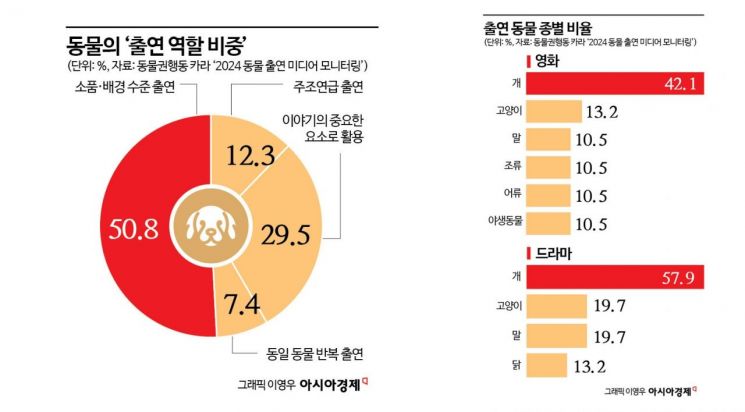
The analysis revealed that more than half of the animal appearances were unrelated to the plot and were used as background or props. Of the 307 titles, 50.8% featured animals only in brief scenes, with no direct connection to the storyline. In contrast, animals played an important role in the plot in only 29.5% of cases, appeared repeatedly in 7.4%, and served as main or supporting characters in just 12.3%.
Among the animals featured, dogs accounted for the largest proportion. In films, 42.1% of the animals appearing were dogs, while in dramas, the figure was 57.9%. Other animals such as cats, horses, chickens, wild animals, fish, and birds also appeared. Notably, chickens frequently appeared even in contemporary dramas, but mostly as background elements. A representative from the Animal Appearance Media Monitoring Center explained, "Most animal appearances were limited to brief scenes of three to five seconds."
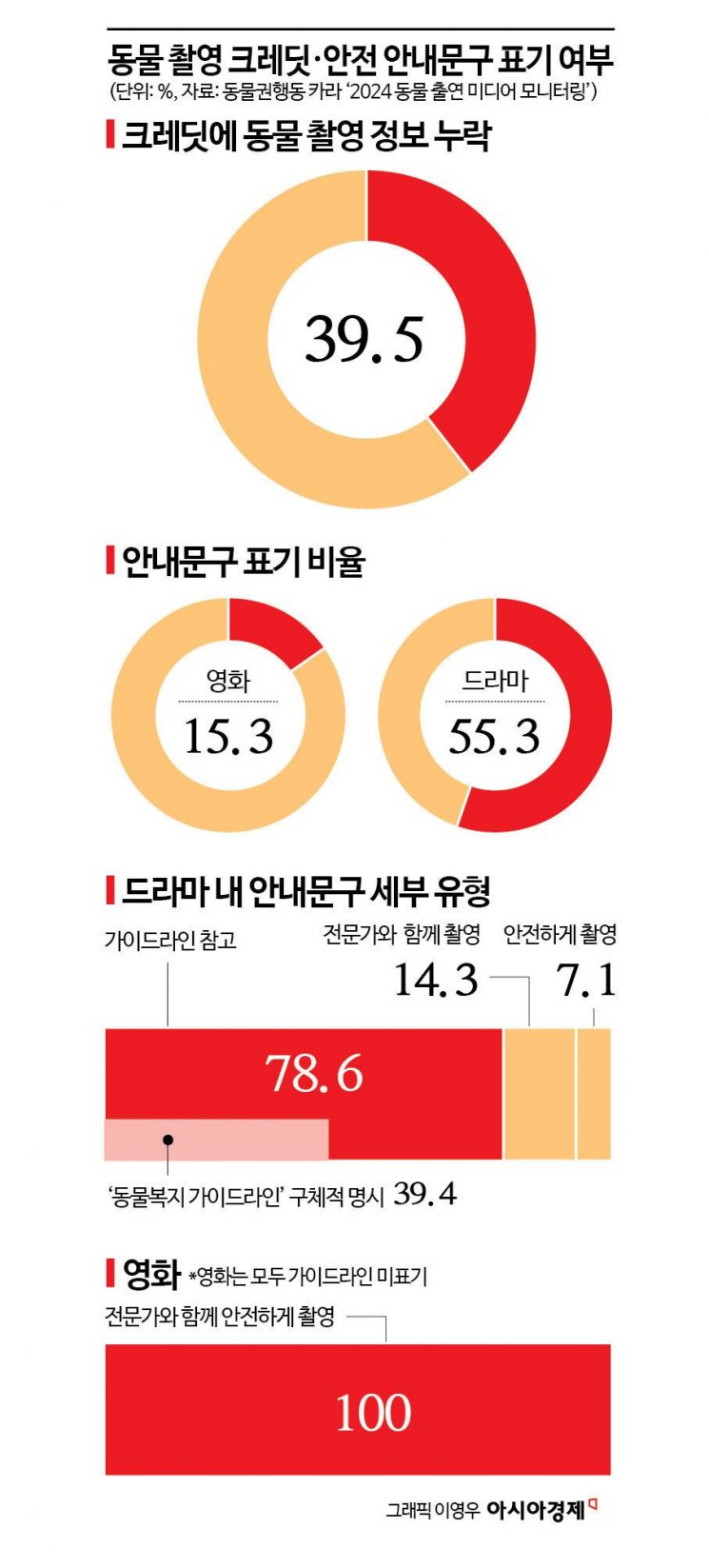
Basic filming information such as the source of the animals, the agencies that arranged them, and the parties responsible for their care should be specified in the end credits. However, 39.5% of the 307 titles did not disclose this information. In particular, only 15.3% of films included a statement indicating that filming was conducted safely. While the figure for dramas was relatively higher at 55.3%, it still amounted to only about half.
Among the 42 dramas that included such statements, 78.6% specified that they "referred to guidelines," and of these, 39.4% specifically mentioned the "animal welfare guidelines." Other statements included "filmed with experts" (14.3%) and "filmed safely" (7.1%). In contrast, not a single film included a statement indicating that animal welfare guidelines had been referenced.
The parties responsible for the safety of animals appearing on screen were also unclear. Activist Kwon Nami pointed out, "Due to the lack of relevant standards, production teams often delegate animal care to farm owners, animal agencies, or aquaculture operators, and try to substitute this responsibility with statements that filming was conducted with experts." She added, "In the case of farm owners, even if an animal dies during filming, they are only required to provide compensation for damages, so it is difficult to see them as truly responsible for the animal's safety."
In a situation where information about the animals appearing on screen and the parties responsible for their care is unclear, simply stating that filming was conducted with experts and safely is not enough to earn the trust of the public. There is an urgent need to establish practical standards for production sites and to ensure transparent disclosure of information.
A representative (referred to as Mr. A) from a film production company said, "Having animal filming guidelines would be a great help," adding, "When it comes time to actually film, there are often no standards to refer to, which can be very confusing. Most producers I talk to are not familiar with these issues." He continued, "Because there are no official standards, we end up relying entirely on experienced agencies, but it is difficult to verify whether those agencies are properly managing the animals, and I worry about potential problems."
© The Asia Business Daily(www.asiae.co.kr). All rights reserved.