Controversy Over Unisex Restroom for Disabled Individuals
Criticism From Within: "It Defies Common Sense"
Contradicts Current Law and Human Rights Commission Recommendations
"Measures Needed to Prevent Recurrence"
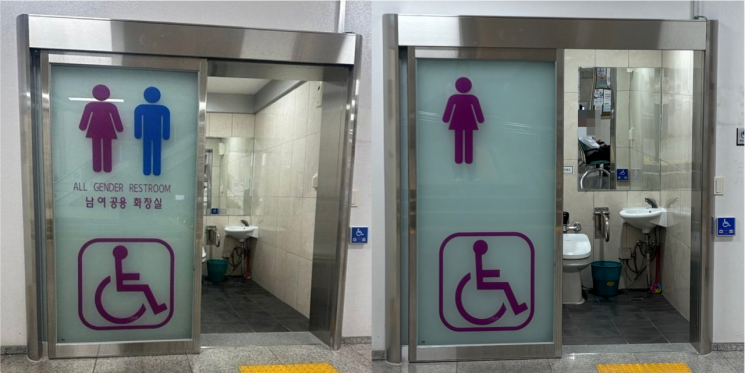 On the 4th of last month, the men's restroom for disabled individuals at the Seoul Central District Court was converted to a 'unisex' restroom. (left) Following criticism and complaints inside and outside the court, it was changed back to 'women only' around the 26th, three weeks later. (right)
It has been confirmed that a unisex restroom for disabled individuals was installed at the Seoul Central District Court building, but was converted to a women-only restroom after just three weeks. While the court emphasized the protection of defendants' rights by establishing a dedicated division for people with disabilities in February 2024, it has revealed shortcomings in the management of basic facilities and the provision of information.
According to Asia Economy's coverage on July 14, the men's restroom for disabled individuals on the first floor of the west wing at the Seoul Central District Court was converted to a unisex restroom on the 4th of last month. A sign reading 'All Gender Restroom' was attached to the restroom door. An official from the Seoul High Court, which manages the Seoul Court Complex, explained, "There were complaints about the existing swing door, and after automating the entrance, the restroom was made unisex."
The current Enforcement Decree of the Act on Public Restrooms stipulates that public restrooms must, in principle, be separated by gender. The Enforcement Rule of the Act on Promotion of Convenience for Persons with Disabilities, the Elderly, and Pregnant Women also requires that restrooms for disabled individuals be installed separately for men and women, allowing unisex restrooms only in unavoidable cases. The National Human Rights Commission of Korea has also recommended gender-segregated restrooms for disabled individuals since 2012, judging unisex installations as discriminatory.
Within the court, there were criticisms regarding the lack of sensitivity in operating a unisex restroom in a space for disabled individuals, without separating men and women. One sitting judge at the Central District Court stated, "It is difficult to understand from a common-sense perspective," and added, "Because disabled individuals are physically vulnerable, unisex restrooms can cause greater inconvenience and risk."
Some have pointed out that this issue does not align with the purpose of the dedicated division for people with disabilities, which was introduced by the Seoul Central District Court last year. In February 2024, the Seoul Central District Court became the first court in the country to establish a dedicated division for people with disabilities. This also does not match the ongoing efforts by the National Court Administration to establish internal regulations for guaranteeing judicial access for people with disabilities, following recommendations from the Judicial Policy Advisory Committee. The judiciary is currently working on establishing regulations for people with disabilities, procedures for confirming disability information, and forming dedicated organizations.
As complaints and internal discussions regarding the unisex restroom for disabled individuals continued, the court changed the restroom to a women-only restroom around the 26th of last month. An official from the Seoul High Court explained, "Due to the shortage of women's restrooms and discussions about appropriateness, it was decided to convert it to a women-only restroom."
However, there are still responses on site that "even basic infrastructure has not been established." The difficulty in obtaining information about the locations of restrooms for disabled individuals within the court building was also pointed out as a problem. In fact, when a reporter inquired about the location of the men's restroom for disabled individuals at the information desk on the first floor, neither the staff member nor the public service worker could provide an accurate answer. Although there are one to three restrooms for men and women with disabilities on each floor of the court building, user guidance remains insufficient.
An official from the National Court Administration stated, "This issue had not been identified," and added, "It is true that the Supreme Court is making efforts and paying attention to improving convenience for people with disabilities." Park Kim Younghee, head of the Disability Discrimination Act Solidarity, emphasized, "As the court is an institution that should first examine legal standards and set an example in terms of human rights, it is necessary to prepare measures to prevent recurrence."
© The Asia Business Daily(www.asiae.co.kr). All rights reserved.












