DNA Inserted into Genetic Relatives Emu and Tinamou
"Lord of the Rings" Director Supports Project with 20 Billion Won
Some Experts Say "Restoring Extinct Animals Is Impossible"
A project to revive the giant moa, a large bird that went extinct in 15th-century New Zealand, has begun.
According to reports from The Guardian and The Daily Telegraph on the 11th (local time), Colossal Biosciences, a Texas-based biotechnology company in the United States, recently announced that it has added the giant moa to its list of animals targeted for de-extinction.
The giant moa was a huge, flightless bird that once lived in New Zealand. The largest individuals could reach a height of 3.6 meters when fully extending their necks. Weighing between 230 and 250 kilograms, it was one of the largest birds in the world. With its long neck and legs, it was highly adapted to grazing on vegetation. As a herbivore, the giant moa mainly ate leaves, twigs, and fruit, and inhabited wide areas across New Zealand. However, after the arrival of the Maori people around the year 1300, the species became extinct within just 100 to 200 years, disappearing by the 15th century. The reasons for extinction were excessive hunting by the Maori and ecological disruption.
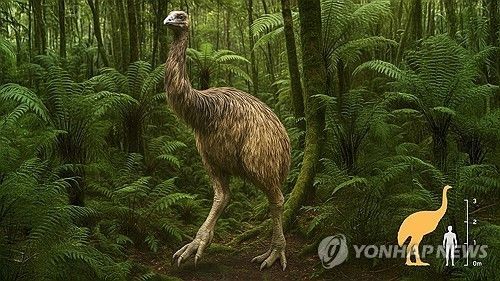
Colossal Biosciences plans to genetically recreate the moa by editing the DNA of its closest living relatives, the emu and the tinamou. The company, in collaboration with the Ngai Tahu Research Centre at the University of Canterbury in New Zealand, aims to revive the giant moa within five to ten years. First, DNA will be extracted from moa fossils, then inserted into the emu and tinamou, its closest relatives. The company explained that birds with modified genes will be released into isolated "rewilding sites" after hatching from eggs.
The giant moa restoration project has received support of about $15 million (approximately 20.6 billion won) from Peter Jackson, the New Zealand-born director of the "Lord of the Rings" film series. Jackson stated, "The hope of seeing the moa again within a few years brings more joy and satisfaction than any film could."
Regarding Colossal's announcement, Maori archaeologist Kyle Davis said, "The earliest ancestors here (in New Zealand) lived alongside the moa, and both archaeology and oral records contain knowledge about these birds and their environment," adding, "We are pleased that we can pursue a bold vision for ecosystem restoration through Colossal's cutting-edge science."
However, some experts have raised doubts about whether it is truly possible to restore the giant moa.
Vincent Lynch, a professor of evolutionary biology at the University at Buffalo in the United States, asserted, "It is not possible to bring back extinct organisms." He continued, "Given enough time, perhaps they could genetically engineer an emu to have traits similar to the moa, as they claim. But that does not make it a moa. It would simply be an emu with transplanted genes."
In addition to the moa, Colossal Biosciences is also attempting to revive other extinct animals such as the mammoth, dodo, and dire wolf. In April, the company claimed to have genetically engineered two gray wolves to possess traits of the dire wolf, a North American predator that went extinct about 13,000 years ago. A few weeks ago, they also released a photo of a "woolly mouse" genetically modified to have mammoth characteristics.
© The Asia Business Daily(www.asiae.co.kr). All rights reserved.
![From Bar Hostess to Organ Seller to High Society... The Grotesque Con of a "Human Counterfeit" [Slate]](https://cwcontent.asiae.co.kr/asiaresize/183/2026021902243444107_1771435474.jpg)
















