Korea National Park Service Succeeds in Photographing the Endangered Musansoejokjebi for the First Time in Eight Years
The "World's Smallest Carnivorous Mammal" Confirmed in Jirisan National Park
Population Remains Unknown Due to Rarity and Agility
The endangered species "Musansoejokjebi" was spotted in Jirisan National Park for the first time in eight years.
The Korea National Park Service announced on July 10 that, during wildlife observation in Jirisan National Park on June 26, they succeeded in photographing an adult Musansoejokjebi peeking its face through a crack in the rocks.
The Musansoejokjebi is known as the "world's smallest carnivorous mammal." Its body length from head to torso is only 15 to 18 cm, with short tail and legs. It weighs between 50 and 150 grams, making it similar in size to a rodent.
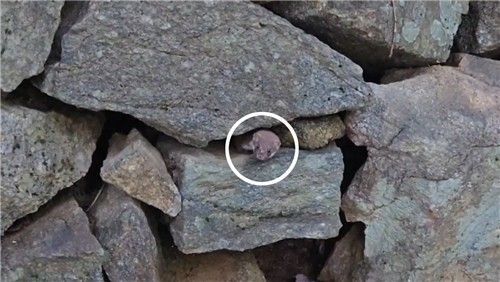 The endangered species "Musansoejokjebi," known as the "world's smallest carnivorous mammal," was captured on camera for the first time in eight years. The Korea National Park Service announced on the 10th that on the 26th of last month, they succeeded in photographing an adult Musansoejokjebi peeking its face through a crack in the rocks during wildlife observation in Jirisan National Park. Yonhap News
The Musansoejokjebi primarily hunts rodents, but also preys on frogs and other animals. Notably, it is known to catch 2,000 to 3,000 mice per year, earning it the nickname "mouse-catching mouse" in North Korea. It is also highly skilled at digging, often taking over rodent burrows to use as its own habitat.
The Musansoejokjebi was first discovered in South Korea in 1974 at an apartment construction site in Seoul. While it is believed to inhabit most regions of South Korea except Jeju Island and Ulleungdo, its exact habitat range and population size remain unknown. Among national parks, surveys have confirmed the presence of the Musansoejokjebi in 10 locations, including Jirisan and Seoraksan.
However, it is very difficult to spot a Musansoejokjebi in person. This is because, as an endangered species, its population is extremely small, and it is highly agile, capable of jumping 20 to 30 cm and remaining active throughout the day. This sighting in Jirisan National Park is the first in eight years since July 1, 2017.
Meanwhile, the Musansoejokjebi was designated as a Class II endangered wild species in July 2012, and its status was upgraded to Class I endangered wild animal in December 2022. Its average lifespan is less than one year, as its small size makes it an easy target for predators such as owls and snakes. In addition, climate change has disrupted the ecosystem, reducing its food sources and destroying its habitat.
© The Asia Business Daily(www.asiae.co.kr). All rights reserved.
![Clutching a Stolen Dior Bag, Saying "I Hate Being Poor but Real"... The Grotesque Con of a "Human Knockoff" [Slate]](https://cwcontent.asiae.co.kr/asiaresize/183/2026021902243444107_1771435474.jpg)











