Still 4,500 Won for 10 Years
Rising Labor and Raw Material Costs
Commercial Act Revision, Shareholder Pressure for Price Hike
The possibility of a cigarette price increase is gaining traction. While food prices have risen one after another, cigarette prices have remained unchanged for 10 years. Labor costs, logistics expenses, and exchange rates have all increased, and recently, with the revision of the Commercial Act enabling shareholders to pressure for price hikes, there is growing sentiment that a cigarette price increase is becoming a reality.
According to an IBK Investment & Securities report on July 12, KT&G's cost of goods sold ratio jumped from 33.5% in 2015, when cigarette prices were last raised, to 52.0% last year. This was due to increased costs of raw and subsidiary materials, higher logistics expenses, and a surge in exchange rates. Although tobacco companies use domestically produced tobacco leaves, they import filters and various other ingredients from overseas, so increases in exchange rates and logistics costs are reflected in product costs.
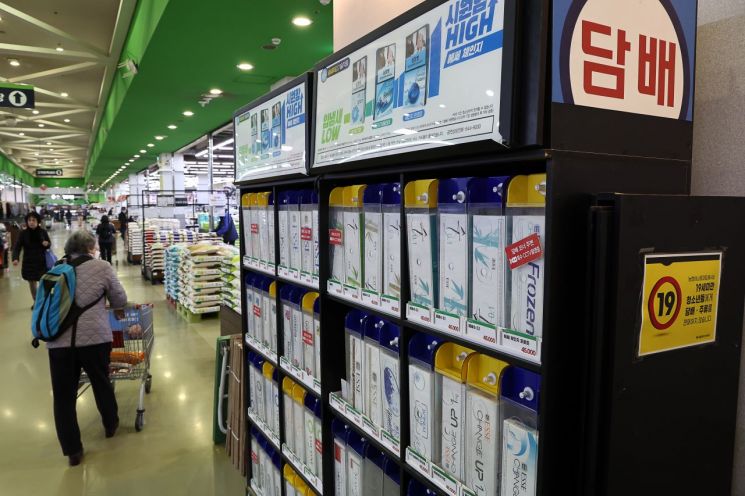
Both domestic and imported tobacco companies have kept cigarette prices frozen at 4,500 won since the government raised tobacco taxes in 2015 and prices were uniformly increased.
However, as cost pressures mount, there are increasing arguments that a cigarette price hike is inevitable. In fact, JTI Korea raised the prices of nine cigarette products by 100 to 200 won in May, citing deteriorating profitability.
Furthermore, the passage of a Commercial Act amendment that strengthens shareholder rights in the National Assembly has further fueled the possibility of a price increase. In order to expand dividends and increase shareholder returns, companies need to improve their performance, and shareholders can now directly demand a cigarette price hike. Cigarette prices in Korea are about half the average price (9,869 won) of the 38 OECD countries, ranking 35th, which suggests there is ample justification for a price increase.
As a result, KT&G's corporate value has been soaring in the stock market since the beginning of this month. The company's share price surged 5% immediately after the passage of the Commercial Act amendment on July 4, and surpassed 140,000 won during trading on July 11. Kim Taehyun, an analyst at IBK Investment & Securities, said, "Expectations for a future cigarette price increase following the Commercial Act revision have been reflected in the share price," and analyzed, "Given the overall rise in food prices, there is ample justification for a cigarette price increase."
There is also speculation that the government may raise tobacco taxes to achieve policy objectives, thereby increasing prices. The government has a plan to reduce the adult male smoking rate to 25.0% (and female to 4.0%) by 2030. Previous studies have found that cigarette price policies are the most effective way to reduce tobacco consumption. Reports indicate that a 10% increase in cigarette prices leads to about a 4% decrease in consumption.
The domestic tobacco market is directly affected by government policy in terms of price structure. Under the Tobacco Business Act, manufacturers or importers set prices by reporting them to the Minister of Strategy and Finance or the mayor/governor, then announcing them publicly.
Currently, a pack of cigarettes sold at 4,500 won in Korea includes various taxes and charges totaling 3,323 won, or 73.8% of the price: individual consumption tax (594 won), value-added tax (409 won), tobacco consumption tax (1,007 won), local education tax (443 won), and the National Health Promotion Levy (841 won). For heated tobacco products (HTP), taxes amount to 3,004 won per pack of 20 sticks (66.8%), and for e-cigarettes, 2,209 won per 1ml of liquid (49.1%). If taxes on tobacco are raised, cigarette prices will inevitably increase as well.
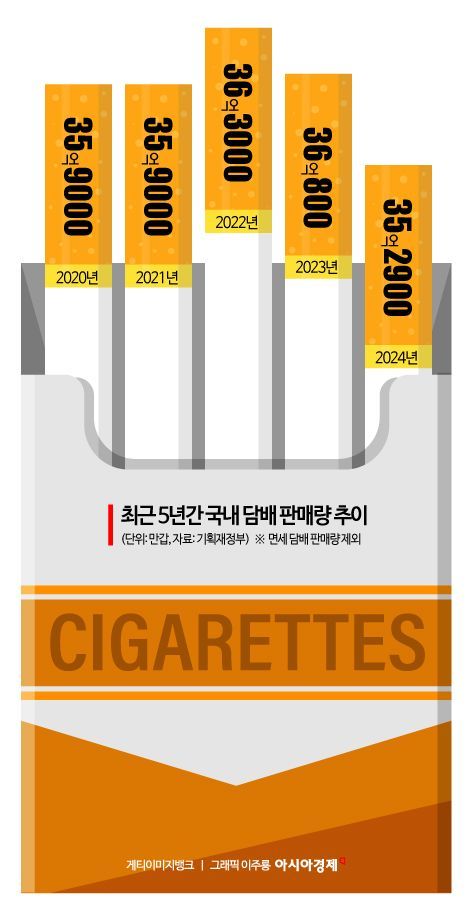
Despite the need for a price increase, the tobacco industry remains cautious, as higher prices could lead to reduced sales. Domestic cigarette sales have been declining for two consecutive years. According to the Ministry of Strategy and Finance's '2024 Tobacco Market Trends,' domestic cigarette sales last year were 3.53 billion packs, down 2.2% from 3.61 billion packs the previous year. An industry official explained, "There have been factors such as increases in raw material costs and labor costs over the past 10 years, but we have not been able to raise cigarette prices," adding, "We have to consider various factors such as government policy and consumer prices."
© The Asia Business Daily(www.asiae.co.kr). All rights reserved.
![User Who Sold Erroneously Deposited Bitcoins to Repay Debt and Fund Entertainment... What Did the Supreme Court Decide in 2021? [Legal Issue Check]](https://cwcontent.asiae.co.kr/asiaresize/183/2026020910431234020_1770601391.png)

















