Discussion on Expanding Global Auto Workers' Rights
UAW Executives Support 25% High Tariffs
Domestic Auto Industry Warns: "Two Hyundai Plants Could Disappear"
Senior officials from the United Auto Workers (UAW), the largest automobile labor union in the United States, visited South Korea and expressed their support for the high tariffs imposed by the Donald Trump administration. Domestic automobile workers, including those from the Hyundai Motor labor union, voiced concerns that the tariffs would result in the loss of more than 10,000 jobs and cause the operating profit margin of small partner companies to fall to around 1%.
Jason Weeden, Chief of Staff to the UAW President, said at the "Discussion on Seeking Measures to Expand Workers' Rights in the Global Automotive Industry in Transition" held on the 10th at the National Assembly Library in Yeouido, Seoul, "Some people may be surprised that the UAW supported President Trump's trade policy," adding, "It is not that we agreed with President Trump's policy, but rather that President Trump aligned with the position the UAW has maintained for a long time."
On July 7 (local time), President Trump sent so-called "tariff letters" to South Korea and other countries, specifying country-specific tariff rates of 25% to 40%. These letters stated that, starting from August 1, all products from South Korea would be subject to a 25% tariff. Separately from these reciprocal tariffs, the United States is currently imposing a 25% item-specific tariff on automobiles and auto parts.
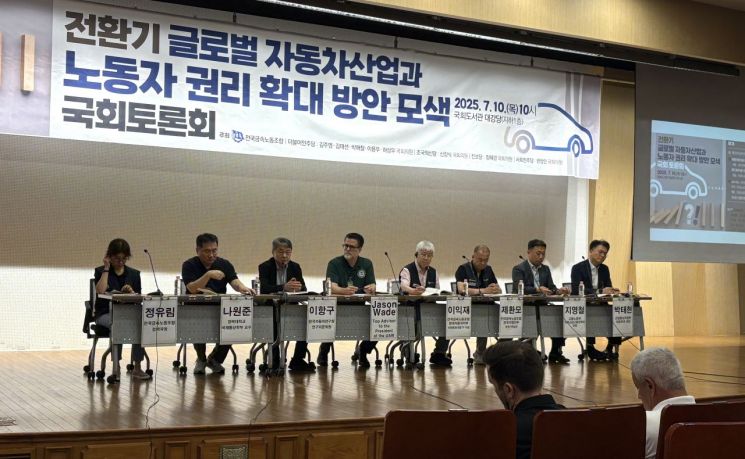 Jason Weeden, Chief of Staff to the President of the United Auto Workers (UAW), is speaking at the "Discussion on Seeking Measures to Expand Workers' Rights in the Global Automotive Industry in Transition" held on the 10th at the National Assembly Library in Yeouido, Seoul. Photo by Jeon Youngju
The UAW defended the tariff policy, arguing that free trade worsens labor conditions not only in the United States but also around the world. Weeden said, "Free trade has acted as the most powerful anti-union policy in the United States," and added, "The reality is that when we demand better working conditions, companies threaten to move jobs overseas."
He continued, "If, due to free trade, companies withdraw from Korea and relocate to Southeast Asian countries, Korean workers will suffer the same hardships as American workers," and added, "There is a perception that the UAW only cares about the interests of American members, but workers around the world are not our enemies."
In response, domestic automobile labor unions expressed concern, calling it "tacit acquiescence for the sake of creating American jobs."
Lee Ikjae, a member of the Future Change Response Task Force (TF) of the Hyundai Motor branch of the Metal Workers' Union, said, "If a 25% tariff is imposed, automobile exports to North America will decrease by 700,000 units," and explained, "This means the loss of two Hyundai Motor plants and 7,000 jobs." He further stated, "If we include auto parts companies, more than 10,000 jobs will be lost in Ulsan alone."
Lee Hangkoo, Research Advisor at the Korea Automotive Technology Institute, said, "The domestic auto parts industry will see its operating profit margin drop by 1.2 percentage points due to the 25% tariff," and explained, "Currently, the average operating profit margin is in the low 3% range, but after the tariff is imposed, it will fall to around 1%." He added, "With such operating profits, it will be difficult to improve working conditions, such as raising workers' wages."
© The Asia Business Daily(www.asiae.co.kr). All rights reserved.


















