Major Copper Importers Are Chile and Canada, Not China
Aims to Boost Domestic Production Like Steel and Aluminum
Manufacturing Sector Faces Rising Costs...Tariff Delay Possible
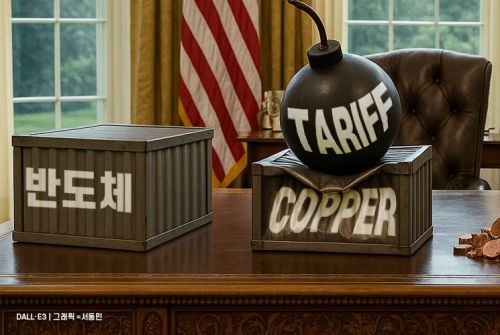
Among non-ferrous metals, copper is uniquely nicknamed "Mr. Copper" or "Dr. Copper." This is because copper is an essential metal used across a wide range of industries, including electricity, construction, automotive, and electronics. As a result, copper demand is highly sensitive to the real economy's business cycle. When the economy is strong, demand for copper rises and prices increase; conversely, when the economy is weak, copper demand falls and prices decline. Because copper prices are seen as a leading indicator of global economic trends, the metal has earned the monikers Mr. Copper and Dr. Copper.
On July 10, LS Securities released a report titled "Copper: The Meaning and Impact of the 50% Tariff," analyzing that the United States imposed a high tariff on copper not so much to contain China, but rather to encourage domestic production.
The Trump administration announced on July 8 that it would impose a 50% tariff on copper?double the market expectation of 25%?in addition to country-specific tariffs. Secretary of Commerce Rutnik stated that the copper tariff is expected to take effect at the end of July or early August. The two major copper futures markets, COMEX in New York and LME in London, reacted immediately. Right after the announcement, the COMEX price surged by 13%, while the LME price fell by 1.2%. Theoretically, the price gap between COMEX and LME should widen to 50% over the LME price, reflecting the tariff rate.
Why is the Trump administration seeking to impose such a high tariff on copper? Along with steel and aluminum, copper is one of the key raw materials for which the United States is highly dependent on imports. As of last year, the United States imported a net 860,000 tons, accounting for 53% of its total copper demand of 1.6 million tons. According to Hong Sungki, an analyst at LS Securities, "China produces 50% of the world's refined copper and 70% of copper semi-finished products, but the United States relies primarily on neighboring countries such as Chile and Canada for its copper imports." He added, "This suggests that the U.S. tariff on copper is not aimed at a trade war with China, but is in fact intended to boost domestic production." The Trump administration, by imposing tariffs on copper?a major raw material for manufacturing, like steel and aluminum?aims to increase copper production within the United States.
The United States is expected to accelerate copper production, including the Resolution Copper Project in Arizona, which has been delayed for over 15 years due to opposition from local indigenous communities. In May, the U.S. Supreme Court approved the transfer of the mine site to Resolution Copper, paving the way for full-scale mine development.
However, there is a possibility that the tariff implementation could be postponed due to the sharp increase in costs for end-users across the U.S. manufacturing sector. If the tariff is delayed for a significant period, copper imports to the United States could continue at the same level as in the first half of the year, potentially prolonging distortions in the copper market. Additionally, similar to tariffs on steel and aluminum, the United States may apply lower tariffs to certain countries.
© The Asia Business Daily(www.asiae.co.kr). All rights reserved.
![Clutching a Stolen Dior Bag, Saying "I Hate Being Poor but Real"... The Grotesque Con of a "Human Knockoff" [Slate]](https://cwcontent.asiae.co.kr/asiaresize/183/2026021902243444107_1771435474.jpg)











