Legislation and Judiciary Committee Launches Full-Scale Debate on Four Prosecution Reform Bills
The Democratic Party and the People Power Party clashed on July 9 at a public hearing on the "Four Prosecution Reform Bills" held by the National Assembly Legislation and Judiciary Committee, expressing sharp disagreements over key issues such as the separation of prosecutorial investigative and indictment powers. The Democratic Party emphasized that prosecution reform is the mandate of the people and must be swiftly legislated, while the People Power Party objected to the ruling party's push for rapid reform, warning that hasty changes could lead to negative side effects.
The Legislation and Judiciary Committee held a public hearing on prosecution reform at the National Assembly in Yeouido, Seoul, on the afternoon of July 9, and listened to statements from legal and academic experts.
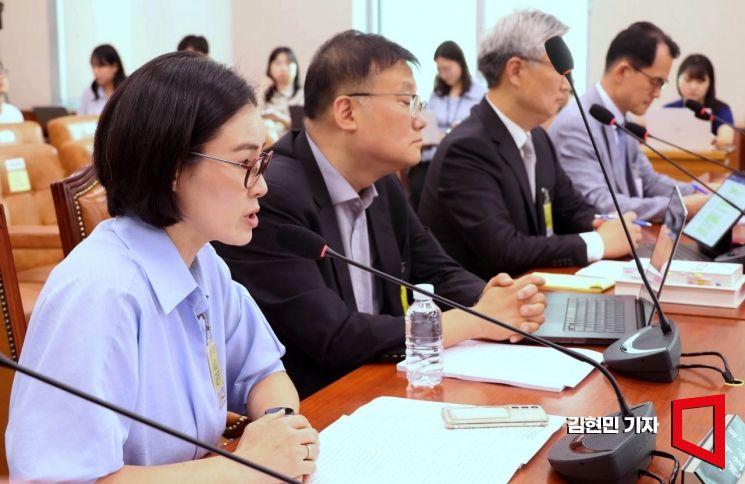 At the public hearing on the prosecution reform bill held at the plenary meeting of the National Assembly's Legislation and Judiciary Committee on the 9th, lawyer Kim Yewon (left in the photo) is speaking. Photo by Kim Hyunmin
At the hearing, the committee gathered expert opinions on four bills previously introduced by Democratic Party lawmakers Kim Yongtae, Jang Kyungtae, and Min Hyungbae: the bill to abolish the Prosecution Office Act, the bill on the establishment and operation of the Public Prosecution Office, the bill on the establishment and operation of the National Investigation Commission, and the bill on the establishment and operation of the Serious Crimes Investigation Agency.
Lee Choonseok, chair of the Legislation and Judiciary Committee from the Democratic Party, stated, "Prosecution reform is now an irresistible task of the times. While thorough discussion is necessary, it is time for the National Assembly to carry out prosecution reform as mandated by the people."
Kim Yongmin, a bill sponsor and the ruling party's secretary, also emphasized, "Separating prosecutorial investigative and indictment powers means relinquishing vested interests of the administration, not strengthening them. In the past, the People Power Party also agreed to reforms such as the separation of prosecutorial powers and even introduced related bills."
Seo Youngkyo stated, "As seen in past cases such as the illegal travel ban incident involving former Vice Minister of Justice Kim Hakui and the Deutsche Motors stock manipulation case, the prosecution acted as 'Yoon Sukyeol's henchman,' which is a disgrace to the prosecution. The people's will is to end this disgrace."
In contrast, the People Power Party argued that the Democratic Party's bills, which seek to abolish the prosecution under the pretext of addressing the abuse of prosecutorial investigative powers by the administration, would only create confusion in the criminal justice system.
Cho Baesook, a People Power Party lawmaker and former prosecutor, pointed out, "While the prosecution's faults are clear, the fundamental cause is that each administration has used the prosecution as a political tool whenever power changed hands. Abolishing the prosecution and establishing a Serious Crimes Investigation Agency could create new centers of power and political police. Sufficient preparation is needed, but this process is being rushed."
Gwak Gyutaek, another People Power Party lawmaker and former prosecutor, also remarked, "Discussing the abolition of the prosecution simply because investigations into politicians are labeled as retaliatory is a misguided direction for reform. This is largely a product of political circles creating issues for political reasons."
Park Juntae of the People Power Party criticized, "If the Democratic Party's bills are enacted, investigations will likely proceed according to the will of the ruling power through the National Investigation Commission. This runs counter to the purpose and intent of reform."
Experts also presented divergent opinions.
Kim Pilseong, a lawyer speaking on behalf of the Democratic Party, argued, "The prosecution monopolizes investigative power, indictment power, and the power to execute sentences, and in reality, it also dominates the Ministry of Justice. It is impossible to change the prosecution without restructuring the organization. Making only partial legal or systemic changes while maintaining the current structure has limitations and risks undermining reform."
Hwang Mungyu, a professor at Joongbu University, also emphasized, "The prosecution's conduct has been far removed from substantive justice. The prosecutor-dominated criminal justice system has clear limitations, and the side effects and harms are too great. We need to create systems and mechanisms suited to an era of diversified investigative powers."
On the other hand, Kim Yewon, a lawyer speaking for the People Power Party, stated, "Since the adjustment of investigative powers between the prosecution and the police, investigation and indictment have already been separated in practice. The claim that abolishing the prosecution will have no side effects is a misunderstanding. To reduce public confusion and prevent waste of taxpayer money, the police should focus on direct investigations, while the prosecution should focus on oversight and control of investigations."
Lawyer Kim Jongmin also said, "We must reform the prosecution to prevent the emergence of political prosecutors like Yoon Sukyeol and Han Donghoon. However, the fundamental cause is the president's appointment power and the prosecution's direct investigative authority centered on special investigation units, not simply the existence of the prosecution itself."
Meanwhile, the Legislation and Judiciary Committee plans to continue deliberating on prosecution reform bills in its first subcommittee for bill review, based on the issues raised at the public hearing.
© The Asia Business Daily(www.asiae.co.kr). All rights reserved.
![Clutching a Stolen Dior Bag, Saying "I Hate Being Poor but Real"... The Grotesque Con of a "Human Knockoff" [Slate]](https://cwcontent.asiae.co.kr/asiaresize/183/2026021902243444107_1771435474.jpg)











