Democratic Party Sets July Deadline for Cumulative Voting System
People Power Party Pushes Bill to Ease Breach of Trust Penalties
The Democratic Party of Korea has set July as the deadline for passing a stronger Commercial Act amendment, which includes the cumulative voting system. The People Power Party is opposing the ruling party's additional legislative moves, claiming that the Commercial Act amendment was agreed upon on the condition that contentious issues would be discussed later.
According to political sources on July 9, the Democratic Party plans to hold a public hearing on July 11 regarding the Commercial Act amendment to gather opinions. Afterward, the party intends to finalize the passage of the amendment, which includes the cumulative voting system and the expansion of separate election of audit committee members, during the July extraordinary session of the National Assembly. Oh Gihyung, chair of the Democratic Party's KOSPI5000 Special Committee, said, "We urge the Legislation and Judiciary Committee to swiftly handle the follow-up tasks related to the Commercial Act amendment."
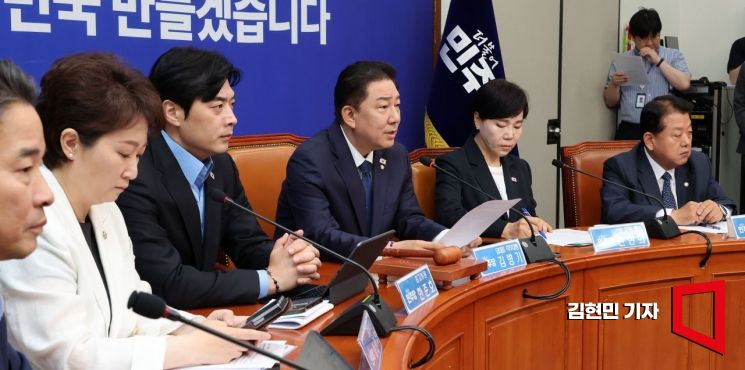 Kim Byungki, Acting Party Leader and Floor Leader of the Democratic Party of Korea, is speaking at the Supreme Council meeting held at the National Assembly on July 9, 2025. Photo by Kim Hyunmin
The cumulative voting system is a mechanism that allows shareholders to concentrate their voting rights for the number of directors to be elected on a specific candidate. For example, when electing three directors, a shareholder with one share can cast three votes for a single candidate, thereby increasing the decision-making power of minority shareholders. The expansion of separate election of audit committee members is a proposal to increase the number of audit committee members elected separately from other directors at the general shareholders' meeting from one to two or more, in order to reduce the influence of major shareholders.
On July 3, the ruling and opposition parties agreed to pass a Commercial Act amendment that includes: expanding the fiduciary duty of directors from the company to shareholders; mandating electronic general shareholders' meetings; and the 3% rule, which limits the voting rights of the largest shareholder to 3% when electing auditors or audit committee members. However, the cumulative voting system and the expansion of separate election of audit committee members, as demanded by the Democratic Party, were set aside for further discussion.
Joo Jinwoo, a member of the Legislation and Judiciary Committee from the People Power Party, said in a phone interview, "We agreed to pass the Commercial Act amendment on the condition that contentious issues would be put on hold," and added, "Unlike the expansion of the fiduciary duty of directors, which is more of a declarative provision, the cumulative voting system has an immediate impact on companies, so we cannot agree to it."
Since the start of the July extraordinary session, the Democratic Party has been accelerating the unilateral passage of controversial bills such as the three broadcasting laws and the Local Currency Act amendment. The People Power Party plans to focus on passing a bill to ease the criminal liability for breach of trust, which was cited as a side effect of the Commercial Act amendment. Ko Dongjin, a member of the People Power Party, has submitted a special law on corporate breach of trust to the National Assembly, which stipulates that if a director acts based on prudent judgment for the company's benefit, they cannot be punished for breach of trust even if the company suffers a loss. Kwak Gyutaek, a member of the Legislation and Judiciary Committee from the People Power Party, said, "Easing the criminal liability for breach of trust is more urgent than passing a stronger Commercial Act amendment, so related bills should be discussed first."
© The Asia Business Daily(www.asiae.co.kr). All rights reserved.


















