Trump Hints at Semiconductor Tariffs... Announcement Could Come as Early as This Month
Four Scenarios Emerge, Including "High Tariffs After Grace Period"
High-Performance Memory like HBM for AI Servers May Be Targeted
Industry: "Export Routes Could Be Blocked Depending on Production Conditions"
Government Activates Consultation Channel to Secure Exemption Status
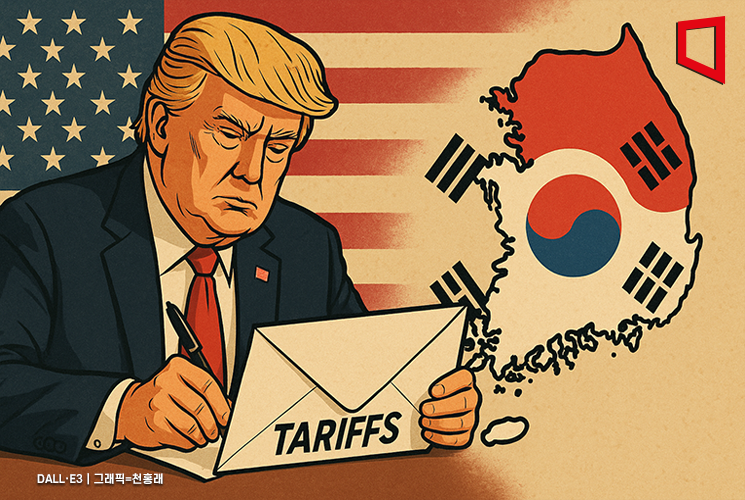
Tensions are rising within the South Korean semiconductor industry after U.S. President Donald Trump announced plans to impose tariffs on semiconductors. As the economic slowdown continues, major companies have launched emergency response measures?including considering restructuring their production bases?because products with high export dependency, such as those focused on AI and high-bandwidth memory (HBM), are being discussed as possible targets for tariffs.
On July 8 (local time), President Trump mentioned the imposition of tariffs on semiconductors and pharmaceuticals during a cabinet meeting, stating, "There will be a major announcement soon." U.S. Secretary of Commerce Howard Lutnick also said that the investigation into semiconductors under Section 232 of the Trade Expansion Act will be completed by the end of this month, raising expectations that an official announcement could come as early as the end of this month or the beginning of next month.
The industry is reviewing countermeasures based on four main scenarios: a grace period followed by high tariffs, differentiated tariffs by country, categorization by product group, and supply chain tracking. Among these, there is speculation that the "one to one-and-a-half year grace period followed by high tariffs" approach, which President Trump suggested for pharmaceuticals, could also be applied to semiconductors.
Semiconductor companies believe that whether or not they have production bases in the United States will be a key variable in the application of tariffs. There are particular concerns that highly technology-intensive products, such as AI server semiconductors and HBM, which have a large proportion of U.S. customers and high unit prices, could be especially impacted by the tariffs.
An industry official stated, "The conditions under which tariffs are applied are more burdensome than the simple tariff rate itself," and added, "Because semiconductors are produced across multiple countries from design to packaging, responding to these measures could become extremely challenging in the future."
Kim Jeonghoe, Vice Chairman of the Korea Semiconductor Industry Association, assessed, "The United States is investigating not only semiconductors but also related devices such as mobile phones under Section 232 of the Trade Expansion Act. If tariffs are imposed, overall demand could contract and the impact on exports could be significant." He continued, "While the impact will vary depending on the tariff rate, companies should consider restructuring their supply chains, including relocating them, to minimize direct damage."
The government is seeking to secure an exemption status through the Korea-U.S. economic security consultation channel. At the same time, it plans to pursue policy responses, recognizing that strategic investments in the United States could serve as leverage in future negotiations.
Vice Chairman Kim emphasized, "In the first half of this year, overall exports by domestic companies such as Samsung Electronics and LG Electronics declined. The National Assembly and the government must swiftly discuss delayed legislation, such as the special semiconductor law, to lay the groundwork for mitigating the industry's shock." He added, "It is also necessary to use the possibility that the U.S. could discourage domestic investment as a persuasive argument in bilateral negotiations."
Han Areum, Senior Research Fellow at the Korea International Trade Association, said, "Because there are a limited number of semiconductor manufacturers and it is difficult to switch suppliers, Korean companies have relatively strong bargaining power compared to other sectors, even if tariffs are actually imposed." She added, "Since the U.S. has a low semiconductor self-sufficiency rate, the potential reduction in local investment by Korean companies could actually serve as leverage in negotiations."
© The Asia Business Daily(www.asiae.co.kr). All rights reserved.

















