Analysis by UNIDO's China Investment Promotion Office
Comprehensive Evaluation of Papers and Citations by 200,000 Researchers
"Chinese and China-Origin Researchers Account for Over Half"
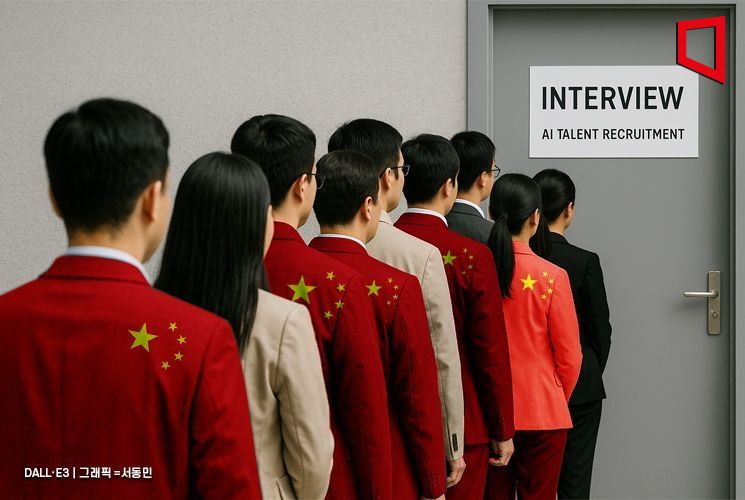
An analysis has found that half of the world's top 100 talents in the field of artificial intelligence (AI) are Chinese. On July 7, the South China Morning Post (SCMP) in Hong Kong reported, citing an analysis by the China Investment Promotion Office (IPTO China) under the United Nations Industrial Development Organization (UNIDO) and Shenzhen-based tech company Dongbei Data, that "50 out of the world's top 100 AI experts are Chinese affiliated with research institutes or companies in China."
This result is based on a comprehensive evaluation of the number of papers and citations from approximately 96,000 academic papers and presentations at major international conferences by around 200,000 researchers between 2015 and 2024. Among the top 100 AI experts identified in this survey, 20 were based in the United States, but half of these were either originally from China or of Chinese descent. When including Chinese researchers working in other countries, the proportion of Chinese among the top 100 exceeds half.
The survey also included He Kaiming, an associate professor at the Massachusetts Institute of Technology in the United States, who is a pioneer in the field of computer vision (an AI technology that mimics human visual capabilities to analyze and interpret images). He is also the author of one of the "most cited papers of the 21st century" as selected by the journal Nature.
The proportion of Chinese researchers in the overall AI research community is also increasing rapidly. In 2015, the number of AI researchers in China was less than 10,000, but by last year, it had surged to 52,000. However, the United States still ranks first overall, with an estimated 63,000 AI researchers as of last year.
According to AI Rankings, which publishes rankings related to AI research, Peking University in China has ranked first in the world in AI research output since 2022. Tsinghua University and Zhejiang University, both in China, ranked second and third, respectively, and half of the top 10 universities were Chinese institutions.
As of last year, the size of China's AI market reached 400 billion yuan (approximately 80.45 trillion won), and it is projected to grow to 811 billion yuan (about 163.14 trillion won) by 2028. AI was also a major topic at China's largest political event, the "Two Sessions," held in March. China announced plans to establish a fund worth 1 trillion yuan (about 200 trillion won) for advanced industries such as AI and quantum science. In particular, China showcased its confidence by highlighting DeepSeek, the AI model that attracted global attention last year.
According to the "AI Index Report 2025" released in April by the Human-Centered AI Institute (HAI) at Stanford University in the United States, the performance gap between the top AI models from the United States and China on the LMSYS Chatbot Arena platform, which compares and evaluates AI performance, was 1.7% as of February. This is based on a comparison of the score received by Google's model, which was evaluated as the best AI model in the United States (1,385 points for language, reasoning, and mathematical coding abilities), and the score received by DeepSeek, which was evaluated as the best AI model in China (1,362 points). The score received by OpenAI, the developer of ChatGPT (1,366 points), was slightly higher than that of DeepSeek.
The report analyzed, "While the United States maintains quantitative leadership in AI model development, Chinese models are rapidly closing the quality gap," and added, "The performance gap on major benchmarks narrowed from double digits in 2023 to nearly parity in 2024."
© The Asia Business Daily(www.asiae.co.kr). All rights reserved.
![Clutching a Stolen Dior Bag, Saying "I Hate Being Poor but Real"... The Grotesque Con of a "Human Knockoff" [Slate]](https://cwcontent.asiae.co.kr/asiaresize/183/2026021902243444107_1771435474.jpg)

















