Seven Nobel Laureates in Economics, Including Krugman,
Contribute Op-Ed to Le Monde Urging "Introduction of Minimum Tax Rate"
"Justice-Based Constraints Needed for Billionaires"
Nobel laureates in economics have spoken with one voice in calling for the introduction of a minimum tax rate on the so-called "super-rich" ultra-wealthy. According to Yonhap News, on July 7 (local time), seven Nobel Prize-winning economists?George Akerlof, Joseph Stiglitz, Paul Krugman, Abhijit Banerjee, Esther Duflo, Daron Acemoglu, and Simon Johnson?pointed out in a joint op-ed sent to the French daily Le Monde that "billionaires contribute very little to the public burden relative to their abilities."
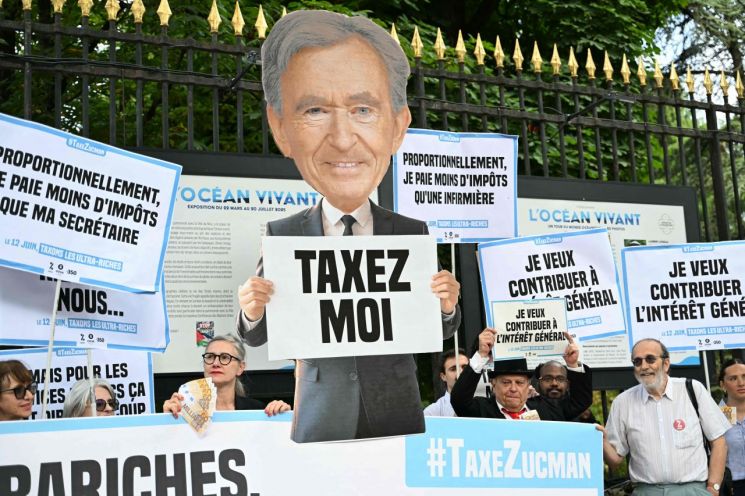 French civic activists are holding a photo of Bernard Arnault, chairman of LVMH, last month, urging the introduction of a minimum tax rate on the ultra-wealthy. Photo by AFP Yonhap News
They stated, "Pioneering research shows that the ultra-wealthy pay only between 0% and 0.6% of their assets in personal income tax," specifying that "in the United States, the figure is about 0.6%, while in France it is 0.1%." They further argued, "If you take into account all mandatory taxes, such as corporate tax, social security contributions, and consumption taxes, and convert them relative to income, the tax burden rate for these individuals is even lower than that of the middle class or high-income workers." They explained, "This is possible because the ultra-wealthy can adjust their asset structures to avoid income tax. For example, in European countries, they establish holding companies and keep dividends tax-exempt within them."
They also stated, "This situation has been made possible as a result of political choices," but added, "It is also possible to impose stronger justice-based constraints on billionaires." As one solution, they proposed that introducing a minimum tax rate based on the assets of the ultra-wealthy would be ideal.
They explained, "This system is effective because it targets all forms of tax avoidance, and it is precisely targeted because it focuses mainly on the wealthiest taxpayers who engage in tax avoidance." They added, "It is also a necessary system because it is difficult to ask other social classes to make efforts if we do not ensure that the wealthiest do not evade taxes."
For example, if a 2% minimum tax rate were imposed on the assets of billionaires worldwide, it could generate a total of 250 billion dollars (about 342 trillion won) in tax revenue from approximately 3,000 individuals. In Europe alone, this would amount to 50 billion dollars (about 68 trillion won). If the minimum tax rate were expanded to include individuals with assets of more than 100 million euros (about 160 billion won), tax revenue would increase even further.
Some countries are beginning to take action. Brazil raised this issue as a G20 agenda item last year, and on June 30 announced a joint initiative with Spain for taxing the ultra-wealthy. South Africa and Chile have also expressed their support. In February, the French National Assembly approved a plan to introduce a 2% minimum tax rate for individuals with assets exceeding 100 million euros, but it was rejected in the Senate.
The scholars emphasized, "In an era of deteriorating public finances and explosive concentration of wealth, the French government should promptly review this bill adopted by the National Assembly," and argued, "France should set an example without waiting for the completion of international agreements." They also pointed out, "According to Forbes, the assets of French billionaires account for about 30% of France's gross domestic product (GDP)," adding, "The ultra-wealthy are thriving in France." Regarding claims that excessive taxation stifles innovation, they stated, "Such claims are not supported by historical experience or economic knowledge," and stressed, "What we need in this era of skyrocketing wealth is a tax on the ultra-high-income class."
© The Asia Business Daily(www.asiae.co.kr). All rights reserved.

















