National Policy Planning Committee Holds Policy Roundtable on R&D Outcome Dissemination
Concerns Raised Over Rights Blind Spots for Researchers at Commissioned Institutions
Calls for Improvements in Tax Equity and Compensation Systems for Technology Holding Companies
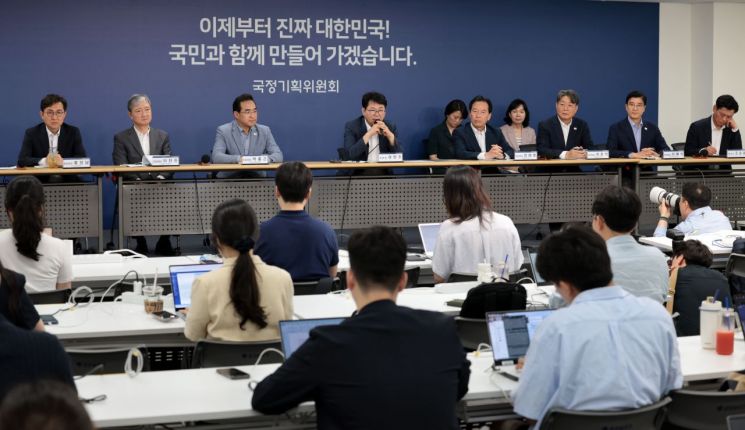
Concerns have been raised about the structure in which researchers affiliated with commissioned research and development (R&D) institutions contribute to public R&D achievements but are excluded from ownership of results and compensation.
The Economic Division 2 of the Presidential National Policy Planning Committee held a "Policy Roundtable on R&D Promotion and Achievement Dissemination" in Seoul on July 8, discussing ways to expand the dissemination of public research outcomes, including strengthening the rights and interests of researchers at commissioned institutions. The meeting, presided over by Division Head Lee Choonseok, was attended by committee member Hwang Jeonga and other officials from the National Policy Planning Committee, as well as representatives from the Korea Institute of S&T Evaluation and Planning, Korea University Technology Holdings, Electronics and Telecommunications Research Institute, Yonsei University, Kongju National University, KAIST, and other research institutes and universities.
The issue of ownership of achievements by commissioned research institutions was addressed first. It was pointed out that researchers at these institutions make substantial contributions to research outcomes but face difficulties in owning intellectual property rights, and even when achievements are commercialized and generate profits, they are at a disadvantage in receiving compensation for employee inventions.
The issue of tax equity for university technology holding companies was also raised. While venture capital firms or startup incubators receive corporate tax exemptions on capital gains from equity transfers when investing in startups, university technology holding companies, which play a similar role, lack relevant regulations and thus face inequitable taxation.
Regarding compensation for achievements, concerns were raised that compensation for employee inventions based on technology royalty income is classified as earned income, resulting in taxes of up to 45%. Participants pointed out that such a tax system discourages researchers.
The need to improve the "3 Projects 5 Public Duties" system, which limits the number of projects a researcher can undertake simultaneously, was also mentioned. There were calls for more flexible application of the system, given the significant increase in research projects since 2010.
Division Head Lee Choonseok stated, "We will remove institutional barriers so that public research achievements can be rapidly disseminated to the market," adding, "We will develop concrete national policy tasks based on feedback from the field."
© The Asia Business Daily(www.asiae.co.kr). All rights reserved.
![Clutching a Stolen Dior Bag, Saying "I Hate Being Poor but Real"... The Grotesque Con of a "Human Knockoff" [Slate]](https://cwcontent.asiae.co.kr/asiaresize/183/2026021902243444107_1771435474.jpg)
















