Gordon Liao, Senior Economist at Circle, Participates in World Economy Research Institute Webinar
"Foreign Investors Will Be More Attracted to Korea's Capital Market with a Won-Based Stablecoin"
"Transparent Transactions Allow Side Effects to Be Prevented Through Active Supervision"
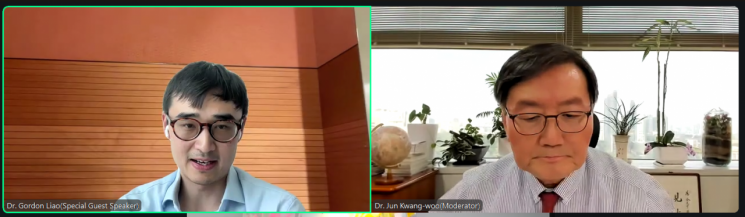 Gordon Liao (left), Senior Economist at Circle, is having a discussion in a webinar on the 8th with Jeon Kwangwoo, Chairman of the World Economy Research Institute (right).
"If Korea introduces a won-based stablecoin, I believe more foreign investors will be drawn to Korea's capital market."
Gordon Liao, Senior Economist at Circle Internet Group, argued during a webinar hosted by the World Economy Research Institute on the 8th, where he gave a presentation titled "The Rise of Stablecoins and the Restructuring of Global Finance," that Korea should actively consider introducing a won-based stablecoin.
A stablecoin is a virtual asset that seeks to maintain price stability by being pegged to a specific asset, such as the US dollar. Tether (USDT) and USDC, both pegged one-to-one with the dollar, are representative examples. The use of stablecoins has recently expanded beyond the virtual asset market; they are increasingly being used as a store of value or integrated into existing payment systems for everyday transactions. The discussion is also active in Korea, as President Lee Jaemyung made the introduction of a won-based stablecoin one of his presidential campaign pledges.
Circle is the issuer of USDC, the world's second-largest stablecoin by market capitalization. Since being listed on Nasdaq last month, its stock price has surged, attracting significant attention from Korean investors as well. Liao, who holds a PhD in economics from Harvard University, previously served as a bond trader at the Harvard Foundation and as a policy advisor to the Federal Reserve (Fed).
Liao cited convenience as the main reason for the recent global interest in stablecoins. He emphasized, "Traditional cross-border remittances are slow, expensive, and lack transparency. For example, sending physical currency from Seoul to New York can take several days and incur high fees, but with stablecoins, it can be done in just a few seconds at a low cost."
He also highlighted superior accessibility as an advantage. Liao explained, "As long as you have a smartphone, you can trade stablecoins anytime and anywhere. This is a significant benefit for emerging markets with high currency volatility or in countries where access to banking services is difficult." He added, "From a corporate perspective, the use of stablecoins can lead to cost savings and create new investment income opportunities."
He noted that over 90% of the stablecoin market is currently dollar-denominated, but argued that Korea should introduce a won-based stablecoin. Liao said, "When I worked at the Harvard Foundation, it was difficult to invest in Asian countries due to the complexity of local markets and regulatory procedures. However, if Korea introduces a won-based stablecoin and tokenizes Korean stocks and bonds, it will become much easier to attract foreign investors." He continued, "The introduction of a won-based stablecoin will increase the openness of the capital market and reduce investment costs. If only dollar-based stablecoins exist, speculative capital flows into the dollar will increase, creating an unhealthy ecosystem."
He acknowledged the concerns of the Bank of Korea and the government regarding the introduction of a won-based stablecoin, but believes these can be addressed through active supervision and regulation. The Bank of Korea is concerned that stablecoins could undermine financial stability and be used for illegal activities such as money laundering. In particular, it worries that allowing non-financial companies, as well as financial institutions, to issue stablecoins could cause confusion in the financial market.
Liao stated, "I am aware of the concerns raised by the Bank of Korea, but these are not insurmountable problems. Stablecoin transactions are inherently transparent and technically traceable, so if the central bank and government establish proper regulations and oversight, illegal use can be sufficiently blocked." He added, "If the won-based stablecoin becomes a medium for trade in Asia, Seoul could become a digital asset hub on par with Hong Kong and Singapore. A well-implemented stablecoin could reshape the landscape of global digital finance."
© The Asia Business Daily(www.asiae.co.kr). All rights reserved.

















