Democratic Party Research Group “Economy is the Democratic Party” Holds Lecture on July 8
“Korean Households Have Low Proportion of Financial Assets”
Kim Byungki: “Hoping for Capital Shift to Financial Markets”
The Democratic Party of Korea’s economic research group, “Economy is the Democratic Party,” discussed measures to alleviate the asset imbalance among Korean households, which is heavily concentrated in real estate, in preparation for the KOSPI 5000 era. New policies were proposed, including a system where landlords and tenants share ownership of housing, as well as the establishment of a Land and Housing Bank and a National REITs (Real Estate Investment Trusts) to secure public housing.
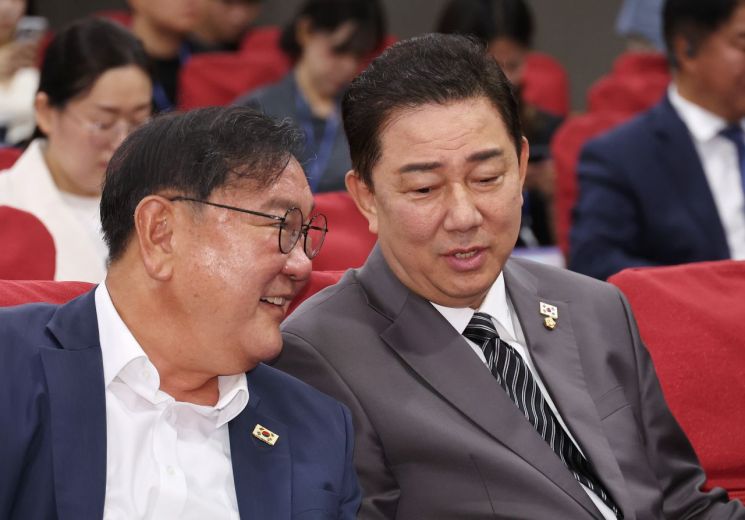
At a lecture hosted by “Economy is the Democratic Party” at the National Assembly Members’ Office Building in Yeouido on July 8, participants examined the asset imbalance in Korean households, which have a high proportion of real estate, and discussed ways to securitize real estate assets. The lecture was delivered by Lee Kwangsoo, head of Kwangsoonebokdeokbang and analyst, under the theme “Real Estate and Stocks: Seeking Methods for Coexistence and Growth.”
According to the lecture, the proportion of non-financial assets and financial assets among Korean households is 75.1% and 24.9%, respectively. This is a lower proportion of financial assets compared to major countries such as the United States (non-financial 29.3%, financial 70.7%) and Japan (non-financial 39.9%, financial 60.1%).
Kim Taenyon, the head of “Economy is the Democratic Party,” stated in his opening remarks, “We want to take this time to explore what the Democratic Party and the new government must do to usher in the KOSPI 5000 era, as proposed by the Democratic Party during the presidential election.” He added, “Currently, the profit structure between real estate and the capital market is 7 to 3, but personally, I would like to see it move to 3 to 7.”
Kim Byungki, acting leader and floor leader of the Democratic Party, also emphasized in his congratulatory address, “I expect that the recently revised Commercial Act will provide a strong motivation for capital concentrated in real estate to move into the financial market.” He stressed, “As we pursue policies for the KOSPI 5000 era, we must continue to remind people that real estate is not the only golden market.”
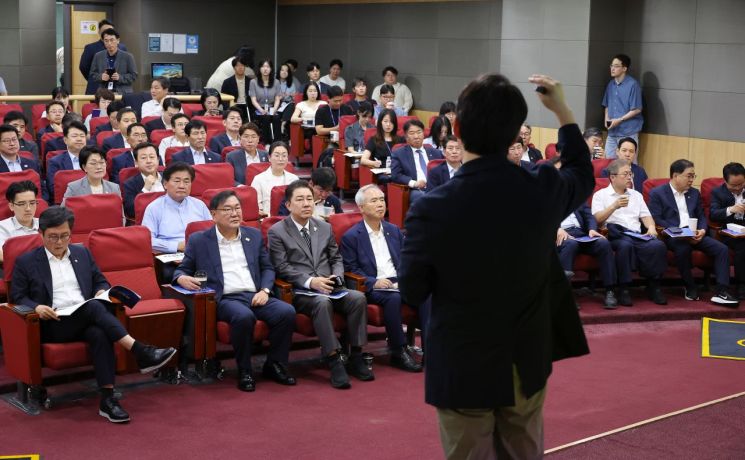
In his lecture, the analyst Lee proposed three reform measures: household debt restructuring, a housing equity sharing system, and the establishment of a Land and Housing Bank and National REITs. For household debt restructuring, new loan regulations would be applied to existing mortgage holders who own multiple properties or hold real estate for investment purposes. If these individuals sell their properties to repay loans, the increased supply of properties for sale would help stabilize housing prices, and those without homes could purchase them using loans.
The housing equity sharing system allows landlords and tenants to enter into voluntary contracts in which landlords sell a portion of their housing equity, and tenants obtain preferential lease rights and purchase options from the landlord. Landlords benefit from asset securitization, capital gains tax incentives, and eased comprehensive real estate tax burdens, while tenants gain housing stability and the benefits of real estate investment.
The Land and Housing Bank and National REITs are measures to secure public housing. The core idea is to raise funds through funding and REITs (which collect investments from multiple investors and distribute profits as dividends), rather than relying on government budgets, in order to quickly supply public housing through redevelopment and reconstruction projects that have been progressing slowly.
The introduction of new measures drew significant interest from lawmakers during the Q&A session. Representative Ahn Dogeol asked whether REITs, which rely on maintaining adequate profitability, could become established in the Korean real estate market. Analyst Lee responded, “Korean real estate generates enormous returns, which attracts a lot of foreign capital,” and added, “Sufficient profits can be secured.”
“Economy is the Democratic Party” plans to hold another lecture on July 15, under the theme “Causes and Solutions for the Korea Discount and a Mid-to-Long-Term Roadmap for Achieving the KOSPI 5000 Era.”
© The Asia Business Daily(www.asiae.co.kr). All rights reserved.
![Clutching a Stolen Dior Bag, Saying "I Hate Being Poor but Real"... The Grotesque Con of a "Human Knockoff" [Slate]](https://cwcontent.asiae.co.kr/asiaresize/183/2026021902243444107_1771435474.jpg)

















