Minimum Wage Commission to Hold 10th Plenary Session on the 8th
Labor-Management Gap Narrows from 1,470 Won to 870 Won
Conclusion Needed by Mid-Month at the Latest
There are expectations that the Minimum Wage Commission’s deliberations to determine next year’s minimum wage could be concluded as early as the 8th. This outlook comes as the gap between labor and management’s demands has narrowed from 1,470 won to 870 won, raising the possibility that both sides may reach a compromise.
On this day, the Minimum Wage Commission will hold its 10th plenary session at the Government Sejong Complex in Sejong, continuing its deliberations to determine next year’s minimum wage. Both labor and management have engaged in repeated negotiations up to the sixth revised proposal, reducing the gap by more than 40% compared to the initial proposals. Initially, labor demanded an hourly wage of 11,500 won, a 14.7% increase from this year, while management called for a de facto freeze at 10,030 won.
The extent to which labor will accept a low increase is being identified as a key variable for a final agreement. Labor representatives have expressed understanding of the difficulties faced by small business owners and SMEs amid prolonged high inflation and economic slowdown. However, they insist that the increase rate must at least match last year’s rate of 1.7%. They argue that a minimum increase equal to last year’s rate is necessary to compensate for the decline in real wages.
 Reconsideration of Next Year's Minimum Wage
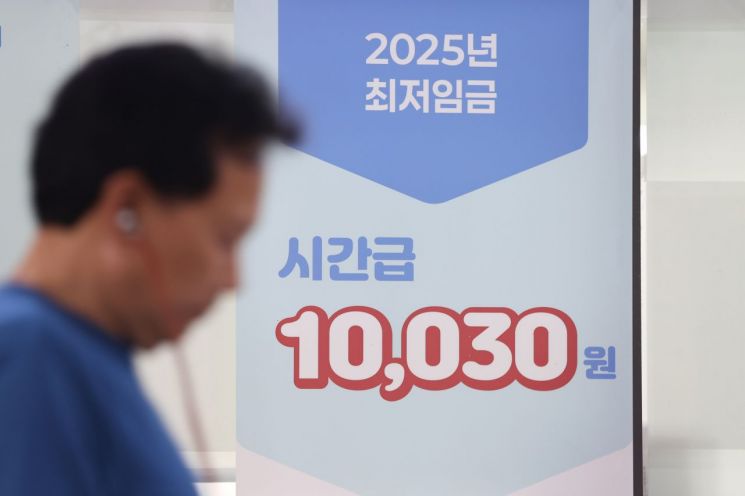
(Seoul=Yonhap News) Minji Kang = The Minimum Wage Commission discussed the amount of next year's minimum wage but failed to reach a conclusion. As labor and management sectors could not narrow their differences, the issue will be discussed again at the 8th plenary meeting on the 1st of next month. The gap in the amount remains large at 1,390 won. The photo shows a wage-related notice in front of the Seoul Western Employment Welfare Plus Center on the 27th. 2025.6.27
Photo by Minji Kang
mjkang@yna.co.kr (End)
In fact, both the Federation of Korean Trade Unions and the Korean Confederation of Trade Unions have asserted in unison that “only by increasing the minimum wage will low-wage workers’ consumption spending rise, leading to increased sales and benefits for small business owners.” Experts believe that, considering inflation and economic indicators, a compromise on next year’s minimum wage increase rate could be reached in the 2?3% range.
This year’s minimum wage deliberations are also significant as it is the first year of the Lee Jaemyung administration. As this government has emphasized the principle of “respect for labor and a grand tripartite compromise,” there are expectations for a decision based on autonomous agreement between labor and management. In fact, the public interest members, who mediate between labor and management, have also stated their intention to minimize intervention. Kwon Soonwon, a professor at Sookmyung Women’s University and secretary of the public interest members, said, “We will help labor and management reach an agreement through maximum consultation.” If the minimum wage is determined through negotiations between labor and management in the first year of the new administration, the government can present this as a result of its efforts to build trust between the two sides. Since the introduction of the minimum wage system in 1988, the minimum wage has been decided through labor-management agreement only seven times: in 1989, 1991, 1993, 1995, 1999, 2007, and 2008.
However, if an agreement is not reached by the end of the day due to time constraints, the public interest members may present a “deliberation facilitation range” at the last minute. The deliberation facilitation range refers to the upper and lower limits of the wage increase rate proposed by the public interest members during the minimum wage decision process. In this case, the range is set by comprehensively considering factors such as economic growth rate, inflation rate, and unemployment rate. According to the Minimum Wage Act, the Minister of Employment and Labor must announce the minimum wage in the official gazette by August 5 each year. Considering the 10-day objection period prior to the announcement, the Commission believes that a conclusion must effectively be reached by mid-month. Last year, the public interest members also proposed a range of “10,000?10,290 won,” and after a vote, the final hourly wage was set at 10,030 won.
© The Asia Business Daily(www.asiae.co.kr). All rights reserved.

![Clutching a Stolen Dior Bag, Saying "I Hate Being Poor but Real"... The Grotesque Con of a "Human Knockoff" [Slate]](https://cwcontent.asiae.co.kr/asiaresize/183/2026021902243444107_1771435474.jpg)















