Sparrows and Magpies Spotted Hunting Lovebugs
Images Later Revealed to Be AI-Generated
"Most Lovebugs Expected to Disappear by Mid-July"
As large numbers of lovebugs (Plecia nearctica) have recently appeared in urban areas during the summer, causing increasing inconvenience for citizens, there have been sightings of birds eating the lovebugs.
Recently, on X (formerly Twitter), multiple eyewitness accounts have been posted describing how birds such as sparrows and magpies have been seen consuming lovebugs.
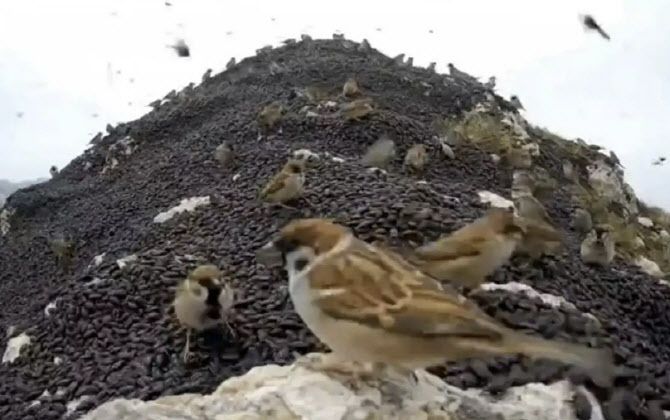
Citizens reported, "Sparrows are eating lovebugs stuck to the windows of commercial buildings," and "There were many lovebugs on the way to Incheon Airport, and several magpies were using the lovebugs as if it were a free buffet." However, it was later confirmed that these videos were fake and created by AI.
Lovebugs are known to have acidic body fluids, which makes them an insect that typical predators such as birds or frogs tend to avoid eating. Park Sunjae, a researcher at the National Institute of Biological Resources, explained on SBS Radio's "Kim Taehyun's Political Show" on July 1 that "when new organisms are introduced from overseas, it takes time for native species to recognize them as prey and start consuming them." He added, "Initially, the absence of natural enemies often leads to a rapid increase in population, but over time, the numbers are naturally regulated in many cases."
When asked, "When will the lovebugs disappear?" he answered, "Based on an analysis of occurrence patterns over several years, we believe that most of the population will disappear by around mid-July." Park also stated, "Lovebug outbreaks usually begin around mid-June and last for about a week, but as the monsoon season subsides, the population tends to decrease."
Recently, the government announced that, through monitoring, it has confirmed that magpies, pigeons, sparrows, and spiders are preying on lovebugs. However, if control relies solely on natural enemies, there are limitations due to the strong reproductive capacity of lovebugs. In particular, in newly affected areas where natural enemies have not yet adapted, the population is rapidly increasing. Therefore, the government is pursuing a dual control strategy: using natural enemies to target adult lovebugs and fungi to target larvae.
© The Asia Business Daily(www.asiae.co.kr). All rights reserved.
![Clutching a Stolen Dior Bag, Saying "I Hate Being Poor but Real"... The Grotesque Con of a "Human Knockoff" [Slate]](https://cwcontent.asiae.co.kr/asiaresize/183/2026021902243444107_1771435474.jpg)
















