Trump Sends Letter to President Lee:
"25% Tariff Imposed from August 1"
Why Trump Is Targeting South Korea and Japan...
South Korea Gains Time for Negotiations, but Faces Difficulties Lowering Item-Specific Tariffs
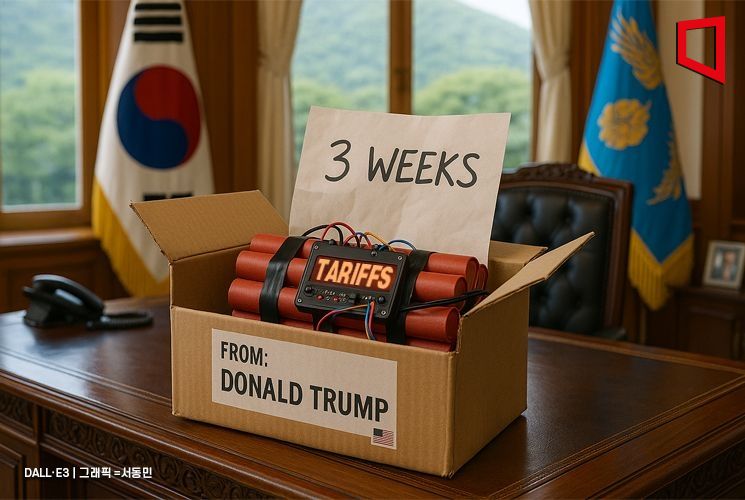
U.S. President Donald Trump announced on July 7 (local time) that he will impose a 25% reciprocal tariff on all South Korean imports starting August 1. Japan was also notified of a 25% tariff, as President Trump targeted the two allies first, escalating pressure. As South Korea's top trade and national security officials traveled to the U.S. together for tariff negotiations, the South Korean government, having received what amounts to a final ultimatum, now faces the critical task of securing the greatest possible tariff reduction through last-minute negotiations during the remaining three-week grace period.
Trump Sends Letter to President Lee: "25% Tariff Imposed from August 1"
On this day, President Trump sent so-called "tariff letters" to 14 countries, including South Korea and Japan, specifying country-by-country tariff rates ranging from 25% to 40%. Around noon, he publicly released the tariff letters sent to South Korea and Japan first via his own social media platform, Truth Social. In the letter addressed to President Lee Jaemyung, Trump wrote, "From August 1, 2025, we will impose only a 25% tariff on all South Korean products," adding, "This figure is much lower than what is required to address the trade deficit gap with South Korea." He also warned that if South Korea imposes retaliatory tariffs on the U.S., additional tariffs will be levied accordingly.
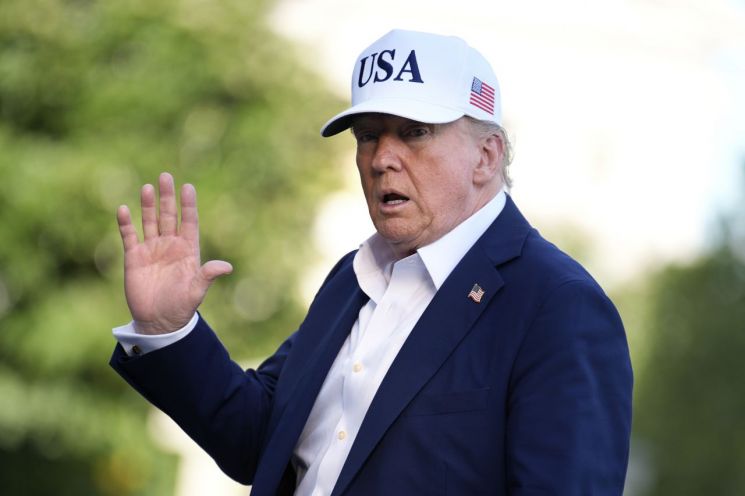
President Trump clarified that these reciprocal tariffs will be applied separately from existing item-specific tariffs. The U.S. currently imposes 25% tariffs on imported automobiles and auto parts, and 50% on steel and aluminum. According to a White House official cited by Reuters, reciprocal tariffs will not be added on top of item-specific tariffs. President Trump also stated that high tariffs will be imposed on transshipment methods that route goods through third countries.
However, he indicated the possibility of adjusting tariffs, provided that trade barriers are eased. President Trump said, "If you want to open up trade markets and remove tariff, non-tariff, policy, and trade barriers, we will consider revising the contents of the letter," and noted that "tariffs may be adjusted upward or downward" depending on South Korea's response. The White House confirmed that President Trump is also expected to sign an executive order extending the grace period for reciprocal tariffs from July 8 to August 1.
On the same day, President Trump sent a letter to Japanese Prime Minister Shigeru Ishiba, notifying him of the imposition of a 25% reciprocal tariff. The U.S. raised the tariff rate on Japan from 24% in April to 25% this time. In addition, the U.S. notified other countries of tariffs, including Malaysia (25%), Myanmar and Laos (40%), Kazakhstan (25%), and South Africa (30%).
Why Trump Is Targeting South Korea and Japan... South Korea Gains Time for Negotiations, but Faces Difficulties Lowering Item-Specific Tariffs
There is much speculation about why President Trump chose to first disclose the tariff letters sent to South Korea and Japan, both major U.S. allies, on social media. In 2024, both countries ranked among the top U.S. trade deficit partners, with annual deficits of $66 billion (8th) and $68.5 billion (7th), respectively. Analysts suggest this is a strategic move to pressure countries that are highly dependent on U.S. security, making retaliation difficult. The trade issues with the U.S. are also similar for both countries. Both South Korea and Japan have strongly demanded the elimination or reduction of U.S. tariffs on automobiles and steel?issues to which President Trump is particularly sensitive as he seeks to address trade imbalances?while showing reluctance to open their markets to U.S. agricultural and livestock products, which has reportedly fueled Trump's dissatisfaction. There may also be an intention to send the message that even allies are not exempt from tough trade negotiations. Notably, the public release of the tariff letter to President Lee at the very time when National Security Advisor Wi Seongrak and Trade Minister Yeo Hankoo are visiting the U.S. for tariff discussions is seen as a move to maximize pressure, secure the upper hand in negotiations, and gain the most advantageous position for the U.S.
Fortunately, the extension of the tariff grace period to August 1 and the maintenance of the reciprocal tariff rate at 25% have led to assessments that the South Korean government has avoided the worst-case scenario by preventing further increases. The Ministry of Trade, Industry and Energy issued a press release after the tariff letter was made public, stating, "We view President Trump's letter as effectively extending the imposition of reciprocal tariffs," and added, "During the remaining period, we will work to resolve the uncertainties caused by tariffs and push for negotiations to achieve mutually beneficial results."
The main issue is that President Trump has made it clear that item-specific tariffs will be imposed separately. The existing U.S. tariffs on automobiles (25%) and steel (50%)?key South Korean exports?mean that the government has made lowering the reciprocal tariff to the basic rate (10%) and eliminating or significantly reducing tariffs on these items its top negotiation priorities. While there is a possibility that item-specific tariffs could be lowered depending on future negotiations, President Trump's stance on auto and steel tariffs appears much tougher than expected. Wendy Cutler, Vice President of the Asia Society Policy Institute (ASPI) and former Deputy U.S. Trade Representative, commented, "It is regrettable that the president announced a 25% tariff on our two closest allies, Japan and South Korea," and analyzed that "this suggests that easing item-specific tariffs, including the top priority of auto tariffs for both countries, will not be accepted." Especially for South Korea, which is highly dependent on exports, failure to significantly reduce not only reciprocal tariffs but also tariffs on key exports such as automobiles and steel would inevitably have a major impact on the overall economy.
The government is reviewing concession plans to meet U.S. demands, such as opening the auto and agricultural markets, scrapping the Online Platform Act, and allowing the export of Google’s precision maps. The strategy also includes expanding cooperation in key industries such as shipbuilding, semiconductors, automobiles, and biotechnology to create more room for tariff reductions. In addition, the government is putting issues of interest to the U.S., such as increasing defense spending and readjusting the role of U.S. Forces Korea, on the table to steer the negotiations in a favorable direction. National Security Advisor Wi’s visit to the U.S. is also clearly aimed at coordinating tariffs and security issues comprehensively, alongside discussions for a possible South Korea-U.S. summit. Attention is focused on whether a summit between the two countries will be arranged at the end of this month, ahead of the August 1 tariff imposition. If such a summit is held, there is a possibility that the two leaders could find a breakthrough through last-minute negotiations.
© The Asia Business Daily(www.asiae.co.kr). All rights reserved.

![Clutching a Stolen Dior Bag, Saying "I Hate Being Poor but Real"... The Grotesque Con of a "Human Knockoff" [Slate]](https://cwcontent.asiae.co.kr/asiaresize/183/2026021902243444107_1771435474.jpg)
















