High-Performance N Brand Gains Spotlight in the Electrification Era
Ioniq 5 N Sweeps Awards for Driving Fun
Virtual Sound and Shifting Preserve the Feel of Internal Combustion
Park Junwoo: "Turning Imagination into Reality, a Bold Attempt"
"Hyundai Also Makes Fun Cars," Proving It to the Industry
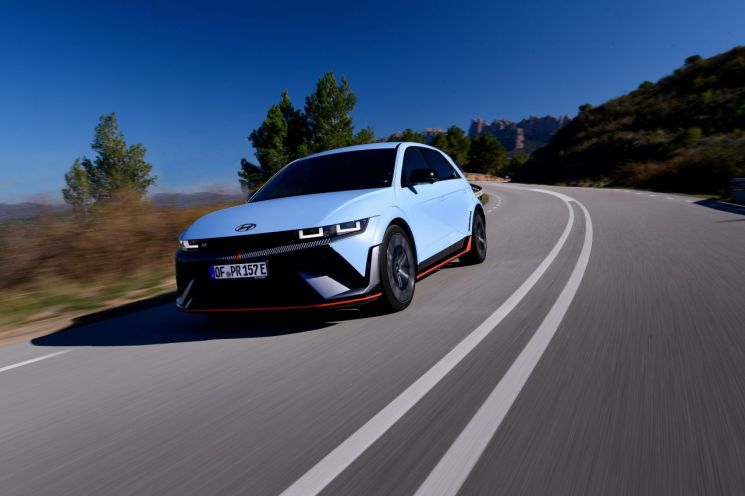
Recently, I heard the name of Hyundai Motor's Ioniq 5 N in one of the most unexpected places: a Xiaomi electric vehicle store located in a shopping mall in Shenzhen, China. While explaining the advantages of the Xiaomi SU7 electric vehicle, a store employee suddenly said, "There is a Korean car model I am particularly interested in," and showed a photo of the Ioniq 5 N. It was quite impressive to see a Chinese EV store employee, in a country with strong pride in its domestic brands, proactively mention and praise a Korean car.
The Ioniq 5 N has previously won credible awards in China, such as being named "Performance Car of the Year" at the 2025 China Car of the Year Awards. This recognition for its technology comes from a market where over 100 local companies launch more than 100 new EV models each year. The Ioniq 5 N was also named the "2024 World Performance Car" at the World Car Awards, which selects the world's best new cars. This award is given based on the comprehensive evaluation of over 100 global automotive journalists, who assess high-performance vehicles for driving performance, technological capabilities, and emotional appeal. Other finalists included BMW's M2 and XM, Ferrari Purosangue, and Porsche Cayenne Turbo E-Hybrid. The Ioniq 5 N was selected as the final winner, surpassing these formidable competitors. What, then, makes the Ioniq 5 N so highly regarded among car enthusiasts worldwide?
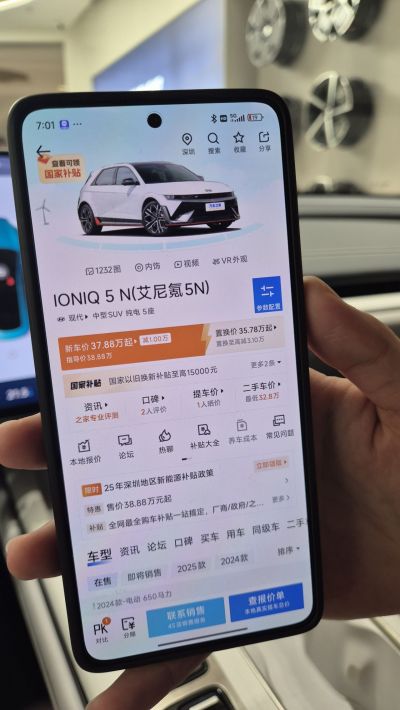 Last month, at a Xiaomi electric vehicle store in Shenzhen, China, an employee is showing a photo of Hyundai's Ioniq 5 N. Photo by Woo Suyeon
"Electric cars can be fun to drive"
Among car enthusiasts, electric vehicles have long been considered boring and unexciting to drive. Complaints abound about the absence of the throaty engine sound at high speeds and the lack of tactile feedback from shifting gears. While acceleration is strong, the driving feel is often described as excessively smooth, leading to a sense of unfamiliarity. The abundance of electronic control systems can make it feel as if the car is driving itself, rather than being under the driver's full control. The joy of driving comes from the sense of mastery over the vehicle, but electric cars rarely provide this feeling. As a result, many driving enthusiasts insist on sticking with internal combustion engine cars.
But what about the Ioniq 5 N? It boasts a solid foundation. For driving to be enjoyable, the driver and car must become one, and this requires robust overall driving performance as a baseline. The Ioniq 5 N passes this test with flying colors. The German automotive magazine Auto Zeitung commented, "Everything related to driving performance?steering response, power distribution, acceleration, and braking?was perfect."
Another differentiator for the Ioniq 5 N is its creative approach. Hyundai set out to make a "fun electric car" through its high-performance N brand, aiming to create a toy for the track. What if you could experience the engine sound and shifting jolts of an internal combustion car in an EV? What if the electronic controls allowed the driver to fine-tune the vehicle even more precisely? What if there were a booster function to add speed, just like in a racing game? The developers explored these imaginative ideas as they conceptualized the Ioniq 5 N.
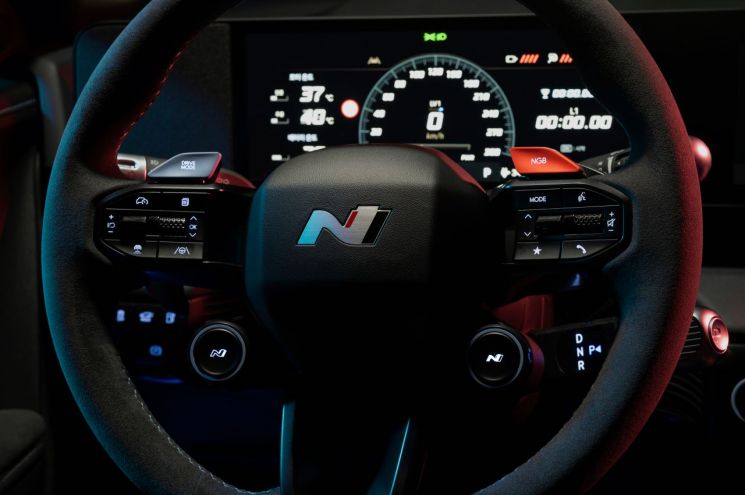
This car is equipped with virtual engine sound and shifting systems, creating the illusion of driving an internal combustion vehicle even though it's an EV. First, the developers created "artificial sounds" to fill the quiet background of electric driving. Drivers can choose from three sounds: Ignition (internal combustion engine sound), Evolution (mechanical sound), and Supersonic (jet engine noise). Selecting the engine sound makes it feel as if you're driving a traditional car. If you choose Supersonic and press the pedal on the track, it can be hard to tell whether you're in a car, a plane, or some kind of spaceship.
The Ioniq 5 N also virtually replicates the subtle vibrations and jolts felt during gear shifts in an internal combustion engine. The dashboard displays the virtual engine's RPM and gear position, and when shifting virtually, the sound changes realistically, as if the actual engine RPM is fluctuating.
There's also a boost function that maximizes driving performance. Similar to the KartRider game, pressing a specific button delivers an extra surge of power, allowing you to outpace competitors. Normally, the Ioniq 5 N produces 609 horsepower, but pressing the button on the right side of the steering wheel activates boost mode, raising the peak output to 650 horsepower.
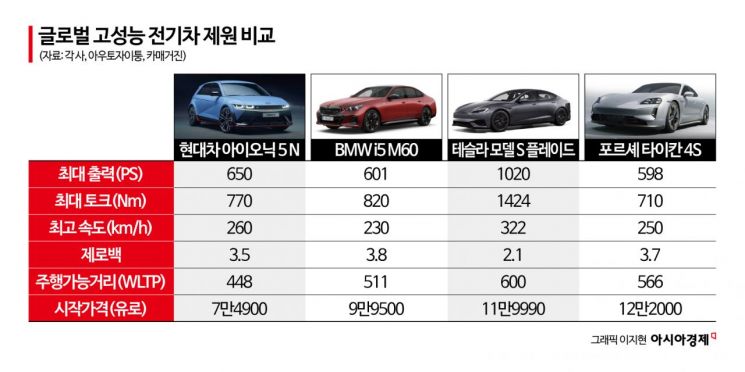
Finally, the Ioniq 5 N's market significance lies in its value for money. High performance and affordability are not usually associated, but Hyundai has managed to create a mass-produced high-performance car that maximizes performance while offering an optimal price. The Ioniq 5 N sells for 74,900 euros in Europe, which is much lower than competitors such as the BMW i5 M60 xDrive (99,500 euros), Tesla Model S Plaid (119,990 euros), and Porsche Taycan 4S (122,000 euros). In terms of performance, it is by no means inferior. The Ioniq 5 N accelerates from 0 to 100 km/h in 3.5 seconds, while the Porsche Taycan 4S does it in 3.7 seconds. Their peak outputs are similar?650 horsepower for the Ioniq 5 N and 598 horsepower for the Taycan 4S?but the price difference exceeds 1.5 times.
Why does Hyundai make high-performance cars that aren't profitable?
Compared to similarly equipped high-performance competitors, the price of the Ioniq 5 N is almost unbelievable. So why does Hyundai produce a mass-market high-performance car that doesn't even generate much profit? I visited Namyang Research Center to speak with Park Junwoo, Executive Director of the N Management Office, who oversees Hyundai's high-performance N brand. Describing himself as a "car geek," the words he used most frequently during our conversation were imagination and courage. On the research center's track that day, rolling lab models such as the RN22e, N Vision 74, and RN24?experimental vehicles developed by the N brand team?were lined up. Introducing these cars, Executive Director Park said, "The rolling labs we built experimentally are like the fathers and mothers of Hyundai's mass-produced cars," and added, "For us, it takes courage to use technology to realize ideas from the realm of imagination that no one else has considered."
Projects such as allowing drivers to change the EV's sound based on their mood, or transforming an everyday grocery-getter into a drift-capable sports car on the track, all started from imagination. The birth of the hydrogen-electric hybrid N Vision 74, once thought impossible, also began as a fantasy of the N brand. Park explained, "The goal of the N brand is not simply to develop advanced technologies. It's about making bold attempts based on free imagination, and having the courage to overcome skepticism or concerns from those around us during the process."
Hyundai actively leverages the N brand for marketing and collaboration with competitors. Achievements and victories in motorsports serve as external proof of Hyundai's technological prowess. There are also cases where motorsports, as a shared interest, have facilitated collaboration with competitors. In October last year, Hyundai and Toyota jointly hosted a motorsport event, and at the final WRC (World Rally Championship) awards ceremony in November, Hyundai Motor Group Chairman Hyun Jeeson and Toyota Group Chairman Akio Toyoda met and created a friendly atmosphere. The meeting of these two leaders, who compete for the top spot in the global auto industry, attracted attention from major media outlets in Korea, Japan, and abroad.
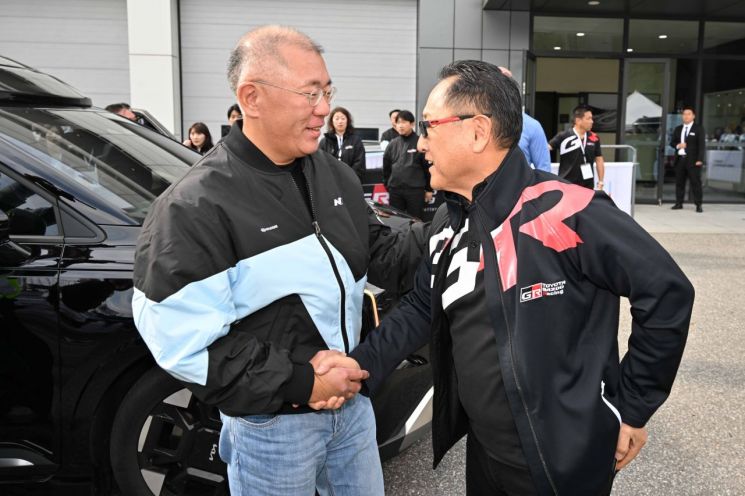 Hyun Jeeson, Chairman of Hyundai Motor Group (left in the photo), and Akio Toyoda, Chairman of Toyota Motor Corporation Group, are warmly shaking hands at the "Hyundai N x Toyota Gazoo Racing Festival" event held in October last year in Yongin, Gyeonggi Province. Provided by Hyundai Motor Group
The birth of the N brand and its 10-year history
'N' stands for Namyang, where Hyundai's global R&D center is located, and Nurburgring, where the N model's performance evaluation center resides. At the end of 2012, Hyundai established Hyundai Motorsport GmbH (HMSG) in Europe, formalizing its entry into motorsports, and officially launched the N brand at the 2015 Frankfurt Motor Show. In 2019, Hyundai won its first World Rally Championship (WRC) manufacturers' title, marking its emergence in motorsports. Technologies developed for motorsports?such as pushing vehicle durability to the limit or minimizing weight?have been directly applied to mass-produced vehicles. The latest technologies developed by the N brand and Namyang Research Center are first introduced in motorsports, then sequentially adopted in rolling labs, high-performance N vehicles, N Line sports trims, and finally in regular mass-produced cars.
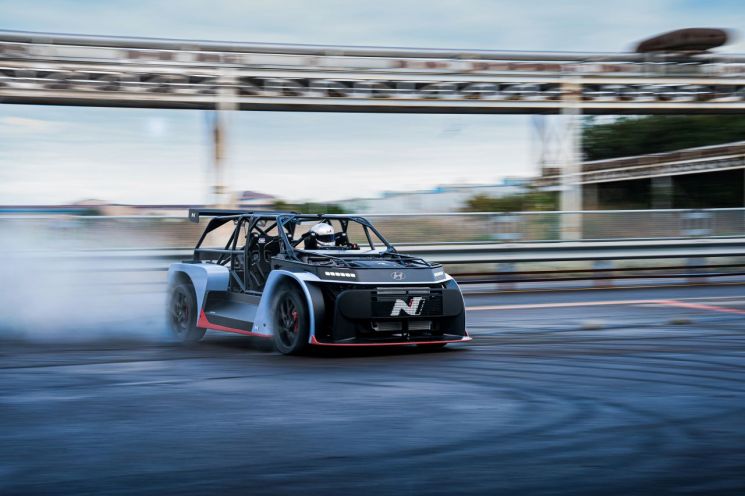 High-performance rolling lab 'RN24' embodying Hyundai Motor Company's next-generation electrification vision for the high-performance N brand. Provided by Hyundai Motor Company
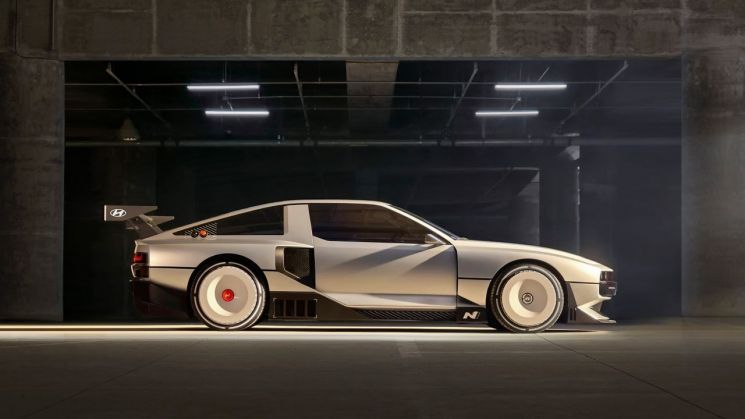 High-performance hydrogen-electric hybrid rolling lab of Hyundai Motor Company's N brand. Provided by Hyundai Motor Company
Starting with the i30 N in 2017, the N brand has successively launched high-performance models such as the Veloster N, i20 N, Kona N, and Avante N. While it showed steady growth with internal combustion engines, the N brand began to gain significant attention as the industry shifted toward electrification. As a latecomer, Hyundai found it nearly impossible to catch up to European and American automakers with decades of experience in internal combustion engine technology. However, as the market shifted to electrification, Hyundai began to stand out in the high-performance EV segment.
In 2022, the N brand unveiled two concept cars that made waves in the industry. The RN22e is a high-performance rolling lab based on Hyundai Motor Group's dedicated EV platform, E-GMP. This rolling lab later became the foundation for the N brand's second high-performance EV, the Ioniq 6 N. Another rolling lab, the N Vision 74, features a hydrogen-electric hybrid system. As the world's first model to combine a hydrogen fuel cell with an EV battery, it merges the advantages of both electric and hydrogen vehicles. This system dramatically increases driving range compared to conventional EVs, while reducing charging time to around five minutes. The industry is watching closely to see if Hyundai can apply this new hydrogen hybrid technology to mass-produced vehicles.
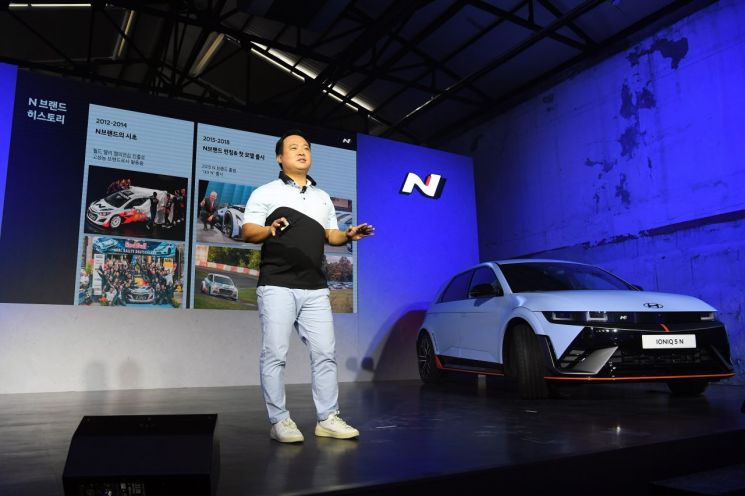 Park Junwoo, Executive Director of Hyundai Motor Company N Management Office, is presenting the history of the N brand at the Ioniq 5 N unveiling event. Photo by Hyundai Motor Company
The next high-performance Hyundai: Ioniq 6 N
This month, Hyundai is set to unveil the Ioniq 6 N, the N brand's second high-performance electric vehicle. The new differentiator is that it is a high-performance EV based on a sedan platform. The previous Ioniq 5 N was built on a sport utility vehicle (SUV) platform, which imposed some limitations for track driving. This time, however, Hyundai aims to introduce a true "track toy" high-performance EV based on a traditional sedan.
The Ioniq 6 N uses the same platform as the Ioniq 5 N but has a lower center of gravity, enabling more stable and precise driving. The virtual shifting system features even closer gear ratios, allowing the car to respond more quickly and agilely. The N Drift Optimizer, which assists with drifting, further subdivides the parameters drivers can control, maximizing driving fun. A researcher involved in the development of the Ioniq 6 N commented, "As a mass-market brand, Hyundai hasn't had many opportunities to showcase Namyang Research Center's technical prowess through production vehicles. The N brand is an effective channel to highlight our capabilities and show the world that Hyundai can also make truly fun cars."
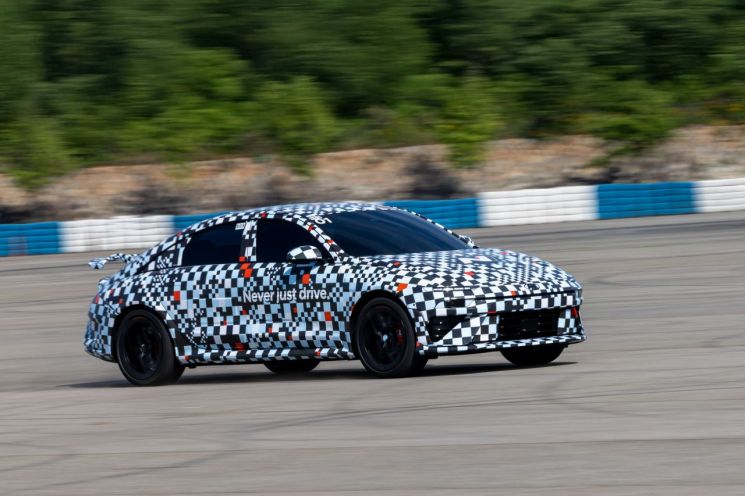 The second mass-production high-performance electric vehicle of Hyundai Motor Company's N brand, the 'Ioniq 6 N' prototype. Provided by Hyundai Motor Company
© The Asia Business Daily(www.asiae.co.kr). All rights reserved.



















