Allowing Assets Like MMFs Could Affect M3 Liquidity
Short-Term Lending May Shrink During a "Crypto Winter"
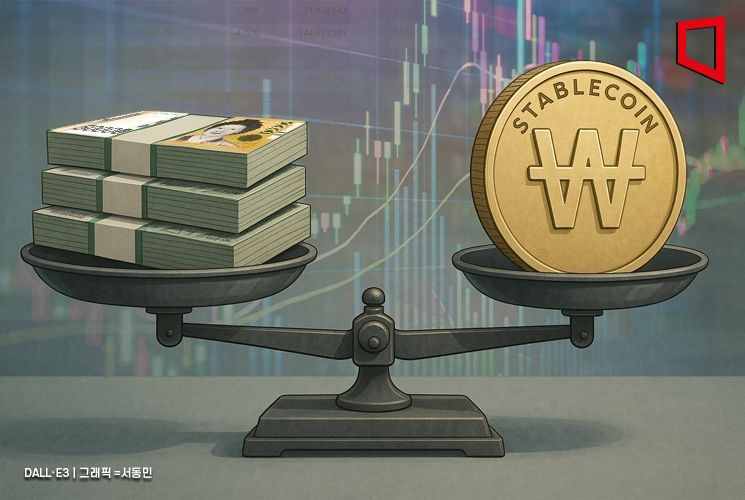
On July 7, DB Financial Investment published a report titled "Liquidity Impact Pathways of Stablecoins," analyzing that stablecoins, which are being considered for introduction in South Korea, do not affect M1 or M2 liquidity, but do have an impact on M3 liquidity. In this case, stablecoins could influence the short-term money market, and if a "crypto winter" occurs?where the stablecoin market stagnates?demand for short-term funds would decrease, which would in turn affect the short-term bond market.
As discussions about stablecoins have recently intensified, an opposing argument has emerged that "stablecoins make liquidity management difficult." However, this claim is somewhat exaggerated. In the financial system, liquidity is created through commercial bank lending and central bank quantitative easing (QE). Stablecoin issuers do not have deposit or lending functions. When funds are collected for coin issuance and used to purchase government bonds, the money is ultimately redeposited into banks. In this scenario, the total amount and composition of assets and liabilities in the banking system do not change.
Even when funds flow into South Korea from abroad via stablecoins, liquidity does not increase; only the exchange rate is affected. For example, if a Korean wishes to acquire the US stablecoin USDT, they must first obtain US dollars and then purchase USDT. The dollars obtained by the Korean are already in circulation from previous issuance, so no additional liquidity is created. In other words, there is little impact on M1 (cash and demand deposits) and M2 (M1 plus short-term savings deposits) liquidity. However, depending on regulations, demand for US Treasury bonds may be affected. If, as in the case of Tether, an issuer is required to increase its US Treasury holdings from the initial 60-70% to 100%, demand for US Treasuries will increase by that additional amount.
However, depending on the assets included in stablecoins, M3 liquidity can change. For example, under the US GENIUS Act, if issuers are allowed to include not only US Treasuries but also money market funds (MMFs) or repurchase agreements (repos), funds are effectively being lent into the financial system, which could potentially increase liquidity. These factors affect financial asset prices and the short-term money market more than the real economy. This could become a variable for future financial markets. The emergence of new suppliers in the short-term money market could ease interest rates and make repo-based leverage more accessible. However, this market is also heavily influenced by policies such as the Federal Reserve's quantitative tightening (QT) and Treasury issuance.
Moon Hongcheol, an analyst at DB Financial Investment, analyzed, "If the share of repos held by coin issuers increases, demand for short-term Treasury bills (T-Bills) will rise and repo funding will become more abundant as the coin ecosystem expands. Conversely, if a crypto winter arrives and lending contracts, the short-term market could experience volatility, which could potentially have a butterfly effect on the entire financial system."
© The Asia Business Daily(www.asiae.co.kr). All rights reserved.

![Clutching a Stolen Dior Bag, Saying "I Hate Being Poor but Real"... The Grotesque Con of a "Human Knockoff" [Slate]](https://cwcontent.asiae.co.kr/asiaresize/183/2026021902243444107_1771435474.jpg)















