"Mining Ban for 50,000 Self-Employed Miners" Announced
Labor Unions Claim "Government Mismanagement Is the Real Issue"
Social conflict over the regulation of unlicensed miners is intensifying in Peru. Peru ranks as the world's second or third largest copper producer.
On July 4 (local time), the Peruvian Ministry of Energy and Mines (MINEM) announced in a press release that, as part of efforts to regulate indiscriminate mining activities and to identify areas where legal operations can be carried out, the government has decided to exclude a total of 50,565 unlicensed self-employed miners nationwide from the formalization process.
Authorities explained that this decision targets those who have not completed registration procedures for more than a year in the Comprehensive Mining Registry (REINFO), which has been operated in Peru since 2012 to legalize the mining sector. Jorge Montero Cornejo, Minister of Energy and Mines, stated that more than 90% of those excluded from the formalization process have failed to fulfill their legal obligations and have operated without a license for over four years, and that all their mining activities are now prohibited.
Additionally, the Ministry of Energy and Mines announced that it plans to fully complete the legalization process for small-scale unlicensed miners by the end of this year. The ministry added that it will intensify crackdowns on illegal mining in order to accelerate the sustainable development of the related industry and to stabilize local communities.
Peru operates a system that allows informal miners to obtain temporary mining registration, extract certain amounts of minerals such as gold and copper, and report their working conditions. The proliferation of unlicensed small-scale operators is attributed to regulatory failures by the authorities. Locally, there is criticism that the government has repeatedly extended the REINFO registration deadline, which has led to 'moral hazard' among miners.
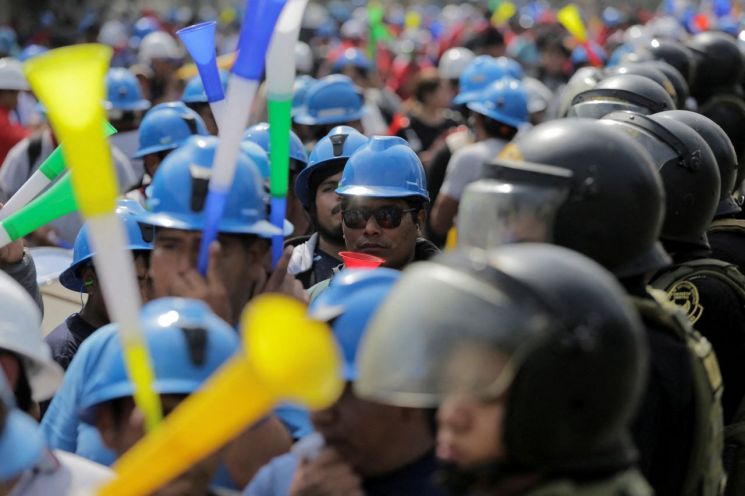
In response to the government's hardline stance, labor unions centered on small-scale miners have strongly protested, arguing that the government's poor management of the Comprehensive Mining Registry is a bigger problem. The National Federation of Small-Scale Miners (Confemin) occupied various roads in Lima and held protests, demanding that the formal registration system be revised to reflect reality and that the end-of-year registration deadline be withdrawn.
Peruvian news agency Andina reported that this process has also caused disruptions in copper transportation. Local media reported that the Peruvian police have strengthened security around government offices, including the National Congress, since the previous day, due to the possibility that miners might attempt to occupy these facilities.
© The Asia Business Daily(www.asiae.co.kr). All rights reserved.












