Bank of Korea Explains
"U.S. Tariffs Begin to Impact Automobiles and Steel"
"Tariff Effects Expected to Intensify in the Second Half"
The Bank of Korea stated regarding the May current account balance, "The impact of U.S. tariffs has started to appear, particularly in automobiles and steel," and added, "The effects of tariffs are expected to become even more pronounced in the second half of the year." Regarding the view that the current situation represents a "recession-type surplus," where both exports and imports have declined but imports have fallen more sharply, resulting in a surplus, the Bank assessed, "It is difficult to see it that way, as external factors have played a much larger role."
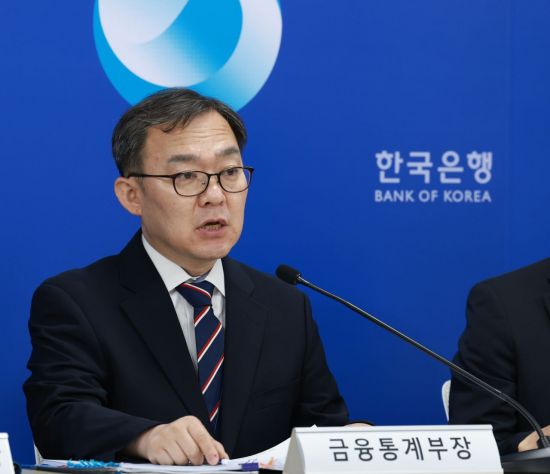 Song Jaechang, Head of the Financial Statistics Department, is speaking at the "May 2025 Balance of Payments (Preliminary) Press Briefing" held at the Bank of Korea in Jung-gu, Seoul, on the morning of the 4th. Provided by the Bank of Korea.
Song Jaechang, Head of the Financial Statistics Department at the Bank of Korea’s Economic Statistics Department 1, explained this at the "May 2025 Balance of Payments (Preliminary) Press Briefing" held on the 4th. The May current account surplus reached $10.14 billion, marking a surplus for the 25th consecutive month, and the surplus was the third largest ever for the month of May. The goods balance (exports minus imports), which accounts for the largest share, also posted a record high for May at $10.66 billion. However, a closer look at the details shows that exports declined for the first time in four months, and although imports also fell, the drop in imports was even greater than that of exports due to lower oil prices, resulting in a wider surplus.
Song pointed out that the decline in exports was due to the impact of U.S. tariffs, particularly on automobiles and steel, based on customs clearance data from January to June. In the first half of the year, automobile exports decreased by 2.1% and steel exports by 3.2% compared to the same period last year. Specifically, exports to the U.S. fell by 16.4% for automobiles and 4.3% for steel.
He said, "If the current impact of tariffs continues, the downward trend will likely become more pronounced for tariffed items in the second half of the year. This is because the tariff increases are expected to be passed on to selling prices, and in the case of automobiles, if local production expands, exports may decrease further." He also noted, "There is uncertainty regarding whether additional items will be subject to tariffs and how reciprocal tariff negotiations with the U.S. will proceed, so we need to monitor not only the predictable factors but also other developments."
However, he took a different stance regarding the view that the surplus is a so-called "recession-type surplus," where imports have decreased more sharply than exports. Song explained, "A recession-type surplus is used to describe a situation where exports decline and imports drop even more due to sluggish domestic consumption and investment, resulting in a surplus. However, the current decrease in exports and imports is more attributable to external factors such as falling oil prices and changes in the trade environment, rather than domestic factors, so it is difficult to classify it as a recession-type surplus."
He added, "Looking at capital goods imports in May, the growth rate slowed from an 8.7% increase in April to 4.9% in May, but the upward trend has continued. Consumer goods, including passenger cars, also switched to an increase in May. From January to May, the growth trend in capital goods was maintained, and consumer goods, though only slightly, also showed an increase. Excluding the effect of falling energy prices, the trend of increasing imports has not changed significantly."
Regarding the potential impact of last month's oil price increase due to the Middle East crisis on the future current account balance, he assessed the effect as limited. Song explained, "Oil prices affect import prices with about a one-month lag, but in May, oil prices dropped significantly, so even based on June customs clearance data, the impact of oil prices has not been that significant. International oil prices, based on Dubai crude, rose from $64 per barrel in May to $69 in June, but it is unlikely to have a major impact in July."
As for the turnaround in foreign stock investment, which increased for the first time in 10 months since July last year, Song explained, "Foreign investor sentiment improved as trade negotiations showed some progress, and domestically, expectations for improved performance in major industries led to net purchases by foreigners." He added, "In June, with the inauguration of the new government and growing expectations for commercial law revisions and programs to enhance corporate value, net investment by foreigners has continued."
© The Asia Business Daily(www.asiae.co.kr). All rights reserved.












