U.S. Nonfarm Payrolls Rise by 147,000, Beating Expectations
Unemployment Rate Drops from 4.2% to 4.1%
July Rate Cut Expectations Fade... 93% Chance of Hold
"Public Sector Leads... Private Employment Hits 8-Month Low"
Last month, U.S. employment increased unexpectedly, while the unemployment rate fell. Despite concerns about an economic slowdown due to aggressive tariff policies, the labor market has remained resilient, leading to a prevailing view that the possibility of an early rate cut in July has faded.
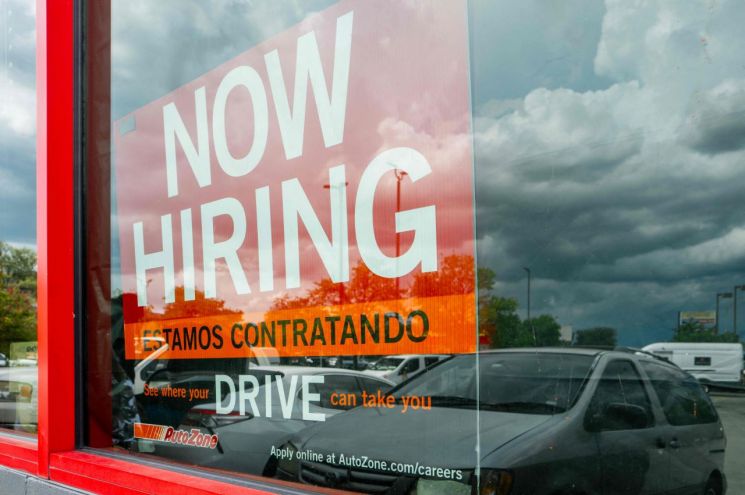
On July 3 (local time), the U.S. Department of Labor announced that nonfarm payrolls increased by 147,000 in June 2025.
This figure significantly exceeds the Bloomberg forecast of 106,000 and is also higher than the May figure of 144,000. The increase in nonfarm payrolls for May was revised upward from the initially reported 139,000 to 144,000.
By sector, state government employment rose by 47,000, with the education sector leading the growth with an increase of 40,000. Employment also increased in healthcare (39,000) and social assistance (19,000).
The unemployment rate fell from 4.2% in May to 4.1% in June. The market had expected the unemployment rate to edge up to 4.3% last month, reaching its highest level since 2021, but contrary to expectations, it actually fell by 0.1 percentage point.
Average hourly earnings rose by 0.2% from the previous month. This exceeded the forecast of 0.3%, but was lower than the May figure of 0.4%.
The unexpected increase in employment last month is seen as a sign that the labor market remains robust despite President Trump's tariff hikes.
This is particularly notable as it came just one day after the release of weak employment data. According to private labor market research firm ADP, private sector job creation decreased by 33,000 in June, raising concerns about a slowdown in hiring. However, the Department of Labor's nonfarm payrolls, which include both private and public sectors, showed strength, easing concerns about a labor market slowdown.
Initial jobless claims were also lower than expected. The Department of Labor reported that initial jobless claims for the week of June 22-28 totaled 233,000, slightly below the market forecast of 240,000. This is the lowest level in six weeks since mid-May. However, continuing claims?those who have been claiming unemployment benefits for more than two weeks?reached 1,964,000, the highest in about four years.
Following the surprise employment data, market expectations that the Federal Reserve (Fed) would cut rates in July quickly diminished. According to CME FedWatch, immediately after the employment report was released, the probability of a July rate cut dropped sharply to 6.7%, down from 23.8% the previous day. The probability of rates being held steady in July rose to 93.3%. The likelihood that the Fed will keep rates unchanged in September also surged from 6.3% the previous day to 29.7%.
The Treasury market reacted immediately. As expectations for a rate cut receded, the yield on the 10-year U.S. Treasury note, the global benchmark for bond yields, rose 3 basis points (1bp=0.01 percentage point) from the previous day to 4.32%. The yield on the 2-year Treasury note, which is sensitive to monetary policy, jumped 8 basis points to 3.87%.
Samir Samana, Senior Global Market Strategist at Wells Fargo Investment Institute, said, "The labor market continues to maintain a solid foundation," and analyzed, "This data reinforces the Fed's wait-and-see stance, making a rate cut in July unlikely."
Some caution that the contraction in private sector employment should not be overlooked. The increase in jobs last month was driven by the public education sector, while private employment rose by only 74,000?its lowest level in eight months since October last year.
Samuel Tombs, Chief U.S. Economist at Pantheon Macroeconomics, noted, "We should ignore the increase in education jobs and focus on the fact that labor demand in the private sector is weakening." He pointed out, "Concerns about tariff hikes, restrictive monetary policy, and further escalation of the trade war are placing significant pressure on labor demand."
© The Asia Business Daily(www.asiae.co.kr). All rights reserved.

















