Forum on the Implementation of Regulations for Nurse Medical Support Work
"Korean Nurses Association Should Oversee Educational Institutions and Qualification Systems"
Although the Nursing Act, which legalizes the work of physician assistant (PA) nurses, has been implemented, concerns have been raised that proper education for these nurses is not being provided at medical sites. As a result, there is growing demand to delegate the education of PA nurses to the Korean Nurses Association (KNA) and to manage this through a certification system, rather than simply requiring completion of a training course.
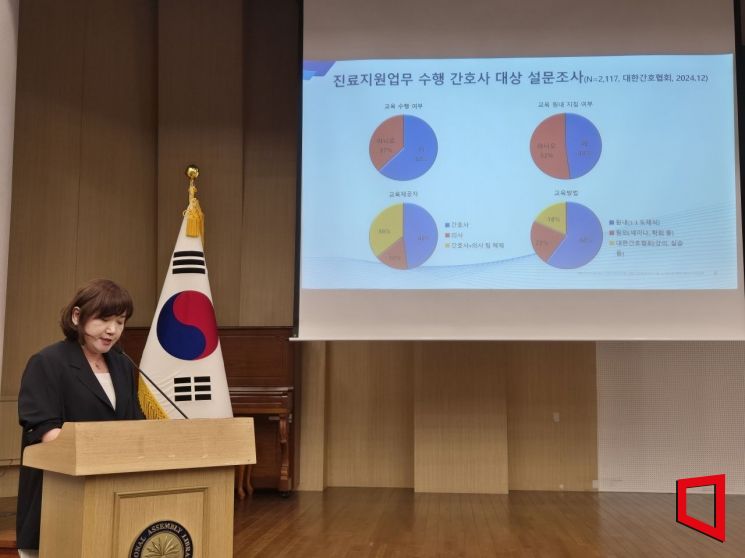 Professor Lee Jia of Kyung Hee University College of Nursing Science is presenting at the "Discussion on the Implementation of Proper Nurse Medical Support Work Regulations" held on the 3rd at the National Assembly in Yeouido, Yeongdeungpo-gu, Seoul. Photo by Choi Taewon
The Korean Nurses Association (KNA) held a forum titled "Discussion on the Implementation of Proper Nurse Medical Support Work Regulations" at the National Assembly in Yeongdeungpo-gu, Seoul, on the 3rd, and emphasized the urgent need to establish clear standards for the scope of PA nurses' work and to standardize the educational system.
Kang Kyungrim, president of the KNA, stated, "The government is delegating PA nurse education to medical institutions, and is attempting to complete the training process by simply issuing certificates at the discretion of the heads of these institutions." She argued, "The KNA should be responsible for overseeing and managing PA nurse training institutions and for establishing a comprehensive qualification system for each field."
Professor Lee Jia of Kyung Hee University College of Nursing Science, who gave a presentation at the event, also said, "Since the KNA has already been conducting dedicated nurse training since last year, the association should continue to oversee nurse education to ensure consistency and to support ongoing career development."
According to the KNA's "Dedicated Nurse Training Management Plan" presented by Professor Lee, as of December last year, there were 137 dedicated nurse training institutions under the management of the KNA, including local nursing societies and university-affiliated hospitals, with a total of 300,591 trainees having completed the program.
Professor Lee made it clear that PA nurse qualifications should be managed through an examination, not simply by completing a training course. She explained, "A system should be established in which nurses complete a standardized curriculum at designated institutions, pass a qualification exam, receive legal protection, and are able to develop their careers through processes such as certificate renewal reviews."
She also strongly supported the argument that the dedicated nurse training system should be delegated to the KNA. Professor Lee predicted, "If the Ministry of Health and Welfare delegates the training and management of dedicated nurses to the KNA, the association will be able to ensure the quality of education and manage institutions where education is lacking."
There were also opinions from the field that the scope of medical support work should be limited, as nurses are facing significant difficulties. Oh Sunyoung, policy director of the Korean Health and Medical Workers' Union and a former nurse, said, "When you ask nurses on the ground, the most urgent problem is that medical support tasks are being shifted to them," and added, "Nurses are currently handling tasks such as obtaining surgical consent forms, writing medical records, and even performing procedures such as prescribing and dressing."
Based on discussions within the health and medical workers' union about institutionalizing the PA system, many expressed the view that even seemingly simple medical acts should not be performed by nurses. Oh stated, "In many frontline hospitals, tasks such as catheter insertion and removal, which can result in patient death even from minor mistakes, are being reassigned to doctors because they are considered too dangerous for nurses. However, if the system becomes institutionalized, nurses will ultimately be required to perform these risky procedures."
Oh also pointed out that the education PA nurses receive is severely insufficient. She said, "According to a survey by the health and medical workers' union, 40.4% of nurses who received medical support training had only eight hours or less of education, while only 7.5% received more than 101 hours of training."
She further emphasized that patient safety should take precedence over efficient hospital operations. Oh stated, "Hospitals may want to utilize dedicated nurses efficiently, but on the ground, patient safety comes first," and stressed, "PA nurses should not be used as substitutes simply because their labor costs are lower than those of specialists."
© The Asia Business Daily(www.asiae.co.kr). All rights reserved.











