Gyeonggi Province has submitted key provincial policy issues, such as the establishment of a semiconductor mega-cluster and the implementation of a 4.5-day workweek, to the Presidential Policy Planning Committee, requesting that these be included in the national policy agenda of the Lee Jaemyung administration.
On July 3, Gyeongin Ko, Vice Governor for Economy of Gyeonggi Province, met with Suhyun Park, Chairman of the Presidential Committee on Balanced National Development, at the Policy Planning Committee located in the annex of the Government Seoul Complex in Changseong-dong. During the meeting, he delivered the "Gyeonggi Province Policy Proposals," which include the "Three Major Future Growth Projects," citizen-centered policies such as the 4.5-day workweek and climate insurance, and the sharing of labor inspection authority with local governments, and provided a detailed explanation of the main points.
The "Three Major Future Growth Projects" that Gyeonggi Province is prioritizing are: ▲ Establishment of a K-Semiconductor Mega-Cluster ▲ Creation of a Climate Tech Cluster and transition to RE100 ▲ Attraction of private AI computing centers and designation of special zones for leading AI projects.
The K-Semiconductor Mega-Cluster project aims to create a special zone centered on the semiconductor value chain in Yongin, Hwaseong, Pyeongtaek, and Icheon, and to promptly enact a "Special Act on Semiconductors" in order to secure both industrial competitiveness and supply chain stability. Through this, the province seeks to attract government support for infrastructure development, tax incentives, and exemption from preliminary feasibility studies, thereby laying the foundation to become a global semiconductor hub.
The "Climate Tech Cluster" for responding to the climate crisis is planned to be established within the Peace Economy Special Zone. The plan includes building an advanced ecosystem that encompasses technology demonstration, business incubation, and regional energy self-sufficiency, in connection with RE100-dedicated industrial complexes and large-scale renewable energy aggregation sites. To achieve this, the province also requested the enactment of a "Special Act on Climate Tech" and national funding support.
The attraction of private AI computing centers and the designation of special zones for leading AI projects are based on the construction of an "AI Highway" and the securing of data infrastructure. The plan includes the creation of regionally specialized clusters centered on Pangyo (such as Siheung AI Bio and Hanam AI Services) and the attraction of AI computing centers.
To realize these goals, Gyeonggi Province included in its proposal the designation of a "Special Zone for Leading AI Projects," cloud support for GPU (semiconductors specialized for graphic processing) and NPU (semiconductors specialized for artificial intelligence), and legal and financial support for the training of 4,000 AI professionals.
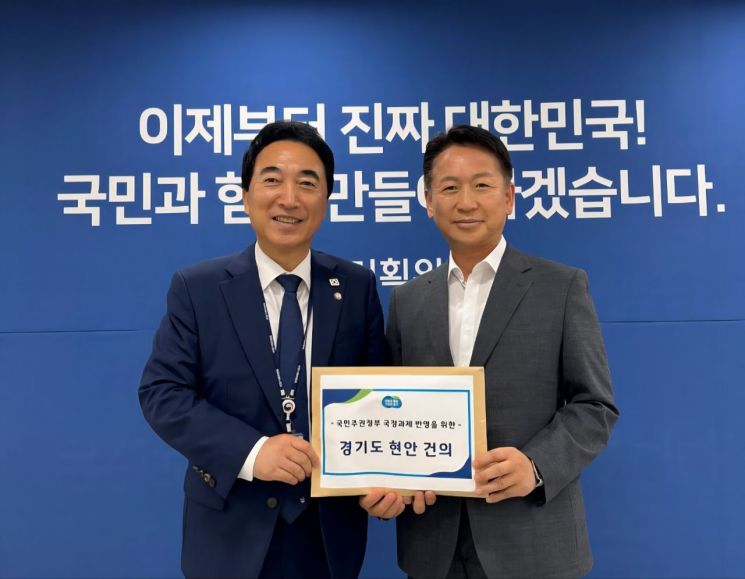 Gyeongin Ko, Vice Governor of Gyeonggi Province for Economy (right), is taking a commemorative photo after delivering national policy tasks to Suhyun Park, Chairman of the Presidential Committee on Balanced National Development, on the 3rd. Provided by Gyeonggi Province
Gyeonggi Province also included in its "citizen-centered policies" ten key issues across five topics in which the province is taking the lead: elderly care systems, state responsibility for caregiving, reduction of working hours, youth opportunities, and climate welfare.
To reduce working hours, Gyeonggi Province has been conducting a pilot project for a 4.5-day workweek with 68 companies in the province since June. As a microcosm and testbed of the Korean economy and labor market, the province plans to share the results of this policy experiment to ensure the successful implementation of the new administration's pledges. It also requested national funding support for the nationwide expansion and institutionalization of the 4.5-day workweek.
Additionally, the province proposed measures for regional development and balanced growth, including the expansion of the railway network, the creation of startup and job infrastructure, the large-scale development plan for northern Gyeonggi, and the establishment of an integrated GTX network.
Along with these, the province also proposed improvements to laws and regulations, such as the sharing of labor inspection authority with local governments.
Meanwhile, the Gyeonggi Province policy proposals were also mentioned during President Lee Jaemyung's press conference marking his 30th day in office, held on the same day. President Lee stated that the government would spare no investment in cutting-edge technology industries such as AI and semiconductors, as well as renewable energy-related industries, and expressed his intention to gradually implement the 4.5-day workweek through social dialogue.
© The Asia Business Daily(www.asiae.co.kr). All rights reserved.

![Clutching a Stolen Dior Bag, Saying "I Hate Being Poor but Real"... The Grotesque Con of a "Human Knockoff" [Slate]](https://cwcontent.asiae.co.kr/asiaresize/183/2026021902243444107_1771435474.jpg)















