Korea Real Estate Board Releases Apartment Price Trends for the Fifth Week of June
Gwacheon Up 0.98%, Bundang Surges 1.17%
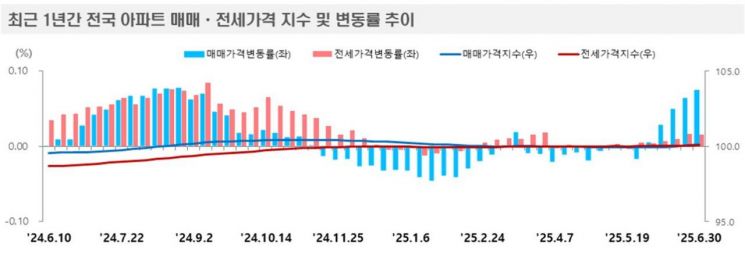
Last week, apartment prices in Seoul continued their upward trend, marking the 22nd consecutive week of increases since February of this year. However, the pace of the rise has somewhat moderated. With the government's lending restrictions leading to a more wait-and-see attitude among buyers, there is growing interest in how housing prices will move in the future.
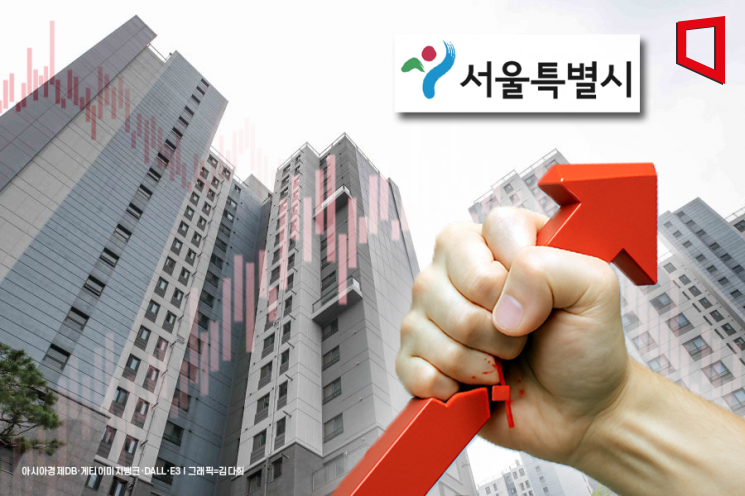
According to weekly apartment price trend data for the fifth week of June (as of June 30) released by the Korea Real Estate Board on July 3, apartment sale prices in Seoul rose by 0.40% compared to the previous week. This is slightly lower than last week's increase of 0.43%. The Korea Real Estate Board explained, "While prices are rising mainly in reconstruction complexes and major developments, the overall increase in Seoul has slightly narrowed as inquiries from buyers in preferred areas have declined."
The upward trend in apartment prices, which had slowed somewhat after the Seoul Metropolitan Government broadly re-designated land transaction permit zones in March this year, picked up sharply in May, with weekly increases accelerating for nearly two months. The anticipation of the third phase of the Debt Service Ratio (DSR) regulation led to a rush of buyers, pushing up housing prices. The government also judged that the situation in Seoul's housing market was concerning and, on June 27, introduced lending restrictions, such as capping mortgage loans at 600 million won.
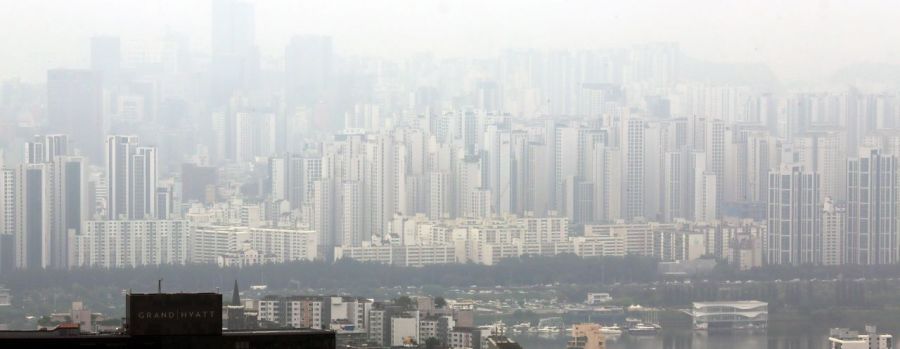 A view of apartment complexes in downtown Seoul from Namsan, Seoul. 2025.06.27 Photo by Dongjoo Yoon
While Seoul's rise moderated, Gyeonggi Province saw prices increase by 0.09%, a larger gain than the previous week's 0.05%. Gwacheon rose by 0.98% compared to the previous week, more than doubling its rate of increase over the same period. Bundang recorded the highest increase among major areas, rising by 1.17% from the previous week. This level of increase is the highest in about seven years and five months, since late January 2018.
If apartment prices rise this much in a single week, it would translate to an annual increase of around 60%. The rise is interpreted as a spillover effect, with buyers moving to adjacent areas after finding it difficult to purchase in preferred districts such as Gangnam, Yongsan, Mapo, and Seongdong in Seoul, amid expectations for redevelopment projects. On this day, a joint inspection team led by the Ministry of Land, Infrastructure and Transport decided to expand on-site inspections, previously focused on the three Gangnam districts and some areas in Seoul, to cover the entire city as well as Gwacheon and Bundang.
Although the apartment sales trends announced today are based on data as of June 30, the industry believes they were not directly affected by the government's lending restrictions announced earlier. This is because the measures, announced on the 27th, were implemented immediately, but the weekend made transactions less active. However, since the lending restrictions are extensive, experts predict that transaction volumes are likely to decrease for the time being.
Park Wongap, chief real estate expert at KB Kookmin Bank, said, "In the case of the December 16 measures announced in 2019 during the Moon Jae-in administration, the market remained in a wait-and-see mode for five to six months after implementation. This time as well, there is a high possibility that the market will enter a 'breather phase' with reduced transactions for the time being, but whether prices will fall remains to be seen."
While the upward trend in apartment prices continues in the Seoul metropolitan area, the decline in provincial areas is steady. Apartment prices outside the metropolitan area fell by 0.02% compared to the previous week. Jeonnam, Gyeongbuk, Gwangju, Daegu, and Jeju all saw decreases from the previous week. Out of 178 surveyed areas, prices rose in 82, an increase of more than 10 areas compared to the previous week.
For apartment rental prices, Seoul saw a 0.07% increase, with the pace of growth slightly lower than the previous week. Incheon, which had been stable, fell by 0.01% over the same period, while Gyeonggi Province rose by 0.05%.
© The Asia Business Daily(www.asiae.co.kr). All rights reserved.
![Clutching a Stolen Dior Bag, Saying "I Hate Being Poor but Real"... The Grotesque Con of a "Human Knockoff" [Slate]](https://cwcontent.asiae.co.kr/asiaresize/183/2026021902243444107_1771435474.jpg)













