Amendment to the Commercial Act Becomes the First Bipartisan Bill Under the Lee Administration
Concerns Over Breach of Trust and Other Side Effects Expected to Be Discussed Later
Following the inauguration of the Lee Jaemyung administration, the first bipartisan cooperative bill?the amendment to the Commercial Act?has passed the National Assembly Legislation and Judiciary Committee. Since both the People Power Party and the Democratic Party of Korea have each made concessions, it is expected that the bill will also be smoothly passed during the plenary session of the National Assembly scheduled for the afternoon.
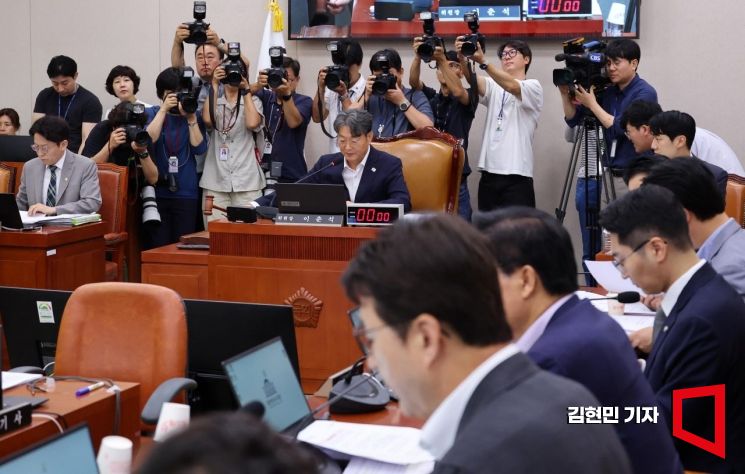 Lee Chunseok, chairman of the National Assembly Legislation and Judiciary Committee, is striking the gavel at the plenary meeting of the Legislation and Judiciary Committee held at the National Assembly on July 3, 2025. Photo by Kim Hyunmin
On the morning of July 3, the Legislation and Judiciary Committee held a plenary meeting and passed the amendment to the Commercial Act. The amendment includes the following: codification of directors' duty of loyalty to shareholders; introduction of electronic general meetings of shareholders; and the so-called 3% rule, which limits the combined voting rights of major shareholders and their related parties to 3% when electing independent audit committee members.
This amendment to the Commercial Act was prepared through consultations between the ruling and opposition parties. The People Power Party, which had previously opposed the amendment, adopted a more forward-looking stance, accelerating the discussions. The Democratic Party of Korea also agreed to hold public hearings for further discussion on certain items included in its re-submitted party proposal, specifically the introduction of cumulative voting for the election of directors at large listed companies, and the expansion of the number of separately elected audit committee members.
Kim Byungki, acting party leader and floor leader of the Democratic Party of Korea, stated at the policy coordination meeting on July 3, "Today marks a historic day as we take the first step into the KOSPI 5000 era," adding, "We will ensure that the amendment to the Commercial Act is processed at the plenary session."
Song Eonseok, interim leader and floor leader of the People Power Party, also said at the emergency countermeasures committee meeting that day, "The government should focus its state affairs on unity and people's livelihoods domestically, and on national interest and trust on the international stage," adding, "The opposition party will also cooperate as much as possible on matters where cooperation is feasible, just as with the amendment to the Commercial Act."
As companies are expressing concerns about potential application of the crime of breach of trust once the bill is enacted, measures to mitigate this are expected to be discussed at a later date. The proposal submitted by Kim Seongwon, a People Power Party lawmaker, at the subcommittee meeting the previous day, included the abolition of the special breach of trust crime under the Commercial Act, emphasizing the need to ease such criminal liability. On the same day, Ko Dongjin, another lawmaker from the same party, proposed an amendment to the Commercial Act to explicitly include judicial precedents on the business judgment rule.
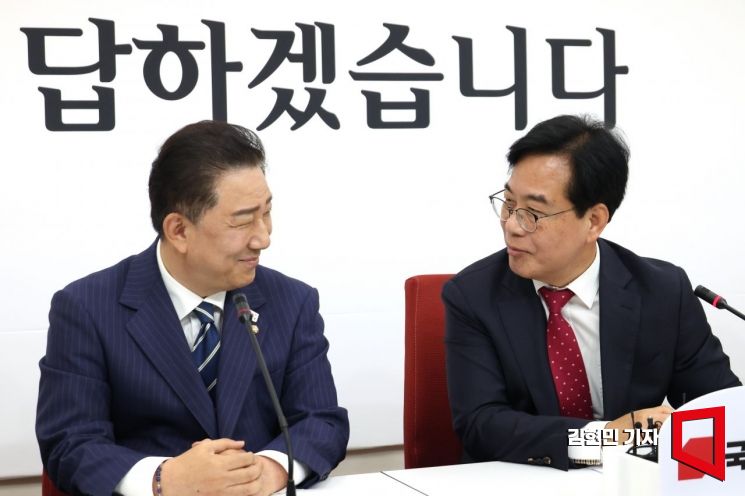 Song Eonseok, floor leader of the People Power Party, is greeting Kim Byungki, acting party leader and floor leader of the Democratic Party of Korea, during a meeting at the National Assembly on June 17, 2025. Photo by Kim Hyunmin
Jang Donghyeok, a People Power Party lawmaker and opposition secretary of the committee, stated at the plenary meeting, "The business community is concerned about how the law codifying directors' duty of loyalty to shareholders will operate," adding, "Regarding the duty of loyalty, I believe the Ministry of Justice must review any side effects of this law six months after its enforcement and report the findings to the Legislation and Judiciary Committee." The Democratic Party of Korea also stated that it would gather opinions from the business sector and reflect them in policy and legislation, leaving open the possibility for supplementary legislation.
The amendment to the Commercial Act, having passed the Legislation and Judiciary Committee, is expected to be passed without any obstacles during the plenary session scheduled for the afternoon. Jin Sungjoon, chair of the Democratic Party of Korea's policy committee, appeared on the YouTube program "Kim Eo-jun's Humility Is Hard News Factory," stating, "The bill is expected to pass at the plenary session," and, "Once passed, it will be promulgated immediately." The confirmation motion for Kim Minseok, the nominee for Prime Minister, is also expected to be approved.
Meanwhile, starting July 10, each standing committee of the National Assembly will conduct confirmation hearings for the ministers of the respective ministries. President Lee Jaemyung submitted requests for confirmation hearings for ministerial nominees?including those for the Ministry of National Defense, Ministry of Foreign Affairs, Ministry of Science and ICT, Ministry of Environment, Ministry of Patriots and Veterans Affairs on June 27, and the Commissioner of the National Tax Service on July 2. The specific schedules for the confirmation hearings will be determined through agreement between the ruling and opposition party secretaries of each standing committee.
© The Asia Business Daily(www.asiae.co.kr). All rights reserved.












