European Commission Unveils Draft Climate Law for 90% Greenhouse Gas Cut
Burden Eased Through "Carbon Credits" from Investments in Developing Countries
Criticism Raised: "A Step Back for Europe's Decarbonization Efforts"
Since the end of June, countries across Europe have been suffering from a heatwave with temperatures hovering around 40 degrees Celsius, while a debate is raging over the European Union (EU)'s newly announced climate goals. Critics argue that the measures are actually a step back compared to previous proposals.
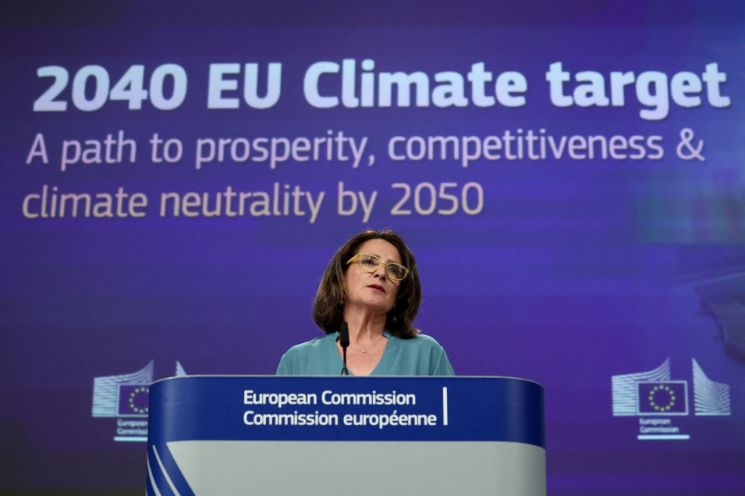 The European Commission held a press conference on the EU climate goals for 2040 on the 2nd in Brussels, Belgium. Photo by Reuters Yonhap News
According to Yonhap News on July 2 (local time), "The European Commission, which serves as the EU's executive body, has released a draft amendment to the climate law that would legally mandate a 90% reduction in greenhouse gas emissions by 2040 compared to 1990 levels." The 2040 target is intended as a stepping stone toward achieving carbon neutrality by 2050, and comes about a year after the EU advisory panel's recommendations, with detailed implementation plans now in place.
The new proposal maintains the existing target of a 90% reduction in greenhouse gases, as previously recommended, but its core is to grant flexibility and discretion to individual member states. The Commission emphasized that the draft released on this day demonstrates its "commitment to maintaining existing climate goals."
In particular, starting in 2036, member states will be allowed to offset up to 3% of their reduction targets using so-called "carbon credits" obtained by investing in environmental projects in third countries. This means that funding activities such as tree planting or renewable energy projects in developing countries will be partially recognized as domestic reductions. Previously, climate targets could only be achieved through efforts within the EU.
This reflects the demands of Germany, the EU's largest economy. Wopke Hoekstra, the EU Commissioner for Climate Action, Net Zero, and Clean Growth, argued, "The effect of reducing greenhouse gases is the same regardless of the region," and described the approach as "fair and smart."
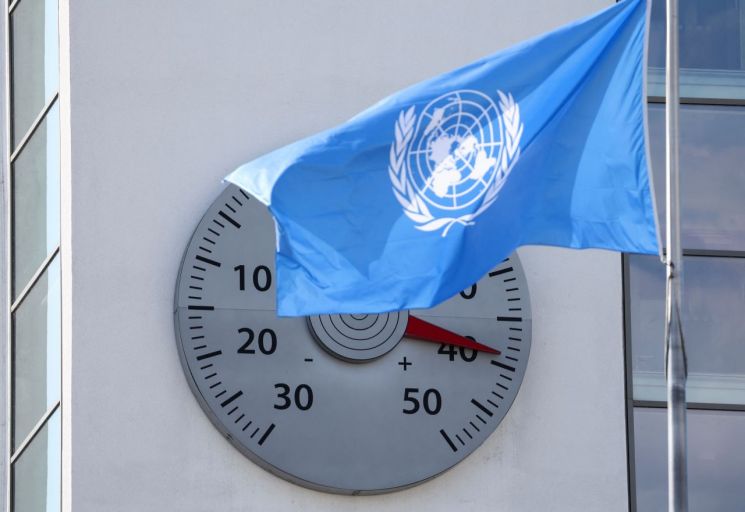 A giant thermometer installed on the wall of the United Nations Framework Convention on Climate Change (UNFCCC) headquarters in the midst of a heatwave across Europe recorded 39 degrees Celsius. Photo by Reuters Yonhap News
However, Bloomberg News pointed out that "there have been past attempts under the Kyoto Protocol to allow developed countries to count local greenhouse gas reductions from projects in developing countries toward their own targets, but these efforts failed due to issues such as lack of effectiveness and reliability."
Experts have also raised criticism. They argue that this is a kind of loophole that could undermine decarbonization efforts within Europe. Neil Makaroff, a researcher at the climate think tank Strategic Perspectives, stated, "Instead of being used for decarbonization within Europe, funds could flow overseas," adding that "whether the EU can establish strict standards for international carbon credits is a key issue."
Meanwhile, it is reported that many countries oppose maintaining the 90% reduction target in the current proposal. Italy has argued that a target of 80-85% is more realistic, while France, the Czech Republic, and others have insisted that more time is needed for discussion. For the draft to be finalized, it must be approved separately by both the Council, representing the 27 EU member states, and the European Parliament after negotiations between the two. The Commission had aimed to complete the legislative process before the UN Framework Convention on Climate Change Conference of the Parties (COP30) in November, but there are predictions that this will be difficult to achieve.
© The Asia Business Daily(www.asiae.co.kr). All rights reserved.


















