Chicken Wholesale Prices Drop 15%,
But Samgyetang and Fried Chicken Prices Keep Rising
Some Places Sell Over 100,000 Chickens a Week
As demand for summer health foods picks up, prices for samgyetang and fried chicken are soaring. In Seoul, a bowl of samgyetang is approaching 20,000 won, while delivery fried chicken is nearing 30,000 won. Meanwhile, the wholesale price of chicken has been on the decline, widening the gap between restaurant prices and raw material costs. In response, major supermarkets have reintroduced ultra-low-priced chicken to attract consumers.
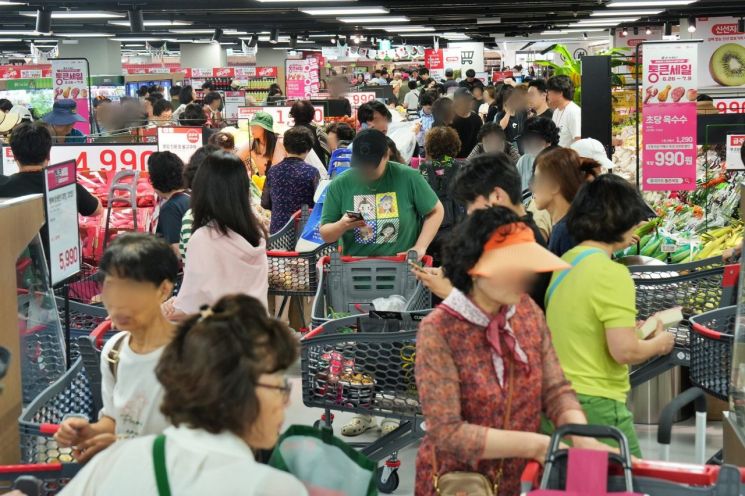 Storefront view of Lotte Mart Grand Grocery Guri branch conducting a "Big Sale."
 Photo by Lotte Mart
Samgyetang and Fried Chicken Prices Soar... Wholesale Chicken Prices Drop 15%
According to "Chamka Price," the price information portal of the Korea Consumer Agency, the average price of samgyetang at restaurants in Seoul as of May was 17,654 won. This represents a 4.6% increase (769 won) compared to the same month last year (16,885 won). The price of samgyetang in Seoul has continued to rise since it surpassed an average of 15,000 won in July 2022. Some well-known specialty restaurants are already selling a single bowl for over 20,000 won. Places such as Tosokchon, Nonhyeon Samgyetang, and Goryeo Samgyetang offer basic samgyetang at 20,000 won.
Franchise fried chicken prices are also high. BHC’s popular menu item "Bburinkle" is priced at 21,000 won, Kyochon Chicken’s "Honey Combo" at 23,000 won, and BBQ’s "Mara Hot Chicken" at 28,000 won. When adding delivery fees (1,000?2,000 won), the actual purchase price approaches 30,000 won.
The price of broiler chicken, the main raw ingredient, has remained relatively stable. According to the Livestock Distribution Information from the Korea Institute for Animal Products Quality Evaluation, as of July 1, the average retail price per kilogram of chicken was 5,764 won, down 5.1% from the same period last year (6,073 won). The wholesale price shows a similar trend. During the same period, the average transaction price for chicken delivered from slaughterhouses to large retailers was 3,966 won per kilogram, a 15.5% decrease from the average price in the same month last year (4,694 won).
Despite the drop in chicken production costs, restaurant prices have not fallen. This is because the decline in the farm price of live chickens is not reflected in the distribution process, while high inflation has rapidly driven up additional costs such as labor, rent, and other ingredients. According to Statistics Korea, the price index for dining out rose from 2.9% in January to 3.0% in February, and has remained in the 3% range for five consecutive months as of last month.
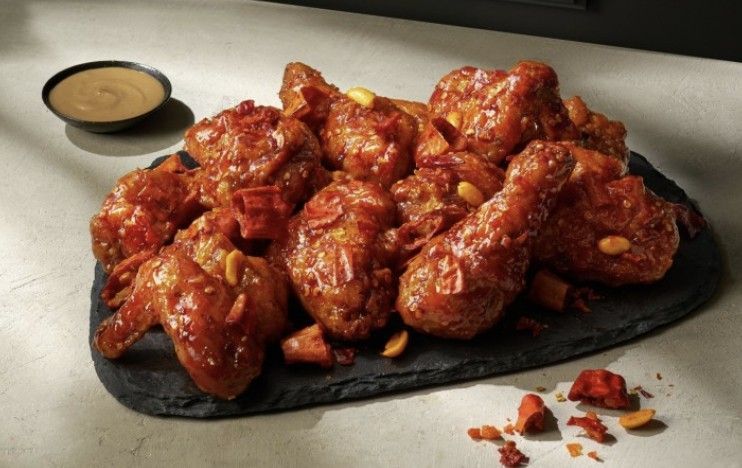
Major Supermarkets Counter with "3,000-Won Chicken"
As dining-out costs rise, major supermarkets have ignited a "chicken price war." Lotte Mart offered its "Tongkeun Chicken (5,000 won)" from June 26 to 30. The daily supply of 15,000 chickens sold out every morning, and cumulative sales for the week exceeded 100,000 chickens. During the sale period, Lotte Mart’s total sales increased by 15% compared to the same period last year. From July 4 to 6, Emart is selling its "Amazing Perfect Chicken" for 3,480 won per chicken as part of its "Goraeit Festa Cool Summer Sale." Homeplus is also celebrating the third anniversary of its "Dangdang Chicken" by offering the "Dangdang 3990 Old-Fashioned Whole Chicken" for 3,990 won from July 3 to 6.
The ultra-low-price marketing strategy by major supermarkets began in the early 2010s and became a representative promotional tool in the industry for some time. The price war, especially for daily food items like chicken, continued until 2015, subsided during the COVID-19 pandemic, and has recently resurfaced.
Supermarkets are once again using ultra-low-price marketing for flagship products like chicken to cope with three major challenges: high inflation, sluggish domestic demand, and the expansion of the e-commerce market. As inflation persists, consumers’ perceived prices have reached a threshold, and price sensitivity has increased further. The rapid growth of online platforms such as Coupang has weakened the position of offline retailers. In response, supermarkets are putting products with high consumer visibility at the forefront to attract foot traffic, while strengthening strategies to increase the average transaction value through related purchases.
© The Asia Business Daily(www.asiae.co.kr). All rights reserved.

![Clutching a Stolen Dior Bag, Saying "I Hate Being Poor but Real"... The Grotesque Con of a "Human Knockoff" [Slate]](https://cwcontent.asiae.co.kr/asiaresize/183/2026021902243444107_1771435474.jpg)
















