Battery Insight Conference 2025 Held on July 2
Domestic Battery Material Companies Seek Strategies
Ecopro, SKIET, POSCO, and Others Participate
The Korean battery materials industry is being put to the test amid rapidly changing global competition. The industry is facing challenges not only from technological competition surrounding core materials such as cathodes, anodes, and separators, but also from the need to develop strategies for entering the US market and the necessity of government support for the industry. Industry insiders and experts are seeking survival strategies through technological differentiation, restructuring of the value chain, and public-private cooperation.
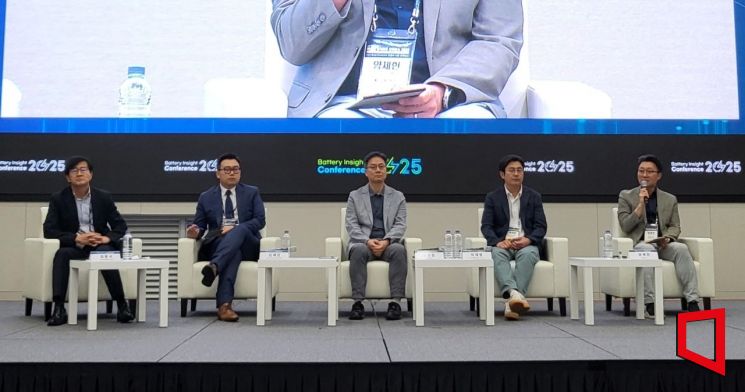 At the 'Battery Insight Conference 2025' held on the 2nd at Osco in Cheongju, Chungbuk, representatives from domestic battery material companies attended to highlight the challenging domestic and international environments and to explore strategies to break through the global market. From the left in the photo: Jongseo Choi, Executive Director of the Korea Battery Industry Association; Jaecheon Kim, Accountant at Afrio Advisory Group; Junhyung Kim, Vice President of SK Innovation (SKIET); Jaebeom Park, Senior Researcher at POSCO Research Institute; Jehun Yang, Director of Ecopro. Photo by Seonga Shim
At the 'Battery Insight Conference 2025' held on July 2 at Osco in Cheongju, Chungbuk, representatives from domestic battery material companies attended to highlight the challenging domestic and international environments and to explore strategies to break through the global market.
Jehun Yang, Director of Ecopro; Jaebeom Park, Senior Researcher at POSCO Research Institute; Junhyung Kim, Vice President of SK IE Technology (SKIET); and Jaecheon Kim, Accountant at Afrio Advisory Group, participated in the event. They gave presentations and engaged in discussions on topics such as the development of material technologies for cathodes, anodes, and separators?which are key to battery performance?and corporate strategies for entering the US market.
First, Jehun Yang, Director of Ecopro, expressed confidence by saying, "The NCM (nickel-cobalt-manganese) batteries in which Korea has excelled will continue to evolve," and added, "We will continue to lead in this technology." Yang introduced Ecopro's diverse NCM battery portfolio, including high-nickel and mid-nickel products, and explained, "Concerns about thermal safety raised by customers and consumers are being addressed through the combined efforts of materials, cells, packs, and systems."
Ecopro is overcoming thermal propagation in NCM batteries with technologies such as electrolyte and cathode decomposition suppression, side cooling tubes, and immersion cooling. At the same time, the company is also focusing on developing low-cost materials such as lithium iron phosphate (LFP) and sodium-ion batteries (SIB). Yang stated, "Ecopro BM is currently operating a pilot line with a capacity of 3,000 tons and is solving several process issues," adding, "It is not yet at a scale where we can secure orders, and I believe that at least a 20,000-ton line is needed to obtain substantial orders."
He continued, "For domestic battery companies to gain an advantage over China in the LFP market, they must develop third- or fourth-generation LFP batteries that are profitable, and they need to establish a value chain that allows for the affordable procurement of phosphor and phosphate, which are controlled by China." He pointed out, "It is difficult to compete solely on price." Yang emphasized, "We will differentiate from China with the 'no-sintering sphere process,' and bold investments are required to produce fourth-generation or higher LFP batteries in an environmentally friendly way."
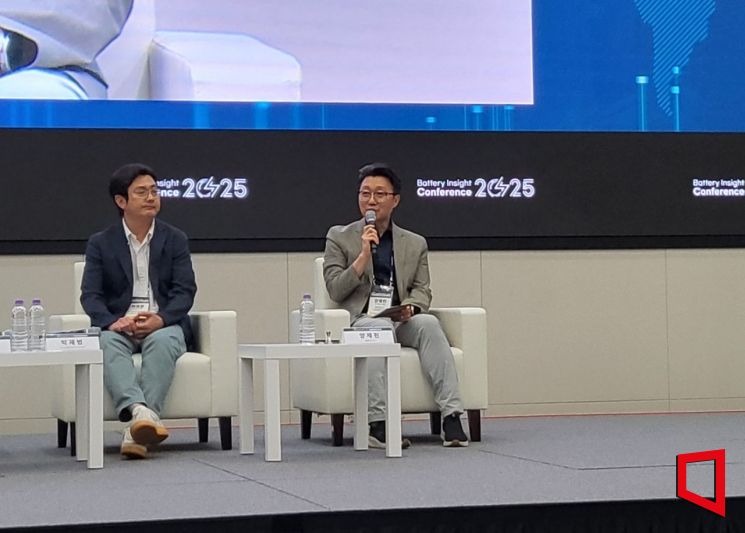
Jaebeom Park, Senior Researcher, reviewed the current state of the secondary battery materials industry and explained the need for government support policies. Park stated, "Sixty-seven percent of the world's graphite is mined in China, and in reality, almost all anode materials are produced in China. China has a relative advantage because it is less constrained by environmental and safety regulations, resulting in lower labor costs, electricity rates, and processing expenses compared to other countries."
He also pointed out, "All four leading domestic companies?Ecopro BM, POSCO Future M, SKIET, and Enchem?shifted to operating losses last year, and the outlook for this year is not positive." He proposed several policies to the government, including: the introduction of a direct refund system and third-party transfers; support for production subsidies; expanded infrastructure support within secondary battery industrial complexes; increased support for overseas resource development investments by private companies; activation of supply chain stabilization funds; and support for joint R&D among domestic companies.
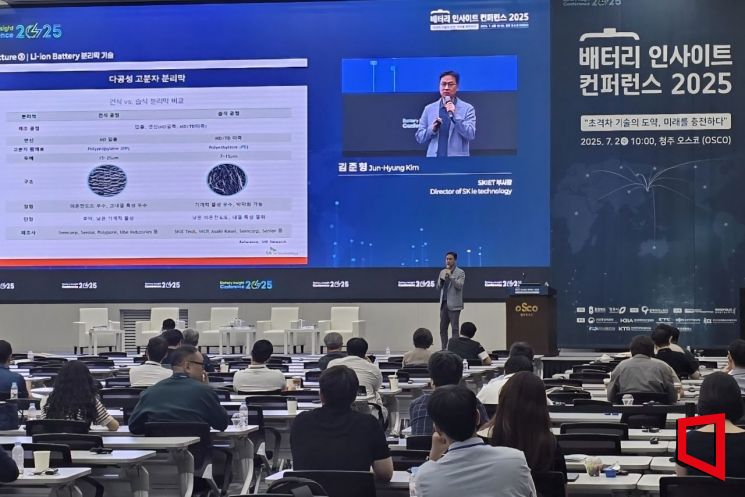
Vice President Junhyung Kim gave a presentation on the characteristics of separators being developed at SKIET and the future of separator technology. SKIET is focusing on separator technology development to ensure both functionality and safety.
Kim introduced the 'high-temperature molten fracture inorganic-coated separator,' which won an award at the world's largest electronics and IT exhibition, CES, and explained, "Previously, 170 degrees Celsius was the limit, but now the separator can withstand up to 300 degrees, improving high-temperature stability." He added, "There was also a demand for improved electrical insulation, and even though the separator is thin, a product with excellent electrical insulation has been developed and commercialized," highlighting SKIET's 'safety separator.'
Kim predicted, "In the future, separators will become 'functional smart separators' that go beyond simple separation functions," and added, "There will be additional requirements, such as monitoring to prevent lithium penetration and overcharging."
Accountant Jaecheon Kim commented, "The United States absolutely does not want China to surpass it," and noted, "Recently, the US has been focusing on manufacturing-related infrastructure to keep China in check." He continued, "As Chinese companies are rapidly catching up with the technology of domestic battery firms, technological cooperation between Korea and the US, leveraging US capital, is emerging as a key task in the US market."
Meanwhile, this conference was held for the second time following last year. It was hosted by Chungcheongbuk-do and Cheongju City and organized by Chungbuk Technopark. The event was a success, with about 500 participants from companies, universities, and research institutes in attendance.
© The Asia Business Daily(www.asiae.co.kr). All rights reserved.














