Korea Institute for Health and Social Affairs Calculates Regional Population Diversity Index
Diversity Index Drops by 9.49% in Sejong... Seoul Down by 0.92%
Wongok-dong in Danwon-gu, Ansan-si Records Highest Diversity Index in the Country
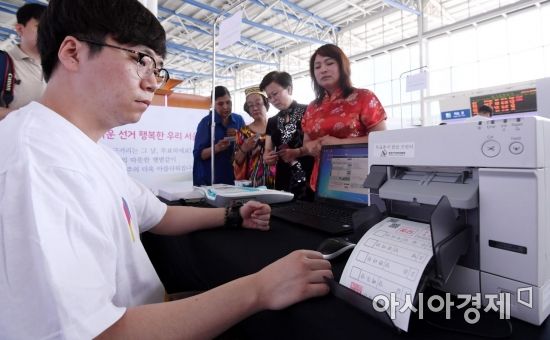 Multicultural family voters are experiencing voting at the Election Information Center opened at Seoul Station. Photo by Asia Economy DB
A study has found that population diversity in South Korea, including race, religion, and culture, has expanded by about 8% over the past five years.
According to the Korea Institute for Health and Social Affairs' research report "Calculation and Utilization of Regional Population Diversity Index" released on July 2, the national population diversity index rose from 0.0527 in 2018 to 0.0568 over five years, an increase of 7.79%.
According to the researchers, the population diversity index is a concept that indicates where the population of a region or group lies on a continuum from "complete homogeneity (0)" to "complete heterogeneity (1)." This index is used to systematically measure population diversity in areas where religion, race, and culture are intermingled.
The researchers used administrative data, such as the population census from 2018 to 2022, to calculate the degree of diversity using the "Blau Index," which measures heterogeneity within a group. In the Blau Index, the closer the value is to 1, the more evenly distributed the populations of various groups are.
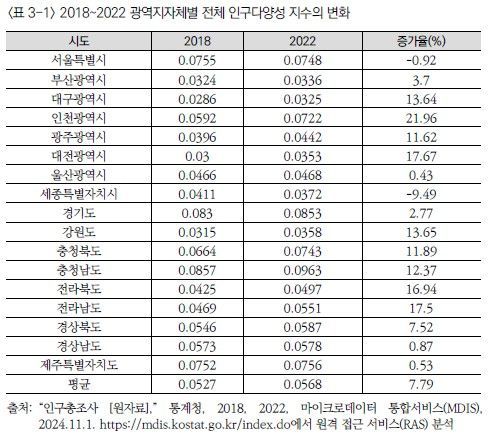 Changes in the overall population diversity index by metropolitan local governments. Provided by the Korea Institute for Health and Social Affairs
By region, Incheon’s population diversity index surged by 21.96%, from 0.0592 to 0.0722 during this period. Daejeon (17.67%), Jeonnam (17.5%), Jeonbuk (16.94%), Gangwon (13.65%), and Daegu (13.64%) also recorded increases of over 10%.
On the other hand, Sejong saw its diversity index decrease by 9.49%, and Seoul's index fell by 0.92%. At the township and neighborhood level, in 2022, Wongok-dong in Danwon-gu, Ansan-si had the highest population diversity index in the country, reaching 0.735. The top five areas were all in Gyeonggi-do: Daegot-myeon in Gimpo-si (0.688), Seonbu 2-dong in Danwon-gu (0.673), Jeongwang 1-dong in Siheung-si (0.665), and Yanggam-myeon in Hwaseong-si (0.653).
In Seoul, Daerim 2-dong in Yeongdeungpo-gu had the highest population diversity index at 0.650.
Due to factors such as low birth rates and immigration policies, the population diversity index for children aged six and under also increased. The index for young children jumped by about 45%, from 0.0419 in 2018 to 0.0609 in 2022.
The researchers explained, "In both 2018 and 2022, the highest indices were found in the southwestern part of Gyeonggi-do, Gimpo, Pocheon, and the southwestern area of Seoul," adding, "In particular, it can be confirmed that foreign workers and marriage immigrants are concentrated in industrial complexes and rural areas."
© The Asia Business Daily(www.asiae.co.kr). All rights reserved.

![Clutching a Stolen Dior Bag, Saying "I Hate Being Poor but Real"... The Grotesque Con of a "Human Knockoff" [Slate]](https://cwcontent.asiae.co.kr/asiaresize/183/2026021902243444107_1771435474.jpg)















