ECB Central Bank Forum Policy Discussion Session on the 1st (Local Time)
Lee Changyong: "Soaring Housing Prices in the Seoul Metropolitan Area, Increasing Financial Stability Risks"
Recent Appreciation of the Won Is a Normalization Following Excessive Depreciation
Tariffs Cause Deflation... Global Fragmentation Will Have a Serious Impact on the Korean Economy
Fundamental Structural Reform Needed Rather Than Monetary or Fiscal Stimulus in a Low-Growth Environment
At a recent meeting with the heads of major central banks, Lee Changyong, Governor of the Bank of Korea, expressed concerns regarding the introduction of a won-based stablecoin. He emphasized that, given the risks of capital outflows and the potential for regulatory arbitrage, thorough discussions with the government are necessary prior to any introduction. Jerome Powell, Chair of the U.S. Federal Reserve, and Christine Lagarde, President of the European Central Bank, echoed Lee's concerns and stressed the need for a regulatory framework to protect money as a public good.
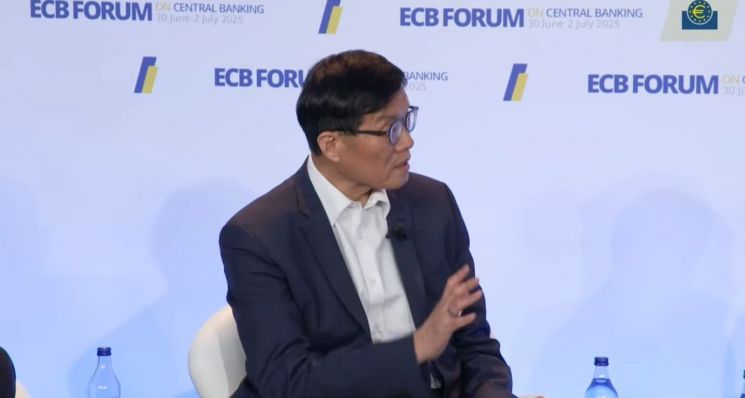 Lee Changyong, Governor of the Bank of Korea, is speaking as a panelist at the policy discussion session of the ECB Central Bank Forum held in Sintra, Portugal, on the 1st (local time). Screenshot from ECB YouTube live broadcast
"Money Is a Public Good" ? Stablecoins Must Have a Regulatory Framework... Central Bank Governors Speak With One Voice
Governor Lee participated as a panelist in the "policy discussion" session of the ECB Central Bank Forum (Sintra Forum) held on the 1st (local time) in Sintra, Portugal. He stated, "My biggest concern is that if unregulated won-based stablecoins are allowed, demand for exchanging them into dollar-based stablecoins will be stimulated, which could lead to capital outflows and a weakening of capital flow management regulations." He added, "Some argue that blockchain technology can sufficiently identify illegal transactions and perform customer verification (KYC), but I am not convinced. In addition, issues such as compliance and potential conflicts with banks must be resolved before introduction."
Governor Lee also stressed that issues such as allowing non-bank institutions to issue stablecoins must be addressed with the government before any introduction. He said, "With the passage of the 'Genius Act' in the United States, many fintech (finance + technology) companies and stablecoin supporters are requesting that the Korean government allow non-bank institutions to issue won-based stablecoins. While we have been experimenting with tokenized deposits within permitted networks alongside private commercial banks, whether to allow non-bank institutions to issue won-based stablecoins in the public sector is beyond the Bank of Korea's authority and requires consultation with government ministries."
Other panelists agreed with Governor Lee. Chair Powell stated, "A regulatory framework at both the federal and state levels is absolutely necessary," adding, "The United States is making progress in establishing that framework." President Lagarde expressed concern, saying, "We are currently in a state of confusion, mixing the concepts of money, payment instruments, and payment infrastructure. If these boundaries collapse, we will lose our ability to implement monetary policy, and the nation's monetary sovereignty could be threatened." She continued, "Money is a public good, and central banks have a responsibility to protect this public good," adding, "A clear policy stance must be established."
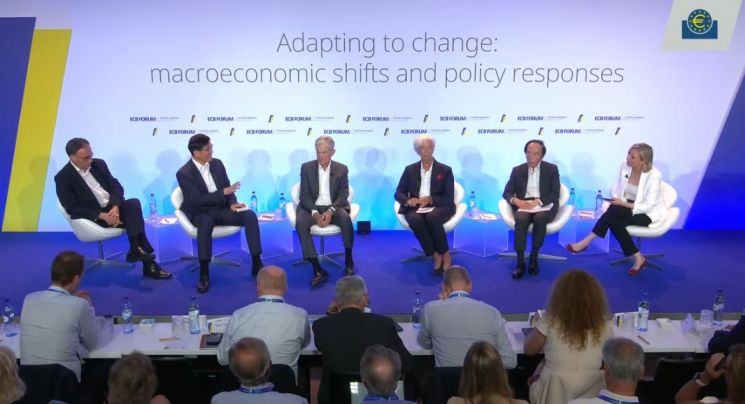 (From left) Andrew Bailey, Governor of the Bank of England; Lee Changyong, Governor of the Bank of Korea; Jerome Powell, Chair of the U.S. Federal Reserve; Christine Lagarde, President of the European Central Bank; and Ueda Kazuo, Governor of the Bank of Japan, are attending as panelists and exchanging views at the policy discussion session of the ECB Central Bank Forum held on the 1st (local time) in Sintra, Portugal. Screenshot from ECB YouTube live broadcast
"Soaring Housing Prices in the Seoul Metropolitan Area, Increasing Financial Stability Risks... Recent Appreciation of the Won Is a Normalization Process"
Meanwhile, the upcoming decision on the base interest rate by the Bank of Korea's Monetary Policy Board, scheduled for the 10th, is widely expected to result in a rate freeze. This comes as Governor Lee has once again pointed out that the recent surge in housing prices in the Seoul metropolitan area is increasing financial stability risks. He stated, "Since October last year, Korea has cut its base interest rate by 1.0 percentage point (100bp; 1bp = 0.01 percentage point). Given the current growth rate, this easing trend is expected to continue," but also said, "When determining the timing and pace of further rate cuts, we will closely monitor financial stability risks."
Regarding recent exchange rate trends, Lee described it as a 'normalization phase for the value of the won.' Although the won has appreciated sharply over the past two months, this is a normalization process following a significant depreciation of the won relative to fundamentals, which was caused by the unexpected 12·3 martial law incident in December last year and subsequent political risks, combined with a slowdown in the Korean economy. The recent global weak-dollar trend is also seen not as a paradigm shift in the status of the dollar, but rather as a process in which market participants are increasing their hedge ratios.
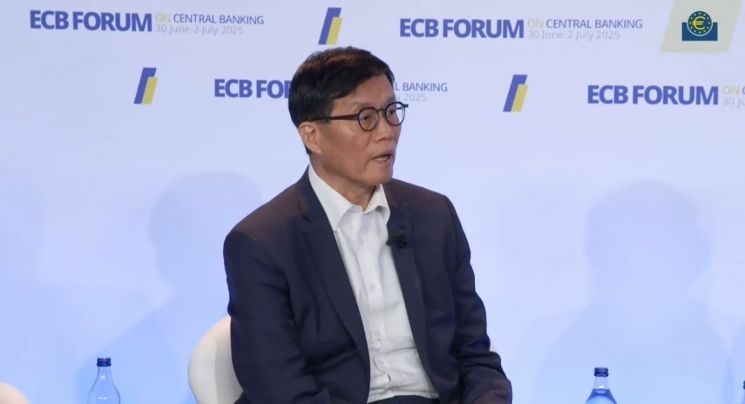 Lee Changyong, Governor of the Bank of Korea, is speaking as a panelist at the policy discussion session of the ECB Central Bank Forum held in Sintra, Portugal, on the 1st (local time). Screenshot from ECB YouTube live broadcast
Tariffs Cause Deflation... Global Fragmentation Will Have Serious Impact on Korea's Export Economy
When asked whether the central bank has countermeasures for the impact of tariffs in Korea, which has a high dependence on trade, Lee replied, "The issue we face is not inflation, but growth impeded by tariffs." He explained, "Currently, Korea's inflation rate is stable at around 2%. We see tariffs as causing deflation (a decline in prices) rather than inflation." This is due to several factors: the low likelihood of Korea imposing retaliatory tariffs, the fact that export prices from China?Korea's major trading partner?have been falling by about 5% annually, and the fact that Korea's economic growth rate is far below its potential growth rate, resulting in very low aggregate demand pressure.
Governor Lee stated that global fragmentation will, in one way or another, have a serious impact on Korea's export-driven economy, noting, "There are not only the direct effects of U.S. tariffs, but also indirect effects via China, Mexico, Canada, and others." He explained that Korea's export decline, global trade stagnation, and the U.S. economic slowdown are all interconnected and will have negative effects on the Korean economy.
However, he also noted that Korean companies have long prepared for supply chain diversification, and that Korea possesses strong industries, such as semiconductors, which are benefiting from advances in artificial intelligence (AI) technology. He believes this gives Korea the resilience to withstand such challenges. Governor Lee reiterated that, despite strong demands for economic stimulus through monetary and fiscal policy in this low-growth environment, what is fundamentally needed is structural reform.
The Sintra Forum is an annual event organized by the ECB in Sintra, Portugal, since 2014, where central bank governors from major countries share and discuss global financial and economic issues. The policy discussion is the core session of the Sintra Forum. This year, the panel included Governor Lee, Chair Powell, President Lagarde, Andrew Bailey, Governor of the Bank of England, and Ueda Kazuo, Governor of the Bank of Japan. On this day, Chair Powell received applause from the audience when he responded to ongoing attacks, including pressure to resign from President Donald Trump, by saying, "I am 100% focused on my job."
© The Asia Business Daily(www.asiae.co.kr). All rights reserved.



















