NATO Sets 5% of GDP Defense Spending Target by 2035
Italy Seeks to Meet Goal Through Civil Engineering Projects
"Long-Awaited Project Classified as Security Investment"
As member states of the North Atlantic Treaty Organization (NATO) have set a goal to spend 5% of their gross domestic product (GDP) on defense by 2035, reports have emerged that the Italian government, facing this challenge, plans to classify civil engineering construction projects as defense spending.
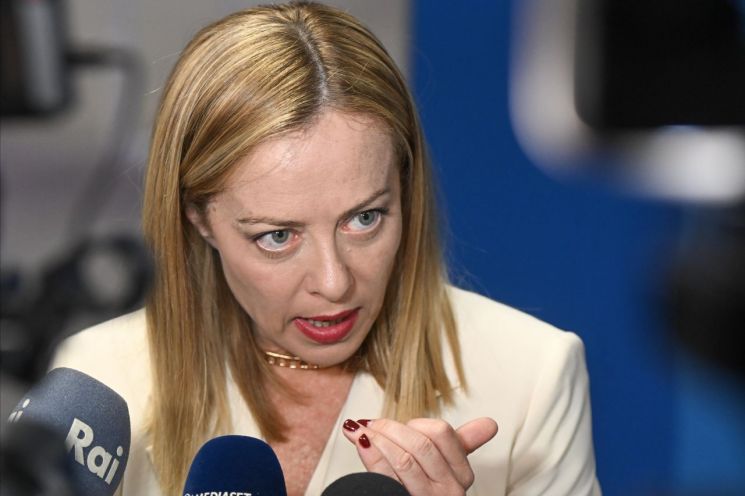 Italian Prime Minister Giorgia Meloni is speaking at the NATO summit held in The Hague, Netherlands, on the 25th of last month (local time). Photo by EPA Yonhap News
According to Yonhap News on July 1 (local time), citing Politico Europe, "Last year, Italy's defense spending amounted to only about 1.5% of its GDP. This was the lowest among the 32 NATO member states, and there have been concerns that it will be difficult for Italy to achieve the recently agreed 5% target." The report added, "As an alternative, the construction of the Messina Bridge has emerged as a solution."
This is essentially a workaround to achieve NATO's defense spending increase target by counting large-scale civil engineering projects as part of the defense budget. The Messina Bridge is a project to build the world's longest suspension bridge across the Strait of Messina, connecting Calabria, in the southwestern "toe" of the Italian peninsula, to the island of Sicily. The total length is 3,666 meters, with a main span of 3,300 meters, making it more than 1.5 times longer than the current world's longest suspension bridge, the Canakkale Bridge in Turkey (2,023 meters). The total budget required amounts to 13.5 billion euros (approximately 21 trillion won).
According to Yonhap News, successive Italian governments have attempted to build the Messina Bridge several times in order to narrow the economic gap between the south and north, but progress has stalled due to excessive construction costs and concerns over stability, as Calabria is an earthquake-prone region. The government now plans to push forward with the project, which has repeatedly been scrapped due to its enormous budget requirements.
Of the 5% GDP spending target set by NATO, 1.5% is recognized as indirect security costs, such as infrastructure protection. The Italian government intends to interpret the Messina Bridge not simply as a transportation infrastructure, but as a "dual-use" facility that can support the strategic movement of NATO forces, and to classify it as an indirect security investment.
A government report in April stated, "The Messina Bridge, while serving civilian purposes, is also strategically important in terms of national and international security, facilitating the movement of Italian and NATO allied forces." The report added, "It will become a key piece of infrastructure for the movement of NATO troops from Northern Europe to the Mediterranean."
Foreign Minister Antonio Tajani emphasized, "Security is not just about tanks; it is a broader concept. Infrastructure such as bridges can also be considered part of security. Sicily is a strategic base for NATO, and the Messina Bridge falls within the concept of defense." Minister of Infrastructure and Transport Matteo Salvini also stated, "Strategic infrastructure can be seen as part of security."
In contrast, Giuseppe Antoci, a member of the European Parliament from the Five Star Movement (M5S), the second-largest opposition party, criticized, "This is a mockery of the public and NATO. I do not believe NATO will accept the bluster of this government. Italy must stop making itself an international laughingstock."
© The Asia Business Daily(www.asiae.co.kr). All rights reserved.
![User Who Sold Erroneously Deposited Bitcoins to Repay Debt and Fund Entertainment... What Did the Supreme Court Decide in 2021? [Legal Issue Check]](https://cwcontent.asiae.co.kr/asiaresize/183/2026020910431234020_1770601391.png)