Discussion on Measures to Revitalize Private Fundraising
Emphasis on Easing CVC Regulations and Legislating BDCs
"To Achieve 3% Potential Growth Rate, Capital Investment Must Increase"
"Barriers Between Industry and Finance Should Be Removed"
There have been calls for a more active role of private financial capital in corporate fundraising, in order to achieve the new administration's economic policy goal of 'genuine growth'.
At the seminar "Measures to Revitalize Private Fundraising in the Era of Global Capital Competition," hosted by the Korea Chamber of Commerce and Industry on July 2, it was pointed out that the current corporate fundraising environment and government finances alone are insufficient to meet the increasing investment demand caused by intensifying competition in advanced industries. Accordingly, there were suggestions that it is necessary to vitalize the private capital market by easing regulations on CVCs (Corporate Venture Capital) and introducing BDCs (Business Development Companies).
Hwang Sewoon, Senior Research Fellow at the Korea Capital Market Institute, who delivered the first presentation, stated, "To achieve the government's target potential growth rate of 3% amid demographic changes, the contribution of capital input to growth must be maintained at a minimum of 1.5%." He added, "This means that an additional capital investment of '75 trillion won plus alpha' compared to the previous year must be made annually to reach this level."
He continued, "Last year, Korea's total capital investment (gross fixed capital formation) amounted to 767.8 trillion won. To enhance the potential growth rate, capital investment needs to be increased by about 7.5 to 8% on average each year." He further explained, "Given the reality of the growing burden of continuous government spending and the surge in new industry investment demand due to advanced industry competition, it is urgent to establish new methodologies to raise such large-scale funds."
Regarding this, Hwang emphasized, "It is necessary to comprehensively review regulations that serve as the link between industry and finance, and to structurally improve the blocked flow of funds by activating market functions." He advocated for strengthening the functions of CVCs. While CVCs have the advantage of supplying capital to innovative companies and supporting mutual growth based on the know-how and business capabilities of parent companies, their activation has been slow due to strict regulations such as limits on external funding (40% of fund formation), overseas investment (20% of total assets), and debt ratio (200%). In fact, last year, 14 companies invested 245.1 billion won, accounting for only 2.2% of the total VC (Venture Capital) investment of 10.9 trillion won, indicating that utilization is still low.
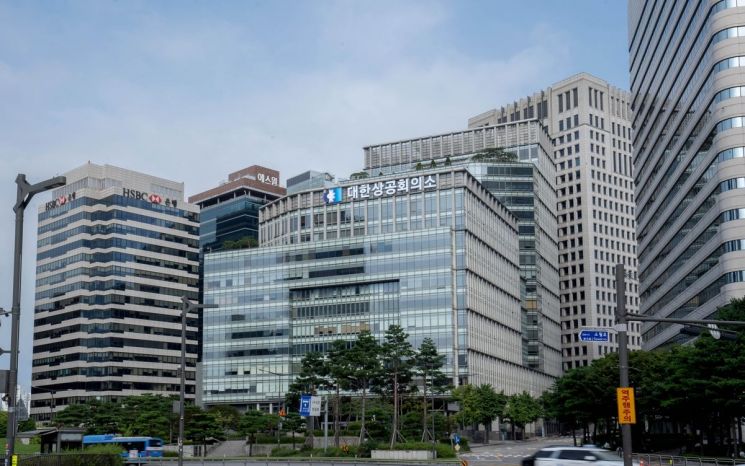 Exterior view of the Korea Chamber of Commerce and Industry building. Korea Chamber of Commerce and Industry.
He also argued that new investment methods should be actively adopted, recommending the prompt legislation of BDCs, which the new administration announced as a presidential campaign pledge. BDCs are listed funds that are required to invest a certain percentage of their assets in unlisted venture companies. If introduced, it is expected that ordinary investors will also be able to invest relatively easily in unlisted companies.
The second presenter, Joo Jinyeol, Professor at Pusan National University, emphasized, "Now is the time to expand mutual investment between industry and finance for corporate survival amid ultra-large-scale capital fundraising competition."
Professor Joo pointed out, "Building a single semiconductor plant requires an investment of 10 to 20 trillion won, and Google is investing 7 to 21 trillion won in constructing seven SMRs. We have entered an era where the scale and intensity of private investment competition are intensifying day by day." He added, "In contrast, in Korea, where there are not even government subsidies, excessive regulations are holding back the growth of advanced industries, placing us at a disadvantage in global competition."
He also stated, "Currently, the regulatory wall between industry and finance for holding companies is being applied not only to banks with deposit functions but to all financial businesses, which is a significant problem." He proposed allowing general holding companies to own asset management companies (collective investment businesses) with low systemic risk.
In addition, for financial holding companies, he suggested easing the 5-15% ownership restriction on non-financial companies. He also recommended shifting to a negative regulatory system in which financial companies are, in principle, allowed to invest in all industries and engage in ancillary businesses except for those specifically prohibited, instead of the current system where only enumerated activities are permitted.
In the subsequent discussion session, Shin Hyun-yoon, Professor Emeritus at Yonsei University, served as moderator, with participants including Hong Dae-sik, Professor at Sogang University; Choi Seung-jae, Professor at Sejong University; Lee Jeong-hwan, Professor at Hanyang University; Jeong Hee-soo, Head of Hana Financial Management Research Institute; and Noh Geun-chang, Head of Hyundai Motor Securities Research Center. They agreed on the need to resolve the excessive concentration of financial capital in real estate and to expand the flow of funds into productive sectors, and proposed various ideas.
Specific suggestions included: lowering the risk-weighted asset (RWA) ratio for venture investments by banks to expand their capacity for venture investment; providing tax benefits to corporate investors participating as LPs; and ensuring that policy finance, such as advanced strategic industry funds, plays a priming role in the private fundraising ecosystem.
© The Asia Business Daily(www.asiae.co.kr). All rights reserved.

















