Laying the Foundation for a Metropolitan City of 700,000 Residents in Gimpo's 8th Administration
Opening New Railway Lines and Reviving Urban Development... Transforming into a City of Books and Education
Line 5 Gimpo Extension Confirmed, Fast-Track Preliminary Feasibility Study Underway... Pursuing Extensions of Lines 2 and 9
Announcement of Hangang 2 Compact City... 6 Trillion KRW Environmental Regeneration Innovation Complex Passes Feasibility Study
Designated as an Educational Development Special Zone and Two Autonomous Public High Schools Selected... Fostering Future Science and Engineering Talent
Gimpo City in Gyeonggi Province, led by Mayor Kim Byungsu, has achieved remarkable results across all sectors, including transportation, urban development, education, and welfare, in just three years since the launch of the 8th popularly elected administration. The city is steadily laying the groundwork to become a "metropolitan city of 700,000 residents."
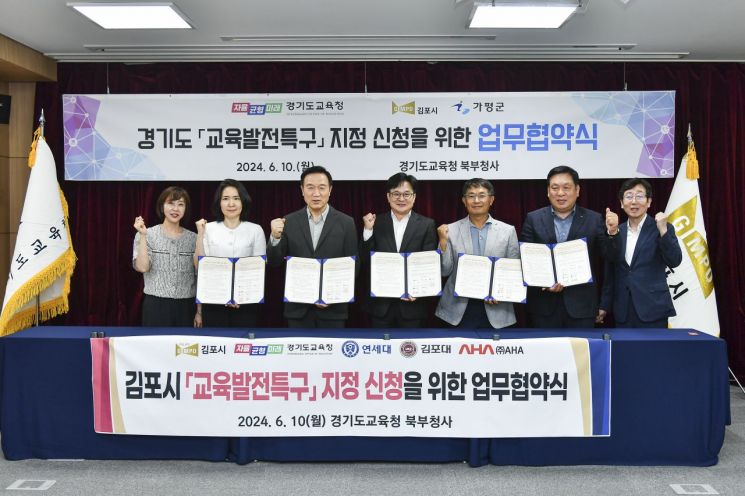 Gim Myeongsu, mayor of Gimpo City, signing the "Business Agreement for Designating Gimpo City as an Educational Development Special Zone" with Gyeonggi Provincial Office of Education and Yonsei University in June last year. Provided by Gimpo City
The slogan of the city administration, "Connected 70 City, Our Gimpo," uses "70" to signify Gimpo's growth into a self-sufficient city with a population of 700,000.
Under Mayor Kim Byungsu's leadership, the 8th popularly elected Gimpo City government focused on addressing major issues in the Seoul metropolitan area during the first half of its term, and is now accelerating efforts to enhance citizen communication and urban competitiveness in the latter half.
The fundamental requirements for Gimpo City to advance as a metropolitan city of 700,000 are: a comprehensive transportation network, urban development for public welfare and a pleasant urban environment, and an excellent educational environment. These conditions foster a sense of attachment among residents, encouraging them to continue living in Gimpo. Since its inauguration in 2022, Gimpo City has met these three requirements by successfully including the Seoul Subway Line 5 Gimpo Extension Project as a main project in the 4th Metropolitan Area Transportation Implementation Plan within just over two years. The city is currently awaiting the results of a fast-track preliminary feasibility study.
Gimpo City succeeded in having the long-awaited Seoul Subway Line 5 Gimpo Extension Project included as a main project in the 4th Metropolitan Area Transportation Implementation Plan. The results of the fast-track preliminary feasibility study are expected to be announced soon, and this is anticipated to mark a groundbreaking turning point in Gimpo's urban development.
Alongside the Line 5 extension, the city is also pursuing extensions of Lines 2 and 9, which are considered efficient and feasible in terms of cost and methodology. Gimpo City, in cooperation with Yangcheon-gu in Seoul, has signed an agreement for the extension of the Sinjeong Branch of Seoul Subway Line 2 to Gimpo and has been conducting a joint study to determine the optimal route. In addition, the city has been researching the possibility of jointly using the Gimpo section of Line 5 with Line 9. As a result, Gimpo City has developed optimal plans for both the Sinjeong Branch of Line 2 and Line 9 extensions to Gimpo and has submitted these to Gyeonggi Province. The city is determined to have these projects included in the upcoming 5th Metropolitan Area Transportation Implementation Plan (2026-2030).
The Goldline has reduced its congestion rate from 230% to 190% and shortened the train interval from 3 minutes 30 seconds to 2 minutes 30 seconds. Since the launch of the 8th administration, six additional train cars have been added to the Goldline. With national attention, Gimpo secured 13 billion KRW in state funding for the first time as a local railway, and by around 2026, the interval is expected to be further reduced to approximately 2 minutes 10 seconds.
The incomplete Gimpo Hangang New Town has been transformed by the announcement of the national Gimpo Hangang 2 Compact City project, enabling the development of a new town comparable in scale to Bundang. Daegot Geomuldaeri, long identified as the main source of environmental pollution, has been reborn as the starting point of a new industry with the Gimpo Environmental Regeneration Innovation Complex project, which passed its preliminary feasibility study. This project is expected to generate 16.2 trillion KRW in economic output and create approximately 119,000 jobs.
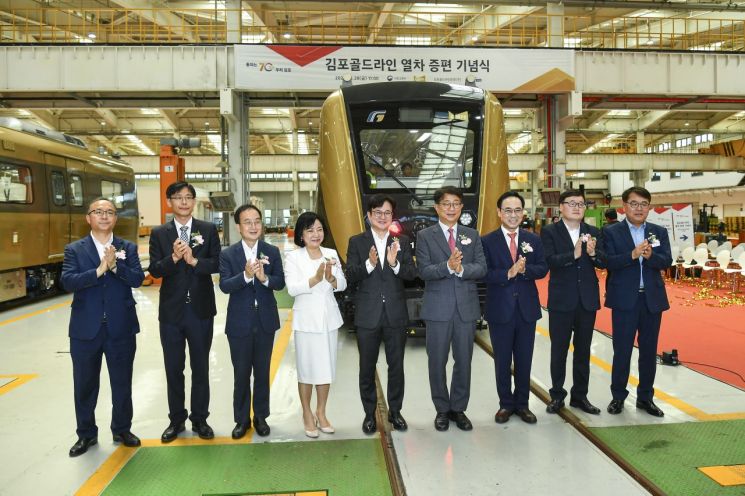 Kim Byungsu, Mayor of Gimpo (center), attending the 'Gimpo Goldline Train Expansion Ceremony.' Provided by Gimpo City
Gimpo City is accelerating the development of both the Hangang 2 Compact City and the Gimpo Environmental Regeneration Innovation Complex as the two pillars of its future. The city is also making rapid progress on the Pungmu Station Area Urban Development Project, the Hangang Cinepolis Complex, and the development of the Gamjeong and Geolpo districts. Gimpo believes that as it moves toward becoming a city of 700,000 residents, it must pursue balanced growth through development that takes into account the unique characteristics of each region, leveraging local strengths and ensuring that the benefits of urban development are maximized for its citizens.
Gimpo's education system, once labeled a "wasteland" and a cause of residents leaving the city, has also seen remarkable changes. Gimpo was designated as an Educational Development Special Zone by the Ministry of Education, laying the foundation to secure up to 10 billion KRW in national funding. The city also signed a "Seoul Learn" agreement with the Seoul Metropolitan Government and converted two local high schools into autonomous public high schools, resulting in tangible improvements.
In addition, through educational cooperation with Yonsei University, Gimpo has established a foundation for fostering future talent in science and engineering. The city is also taking the lead in enhancing the global competencies of students and citizens through native English education and intercultural exchange programs. This year, Gimpo was selected as the host city for the 2025 Korea Reading Festival and is operating a variety of reading culture programs throughout the year.
To ease the burden of child-rearing, Gimpo City is also driving meaningful changes in childcare and after-school care services.
Since the launch of the 8th administration, the city has worked to change the perception of public care from a low-quality, universal service to a high-quality, stable care system with high actual usage rates. The city is eliminating blind spots in care services and improving the quality of its programs.
In 2024, the Pungmu branch of the Childcare Comprehensive Support Center was opened, and this year, the Tongeon branch is set to open. The number of "hourly childcare service providers," which offer hourly care for infants raised at home, has been expanded to 10 integrated classes.
The city is also operating "Anytime Care," which allows families to entrust infants and elementary school students in emergency situations. In addition, Gimpo is becoming a city where it is easier to have and raise children by supporting 90% of the out-of-pocket costs for maternal and newborn health care services and opening a child development support center.
© The Asia Business Daily(www.asiae.co.kr). All rights reserved.
![Clutching a Stolen Dior Bag, Saying "I Hate Being Poor but Real"... The Grotesque Con of a "Human Knockoff" [Slate]](https://cwcontent.asiae.co.kr/asiaresize/183/2026021902243444107_1771435474.jpg)

















