Last year, the background concentration of carbon dioxide on the Korean Peninsula reached its highest level since observations began.
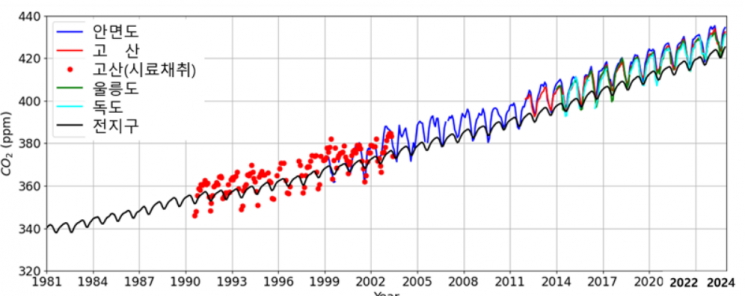 Anmyeondo, Gosan, Ulleungdo, Dokdo, and the global background concentration of carbon dioxide (CO2). Provided by the Korea Meteorological Administration
On June 30, the National Institute of Meteorological Sciences under the Korea Meteorological Administration announced in the "2024 Global Atmosphere Watch Report" that last year’s background concentration of carbon dioxide in Korea reached 430.7 ppm at Anmyeondo, 429.0 ppm at Gosan, and 428.0 ppm at Ulleungdo, setting new record highs at all three observation sites.
Anmyeondo, Gosan, and Ulleungdo are locations where the Korea Meteorological Administration has been monitoring climate change-related substances on the Korean Peninsula since 1997. Background concentration refers to the concentration measured in air that is uniformly mixed and minimally affected by local influences around the observation site.
At Anmyeondo, the concentration increased by 3.1 ppm compared to 2023, marking the second largest annual increase in the past ten years (2015?2024), following 2016. At Gosan and Ulleungdo, the concentrations rose by 2.9 ppm and 2.4 ppm, respectively, compared to the previous year.
According to the U.S. National Oceanic and Atmospheric Administration, the global average background concentration of carbon dioxide announced in April 2024 was 422.8 ppm, an increase of 3.4 ppm from the previous year. This is the largest annual increase in the past ten years.
Last year, the background concentrations of methane, nitrous oxide, and sulfur hexafluoride in Korea also reached record highs at all three sites, just like carbon dioxide. Other global atmosphere watch indicators, such as aerosols, reactive gases in the atmosphere, and precipitation acidity (pH), showed a general decreasing trend.
Jang Dongun, Administrator of the Korea Meteorological Administration, stated, "As the impacts of climate change become increasingly evident, we will focus all our efforts on providing scientific climate change policy information that can serve as a foundation for establishing national climate change response policies." He added, "In particular, we will further strengthen our capabilities in tracing the origins, analyzing the impacts, and assessing the effects of climate change-related substances."
© The Asia Business Daily(www.asiae.co.kr). All rights reserved.

















