Temperature Gap in Seoul Real Estate After Implementation of Ultra-Strict Loan Regulations
Buyers Give Up on Mid- to High-Tier Areas as Mortgage Loans Over 600 Million Won Are Blocked
Increased Interest in Outskirts of Seoul... Concerns Over Balloon Effect
Move-In Requirement and Adjustment of Jeonse Guarantee Ratio Affect Ordinary Citizens
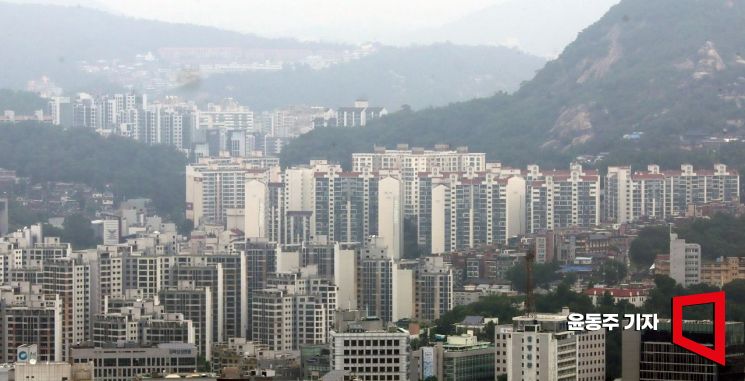 On the 27th, apartment prices in Mapo and Seongdong districts of Seoul rose at the largest rate since related statistics began to be published in 2013. The expectation that Seoul apartment prices will continue to rise is forecasted to sustain the upward trend for the time being. The photo shows a panoramic view of apartment complexes in downtown Seoul as seen from Namsan, Seoul. 2025.06.27 Photo by Dongju Yoon
"There aren't many listings available right now. Apartments priced in the 600 million won range are not affected by loan regulations, so some clients are paying attention to areas like Nodogang," said the representative of Agency A in Junggye-dong, Nowon-gu.
"This area doesn't rely heavily on loans, so the loan regulations don't have much impact here. There are many people saying they'll come to see houses even on weekends," said an employee at Agency B in Eungam-dong, Eunpyeong-gu.
"If the loan regulations block the Hangang Belt, I think demand will heat up in the outskirts of Seoul and even in adjacent areas of Gyeonggi Province. We had to extend our business hours on Friday to process contracts for clients who had only made preliminary agreements," said the representative of Agency C in Guri, Gyeonggi Province.
After the financial authorities announced new loan regulations on the 27th, which block mortgage loans for properties over 600 million won, attention has shifted to mid- and lower-tier areas such as the outskirts of Seoul where the loan burden is relatively low. With the start of extremely strict regulations that even limit loans for real end-users, such as the First-Time Homebuyer, Didimdol, and Bogeummul programs, the cash burden for purchasing homes in Gangnam's three districts, Mapo, Yongsan, and other areas with many apartments priced over 1.5 billion won has increased, leading buyers to seek alternatives. Experts pointed out that urgent attention is needed to address the balloon effect of rising home prices in surrounding areas, the increased housing burden on tenants, and supply instability.
Different Responses by Price Range
After the loan regulations, real estate agencies throughout the Seoul metropolitan area on the 27th and 28th reported a clear difference in sentiment depending on the price range of properties. In prime areas where buyers need loans exceeding 600 million won, many gave up on purchasing after missing the "last train" for loans. In areas where homes can be bought for around 1 billion won, buyer inquiries continued. The representative of Agency D near Gongdeok-dong, Mapo-gu, said, "Several groups of clients had said they would come to see houses over the weekend, but they ended up canceling one after another, saying they probably couldn't buy since they wouldn't get loans anyway."
The atmosphere was different in the outskirts of Seoul, such as Nowon, Dobong, and Gangbuk districts. An employee at Agency E in Mia-dong, Gangbuk-gu, said, "Since the end of May, there has been a sharp increase in clients, and even after the announcement of the regulations, there has been a steady stream of people wanting to view homes. Many believe that for apartments priced in the 600 million won range, the new loan regulations will actually drive prices up."
The manager at Agency B in Eungam-dong, Eunpyeong-gu, explained, "There were many clients who wanted to view homes or make appointments even on weekends. Among those who had planned to buy homes for gap investment, some requested to be matched with tenants who could move in without taking out loans, by lowering the jeonse deposit instead."
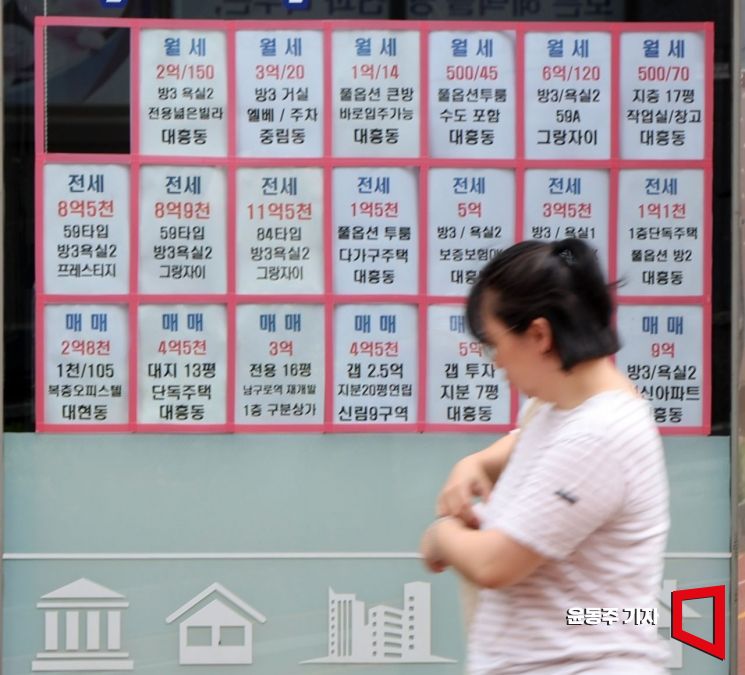 On the 27th, apartment prices in Mapo and Seongdong districts of Seoul rose by the largest margin since related statistics began to be published in 2013. It is expected that the upward trend in Seoul apartment prices will continue for the time being due to the expectation that prices will rise further. The photo shows a real transaction notice at a real estate agency in Mapo, Seoul. 2025.06.27 Photo by Dongju Yoon
There are also predictions that prime areas along the Hangang River, such as Gangnam's three districts, will see an increase in listings as it becomes harder to find buyers. The representative of Agency F near Banpo-dong said, "Many homeowners who had withdrawn their listings due to rising prices are now calling to ask what will happen next. I think they will start putting their properties back on the market as time goes by. I don't know if prices will fall, but price increases are likely to be limited for the time being."
According to the Seoul Real Estate Information Plaza, as of the 30th, there were 8,031 apartment transactions in May and 5,728 in June. The May transaction volume was the highest since March, when the land transaction permit zone (Toheoguyeok) designation was lifted, which had 10,293 transactions. Considering that there is still about a month left for reporting real transactions for June, the June transaction volume is expected to surpass May's. However, some predict that a decline in transaction volume is inevitable after the loan regulations.
Experts: "Balloon Effect Must Be Closely Monitored"
Given that the new regulations have a significant impact on real demand from ordinary citizens, some experts argue that the government must closely monitor the balloon effect. Ham Youngjin, head of the Real Estate Research Lab at Woori Bank, said, "We need to pay close attention to the balloon effect in outer areas like Nodogang (Nowon, Dobong, Gangbuk) and Geumgwang-gu (Geumcheon, Gwanak, Guro), where many listings are in the 600 to 800 million won range." Ko Jongwan, director of the Korea Asset Management Research Institute, also predicted, "There is a possibility that home prices in the outskirts will become volatile."
Lee Eunhyeong, a research fellow at the Korea Institute of Construction Policy, said, "Setting a uniform loan limit for both end-users and multiple homeowners is an unprecedentedly strong measure. While there may be some immediate effects, this alone is not enough to expect long-term policy impact."
Kim Hyosun, chief real estate expert at NH Nonghyup Bank, said, "Rather than mid- to low-priced homes, it is properties in the 800 million to 2 billion won range that are seeing a reduction in loan amounts compared to before. The balloon effect is spreading mainly in areas where people can still buy homes with loans. In the long term, financial regulations may become more flexible once household debt is managed to a certain extent, and the potential for demand to revive when loans become available could recur repeatedly."
Kwon Youngsun, team leader at Shinhan Bank's Real Estate Investment Advisory Center, explained, "While these regulations may have the effect of calming the market, it doesn't mean that demand will disappear. Anxiety about supply still persists, so a signal to increase supply is needed."
Some experts also point out that the requirement to move in within six months when taking out a mortgage could drive up jeonse prices and fuel the balloon effect. Park Wongap, real estate expert at KB Kookmin Bank, noted, "Because the new regulations require buyers to move in after purchasing a home, the supply of rental properties for jeonse and monthly rent could decrease. With the aftermath of rental fraud causing demand for apartment jeonse to surge, and with fewer new apartment completions, the imbalance in the jeonse supply could worsen."
Ham also emphasized, "The guarantee ratio for jeonse loans has been lowered from 90% to 80%. Combined with expectations of a base rate cut, this could lead to both rising jeonse prices and a shift toward monthly rentals. The housing burden on tenants could increase, so close monitoring is necessary."
© The Asia Business Daily(www.asiae.co.kr). All rights reserved.


















