In Response to Business Community Concerns:
"Reviewing the Abolition of the Special Breach of Trust Crime"
However, It Will Not Be Included in the Current Amendment
As the June extraordinary session of the National Assembly draws to a close, the Commercial Act amendment bill, led by the Democratic Party of Korea, is expected to pass this week. While the party has indicated an openness to further discussions, such as the possible abolition of the special breach of trust crime in response to concerns raised by the business community, these changes are not expected to be included in the current amendment.
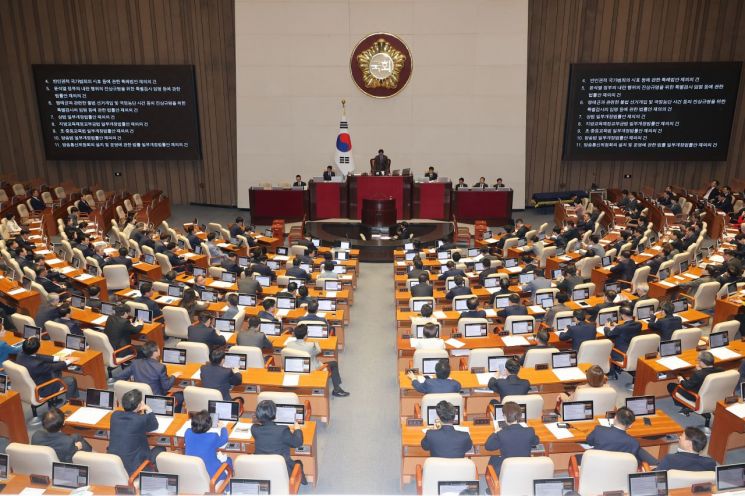
On the morning of June 30, Moon Jinseok, Chief Deputy Floor Leader of the Democratic Party, announced at the main building of the National Assembly in Yeouido, "We plan to pass the Commercial Act amendment bill during this week's extraordinary session." Previously, on the day before, National Assembly Speaker Woo Wonshik suggested that a plenary session would be held on July 3, the day before the end of the June session, requesting bipartisan consultations on the confirmation of Kim Minseok as Prime Minister nominee.
The Democratic Party reintroduced the Commercial Act amendment bill after the inauguration of the Lee Jaemyung administration. The bill maintains the original provisions, including: explicitly stipulating directors' duty of loyalty to shareholders; introducing cumulative voting for the election of directors in large listed companies; expanding the number of directors for separately elected audit committee members; and introducing electronic general meetings of shareholders. However, the implementation timing has been changed so that, except for electronic general meetings, the amendments will take effect immediately upon promulgation. Additionally, a '3% rule' has been added, limiting the voting rights of the largest shareholder and related parties to a combined 3% when electing audit committee members.
Since the Democratic Party is now the ruling party and is driving the amendment, the likelihood of the President exercising the right to request reconsideration (veto) has decreased. As a result, the party is expected to include as many provisions as possible in the bill this time. Under the previous Yoon Suk Yeol administration, the bill that passed the National Assembly included only two provisions: explicitly stipulating directors' duty of loyalty to shareholders and introducing electronic general meetings. Kim Hyunjung, the party spokesperson, stated, "Which additional provisions will be included will be discussed in the Legislation and Judiciary Committee."
With the Democratic Party, formerly the opposition, now in power, the passage of the Commercial Act amendment has become inevitable. Meanwhile, the business community is calling for supplementary legislation, such as easing the breach of trust crime, due to concerns about excessive litigation. The Democratic Party has stated that it will consider these concerns, but it appears unlikely that such measures will be included in the amendment to be passed at this week's plenary session.
Kim Hyunjung, the party spokesperson, said, "There is a special breach of trust crime under the Commercial Act, and there is also a breach of trust crime under the Criminal Act. In advanced countries, the breach of trust crime itself is rare." She added, "The Special Committee for the KOSPI 5000 Era is open to the possibility of abolishing the special breach of trust crime under the Commercial Act." However, she also noted, "Due to time constraints, it cannot be included in this amendment, but further discussions are possible in the future."
Meanwhile, the Democratic Party also plans to pass the Local Education Finance Grant Act and the Free High School Education Act, along with the Commercial Act amendment, within the June session. Moon, the Chief Deputy Floor Leader, stated, "These bills also need to pass to ensure there are no issues with executing the supplementary budget." The party plans to deliberate further on the Yellow Envelope Act, the Grain Management Act, and the three broadcasting laws.
© The Asia Business Daily(www.asiae.co.kr). All rights reserved.

















