Gyeonggi Province announced on the 30th that all aspects of the 'DMZ (Demilitarized Zone) Area Ecological Environment Monitoring and Ecological Education' project are progressing as planned, with the completion of spring ecological environment monitoring and ecological education for local residents, which were promoted as part of the project.
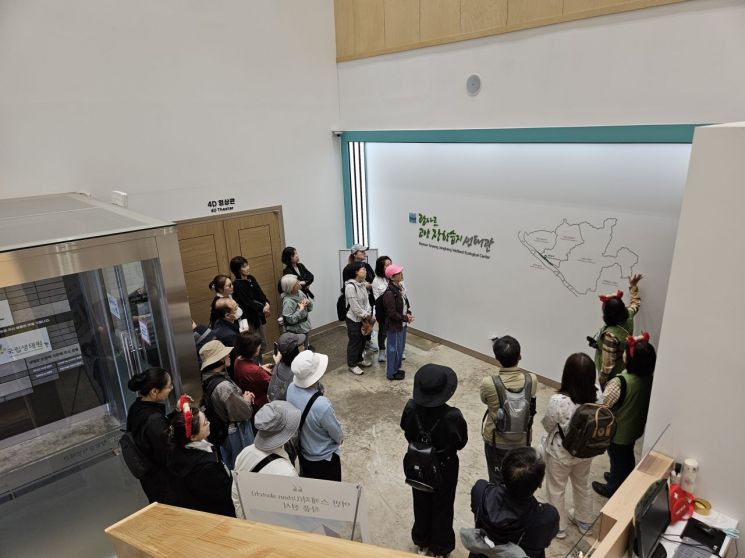 Gyeonggi Province conducted 'DMZ (Demilitarized Zone) Area Ecological Environment Monitoring and Ecological Education' at Janghang Wetland on the 28th. Provided by Gyeonggi Province
The 'Gyeonggi Province DMZ Area Ecological Environment Monitoring and Ecological Education' project aims to shed new light on the ecological value of the DMZ area and contribute to the conservation of the ecological environment by surveying and recording various species, including endangered species. In addition, the project focuses on raising awareness and interest in the DMZ by providing ecological education to local residents and ecological field activists.
In March and April, spring ecological environment monitoring was conducted on amphibians and reptiles along the DMZ Peace Trail. As a result, two families and five species of amphibians and three families and four species of reptiles were observed. In particular, the discovery of native amphibians such as the Korean Brown Frog and the Korean Salamander, which inhabit only pristine environments, confirmed that the DMZ area’s ecosystem remains healthy and its natural state is well preserved.
From May to June, ecological conservation leader training was provided to local residents, guides, and teachers, enhancing the ecological capabilities of residents. In Goyang and Gimpo, four training sessions were held for 104 participants, combining theoretical lectures on flora and fauna inhabiting the DMZ with field experiences at Janghang Wetland, which is designated as a Ramsar Wetland. As a result, participant satisfaction was very high, scoring 93.4 points. In June, four additional training sessions were held in Paju and Yeoncheon for 119 participants, widely promoting the excellence and value of DMZ ecology.
The province plans to conduct additional monitoring in the second half of the year to confirm species diversity in the DMZ area. In addition, play- and experience-based programs will be operated at the former US military base Camp Greaves inside the Civilian Control Line, enabling future generations, including youth, to understand the DMZ ecological environment easily and enjoyably.
Park Mijeong, Director of the DMZ Policy Division of Gyeonggi Province, stated, "Recently, changes in the composition of species in the DMZ area have been observed due to the impact of climate change, making continuous observation of species changes and habitat conservation very important." She added, "In particular, it is essential for local residents to understand and take pride in the ecological value of the DMZ, as this is at the core of DMZ ecological environment policy. We will continue to ensure the smooth progress of this project in the future."
© The Asia Business Daily(www.asiae.co.kr). All rights reserved.

![Clutching a Stolen Dior Bag, Saying "I Hate Being Poor but Real"... The Grotesque Con of a "Human Knockoff" [Slate]](https://cwcontent.asiae.co.kr/asiaresize/183/2026021902243444107_1771435474.jpg)















