Expansion of Customized Welfare with "Hyodobapsang"
Specialized "Red Road" Street Also Gaining Popularity
"Pushing Forward with the Mapo Riverside 8.2 Project"
"Those Who Work Well Should Be Promoted"
"One hour of the district mayor's time is equivalent in value to 370,000 hours, the combined time of our 370,000 residents. Because I am well aware of the weight and responsibility of this, I have not wasted a single moment."
"Thanks to this mindset, Mapo District has achieved four first-place rankings in the Statistics Korea Community Survey. We ranked first in various areas, including satisfaction with daily life, overall life satisfaction, happiness, and welfare for pregnancy, childbirth, and childrearing."
On July 1, Park Kangsoo, mayor of Mapo District in Seoul, marked the start of his fourth year in office with a thumbs-up gesture. Mayor Park emphasized, "Objective indicators show the changes in Mapo," and added, "We must work creatively and continuously, and the public sector must change as society changes." He stated, "The most important authority of the district mayor is personnel management," and explained, "Only when people who work well are promoted, and those who work hard are placed in important positions, will the district office and the public sector as a whole change."
 Park Gangsu, mayor of Mapo District, said in an interview on the 25th of last month, "People who work well should be promoted, and those who work hard should be given important positions for the public service to change." Provided by Mapo District Office.
He cited the "Resident-Participation Hyodobapsang" and the creation of the "Red Road" as the representative policies of the past three years. The Hyodobapsang is more than just a meal; it is a customized welfare service unique to Mapo District, where seniors aged 75 and older are provided with one meal a day, companionship, health checks, and one-stop connections to legal and tax consultations. The Red Road is a specialized street project that divides the Hongdae area, symbolizing youth and passion, into seven zones from R1 to R7, preserving individuality while systematizing the area.
Mayor Park said, "The operating costs for the Hyodobapsang are covered by the district, but the meal expenses are funded entirely by resident donations. Among the donors, there is someone who contributed 100 million won, and there are also cases where individuals have pledged to donate their entire estate posthumously." In just over two years since the Hyodobapsang began, more than 2.2 billion won in voluntary donations have been collected.
He explained, "Unlike traditional meal services centered on senior centers, the Hyodobapsang provides meals at various venues such as churches, temples, and public institutions, expanding the service to seniors who do not use senior centers. Currently, 2,000 out of approximately 27,000 eligible seniors are receiving meals, but by the end of this year, we plan to increase this number to 5,000."
He added, "The Hyodobapsang is a project that would be difficult without residents' voluntary donations and a culture of giving. Many local governments have visited to benchmark the program, but they have not dared to implement it for this very reason."
The Red Road is a project unique to Mapo that aims to create a street culture and revitalize the local economy. Various festivals and content have been developed around the Red Road, attracting both domestic and international tourists. According to Seoul Metro, the daily average number of passengers getting on and off at Hongdaeipgu Station on Subway Line 2 is about 150,000, which is five times the Seoul subway average.
Mayor Park visits an average of about 10 sites per day. He said, "By listening to residents at the scene, thinking from their perspective, and identifying the root causes, solutions emerge and policies are created." He explained that advanced policies such as the Hyodobapsang, Red Road, Mapo Circular Train Bus, Disability Life Safety Insurance, Wheelchair Lift Service, Sunlight Center (Integrated Pregnancy and Childcare Support Center), Cheotkkeut Center (Support Space for Single Mothers), Mapo Mom Cafe, and Babysitter House were all first created based on this approach.
Mayor Park is also preparing major development projects for Mapo's future. The "Mapo Riverside 8.2 Project" is a long-term initiative to transform the 8.2 km stretch along the Han River in Mapo District into a world-class tourism and cultural destination. The project includes various development plans such as relocating military bases and building a complex cultural and arts center.
Mayor Park said, "We must actively request cooperation from higher-level agencies and logically persuade them of the necessity of development. This project is a long-term task that will take more than 10 years, with the goal of making Mapo a city comparable to Gangnam and Seocho." He plans to announce specific plans later this month.
 Kangsoo Park, mayor of Mapo District, said, "I have always done my best every day with the determination that how I served as mayor is more important than how many times I served." Provided by Mapo District.
The following is a Q&A with Mayor Park Kangsoo of Mapo District.
▲You have spent three busy years.
- The district mayor is, in essence, the steward responsible for managing Mapo District. How the limited budget is used and where it is focused can determine the entire future direction of Mapo. That is why I believe it is important to operate the district with at least a 10-year perspective. If we focus only on solving immediate problems and achieving short-term results, it can end up as one-off administration with little effectiveness, ultimately leading to wasted precious resources.
With the belief that "a truly advanced city is one where seniors, children, and people with disabilities live well," I have always prioritized improving residents' quality of life and policies for the socially disadvantaged. Looking back, the past three years have been "a time of moving forward without stopping." I have always done my best every day with the determination that how I served as mayor is more important than how many times I served.
▲Are there any mid- to long-term projects you are pursuing?
- Mapo District has an 8.2 km stretch along the Han River. Among Seoul's districts, Mapo has the longest riverside area, giving it great potential for waterfront development. Leveraging this, we are pursuing the "Mapo Riverside 8.2 Project" as a core mid- to long-term strategic initiative.
The "Mapo Riverside 8.2 Project" is a comprehensive development plan to systematically develop the waterfront hubs and surrounding areas along the Han River in Mapo District. It brings together previously fragmented plans focused on individual sites into an integrated, systematic development strategy and sets out development guidelines.
The "Mapo Riverside 8.2 Project" aims to create a complex space where culture, environment, housing, and public services are organically combined, going beyond simple urban development. Through the development of multi-layered complex facilities, including a Han River View Library, sports center, and scale-up center, the project will not only meet the cultural and leisure needs of local residents but also strengthen support for startups and entrepreneurship. Once the study results are released later this month, we plan to announce them publicly.
▲You have one year left in your term. Which area will you focus on most?
- I will focus on issues directly related to residents' livelihoods and revitalizing the local economy. Especially in difficult times, it is the mayor's responsibility to help residents not lose hope.
We will fully operate the "Mapo Circular Train Bus," which connects the 11 major commercial districts of Mapo, to create a tourism belt linking local commercial districts. Unlike conventional tour buses that focus on main roads, this bus is designed to pass through Mapo's hidden attractions and unique alleyway businesses, making them easily accessible to both tourists and residents. We expect this will greatly contribute to revitalizing local businesses and unique tourism resources in Mapo.
We will continue to expand and systematize the foundation for young people to prepare for employment and entrepreneurship and to become self-reliant, through initiatives such as "Young Merchants' One-Month Stay in Traditional Markets," the "Youth Startup Support Center," a "Youth House" with 29 rooms, and "Space," a Mapo-style study cafe. We will also focus on actively supporting women who have experienced career interruptions to achieve economic independence and return to society.
▲There is ongoing conflict with the Seoul Metropolitan Government over issues such as the additional installation of the Metropolitan Resource Recovery Facility and the joint use agreement for the Mapo Resource Recovery Facility. It seems difficult to find a solution.
- The most urgent obstacle that must be resolved for Mapo District to become a truly sustainable city and to ensure a safe environment for residents is the incinerator issue.
Mapo District has quietly borne the burden of handling Seoul's waste for decades. For 15 years, waste from all over Seoul was indiscriminately piled up at Nanjido, and even now, contaminated water continues to flow underground. Since 2005, an incinerator with a daily capacity of 750 tons has been in operation. However, the Seoul Metropolitan Government unilaterally pushed for the installation of a new incinerator site in Mapo. The opinions of residents and the district were completely excluded, and an agreement was signed to indefinitely extend the joint use of the existing Mapo Resource Recovery Facility.
This entire process is a classic example of "one-sided administration" that disregarded not only procedural legitimacy, but also the principles of fairness among districts and resident consultation. Even the Seoul Metropolitan Government's statement to the media that "we consulted with Mapo District" is not true. In reality, they disguised a few words exchanged over a meal as consultation, and even though our district official clearly stated, "A meeting is possible, but consultation is not," they distorted this as an agreement.
The central government and the Seoul Metropolitan Government must immediately undertake a comprehensive review of the installation and operation of the incinerator. Policy must be redesigned based on the values of establishing a sustainable waste reduction system, setting principles for shared responsibility among districts, and ensuring genuine resident consultation, rather than administrative convenience.
The current structure, in which basic local governments are left with only responsibility and no decision-making power over issues directly affecting residents' lives, must also be changed.
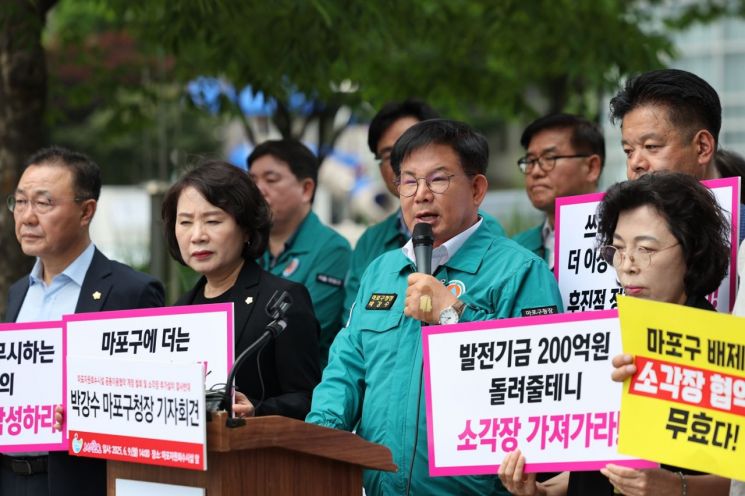 A press conference held on the 9th of last month opposing the additional installation of the Metropolitan Resource Recovery Facility and declaring the invalidity of the joint use agreement for the Mapo Resource Recovery Facility. Provided by Mapo District Office.
© The Asia Business Daily(www.asiae.co.kr). All rights reserved.

![Clutching a Stolen Dior Bag, Saying "I Hate Being Poor but Real"... The Grotesque Con of a "Human Knockoff" [Slate]](https://cwcontent.asiae.co.kr/asiaresize/183/2026021902243444107_1771435474.jpg)

















