US Supply Decline and Weak Won Drive Up Prices
Australian Beef and Pork Also See Increases
The price of US beef has surged more than 30% compared to the average year. As the price of US beef rises, the prices of alternative products such as Australian beef and both domestic and imported pork are also increasing.
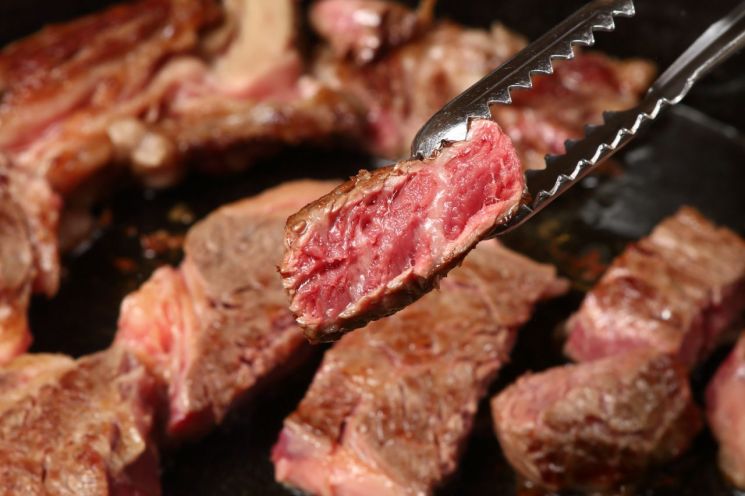
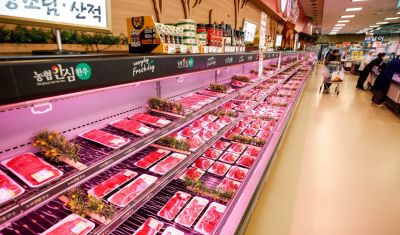
According to the distribution industry on June 28, the nationwide average retail price of US beef (short ribs, frozen) as of June 24 was 4,481 won per 100 grams. This represents an increase of 13.1% compared to last year (3,961 won) and a rise of 34.8% compared to the average year (3,323 won). The price of Australian beef (short ribs, frozen), which is an alternative product, also reached 4,408 won per 100 grams, up 12.4% from last year (3,923 won) and 25.5% higher than the average year (3,512 won).
The main reasons for the sharp price increase are a decrease in supply within the United States and the weakening of the Korean won. In recent years, beef production in the US has declined to an unprecedented degree. According to the US Department of Agriculture (USDA), as of January this year, the number of cattle in the US stood at 87.2 million, the lowest figure since 1951. Due to abnormal weather, severe summer droughts and harsh winter cold have reduced pastures and feed crops, and in 2023, 60% of the entire US territory was designated as a drought disaster area. Furthermore, the cost of feed has risen, causing many farmers to give up cattle farming as they could no longer bear the production costs. As a result, the price of live cattle futures on the Chicago Mercantile Exchange (CME) recently approached 230 cents per pound, marking an all-time high.
The high exchange rate has also contributed to the increase in US beef prices. According to the Bank of Korea, the won-dollar exchange rate, which remained in the low 1,300-won range at 1,338.80 won on August 23 last year, nearly reached 1,500 won at 1,484.10 won on April 9 this year. Although the current won-dollar exchange rate has dropped to the 1,360-won range, it takes about two months for this to be reflected in import prices.
As more consumers turn to Australian beef or pork as alternatives to US beef, overall livestock prices are on the rise. The retail price of imported pork (pork belly, frozen) is 1,464 won per 100 grams, about 4% higher than the average year. The retail price of domestic pork (pork belly, frozen) is 2,750 won, up 4.0% from last year and 4.5% higher than the average year.
In contrast, the price of Korean Hanwoo beef remains relatively low. The retail price of Hanwoo beef (tenderloin, grade 1+) is 13,066 won per 100 grams, which is 5.7% higher than last year but 3.7% lower than the average year.
© The Asia Business Daily(www.asiae.co.kr). All rights reserved.


















