U.S. Deploys Bunker-Busters on Fordow and Natanz
Only Cruise Missiles Used on Deeply Buried Isfahan
"Iran May Have Concealed Highly Enriched Uranium"
The U.S. military recently carried out precision strikes on three Iranian nuclear facilities, but it has been confirmed that a bunker-buster bomb was not used on one of them, the Isfahan facility. According to the U.S. Joint Chiefs of Staff, this is because the Isfahan facility is located deep underground, making even penetrator bombs ineffective.
On June 27 (local time), U.S. broadcaster CNN reported that Dan Kane, Chairman of the U.S. Joint Chiefs of Staff, stated during a Senate intelligence briefing, "The Isfahan facility is too deep to use a bunker-buster." The bunker-buster refers to the GBU-57, a massive penetrator bomb used by the U.S. as a primary weapon against underground facilities. In this airstrike, twelve bombs were dropped on Fordow and two on Natanz.
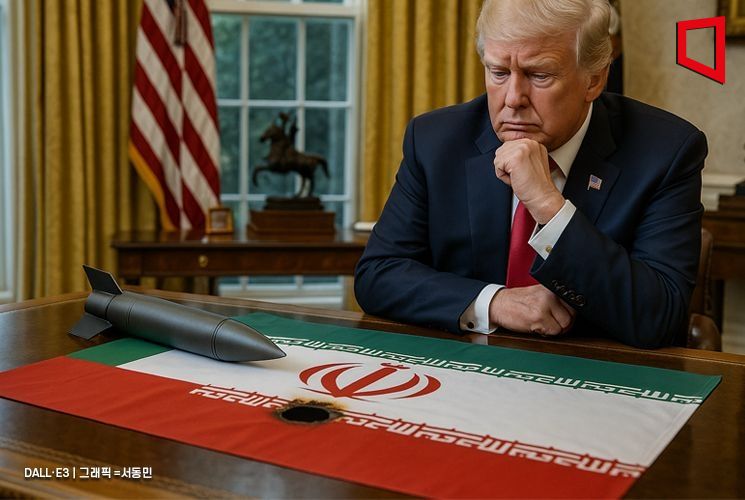
Isfahan is known as a key facility where about 60% of Iran's highly enriched uranium is stored. However, this time, the attack was carried out only with Tomahawk cruise missiles launched from a U.S. submarine deployed in Middle Eastern waters. As a result, there are observations that it is uncertain whether the actual nuclear material was removed.
The Iranian side claims that the nuclear material was moved to a safe location before the airstrike. U.S. senators have also raised questions about the effectiveness of the strike. Senator Chris Murphy (Democrat, Connecticut) said, "Isfahan is at a depth that the U.S. cannot access," and added, "Iran has the capability to move a significant amount of its stockpile to areas beyond the reach of U.S. bombing capabilities." Senator Lindsey Graham (Republican, South Carolina) stated, "We do not know where the 900 pounds (about 408 kg) of highly enriched uranium is located."
Experts have confirmed through satellite imagery and other means that vehicles approached the Isfahan facility after the airstrike, and that obstacles at the entrance were removed. This has raised the possibility that Iran may have relocated the nuclear material elsewhere. Some have assessed that this operation only succeeded in removing part of the nuclear program.
© The Asia Business Daily(www.asiae.co.kr). All rights reserved.
![Clutching a Stolen Dior Bag, Saying "I Hate Being Poor but Real"... The Grotesque Con of a "Human Knockoff" [Slate]](https://cwcontent.asiae.co.kr/asiaresize/183/2026021902243444107_1771435474.jpg)
















