KDCA Publishes "2024 Annual Report on Infectious Disease Notifications"
Sharp Rise in Scarlet Fever, Chickenpox, and CRE Infections
Decline in Mumps and Tuberculosis Cases
Last year, there was a surge in respiratory infectious diseases such as pertussis among children and adolescents, as well as increases in scarlet fever and chickenpox. As a result, the total number of infectious disease cases, excluding COVID-19, rose by 54.5% compared to the previous year.
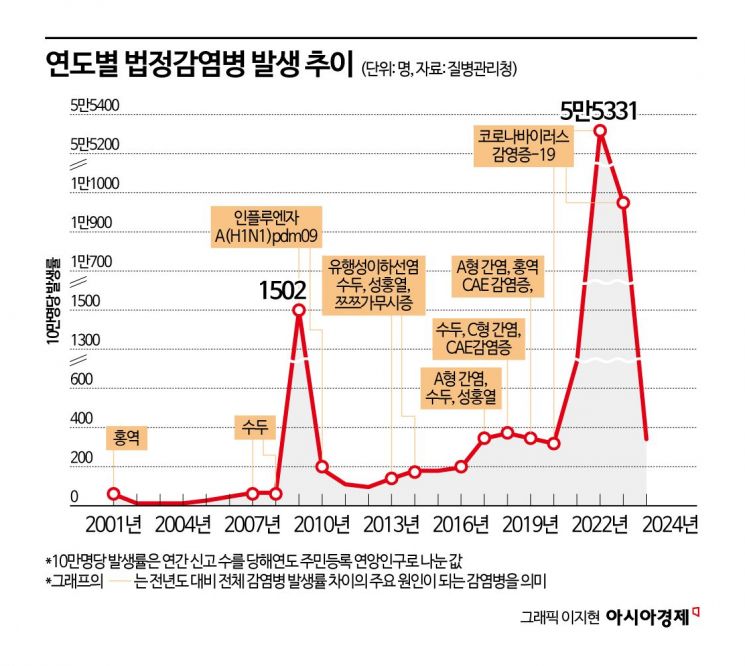
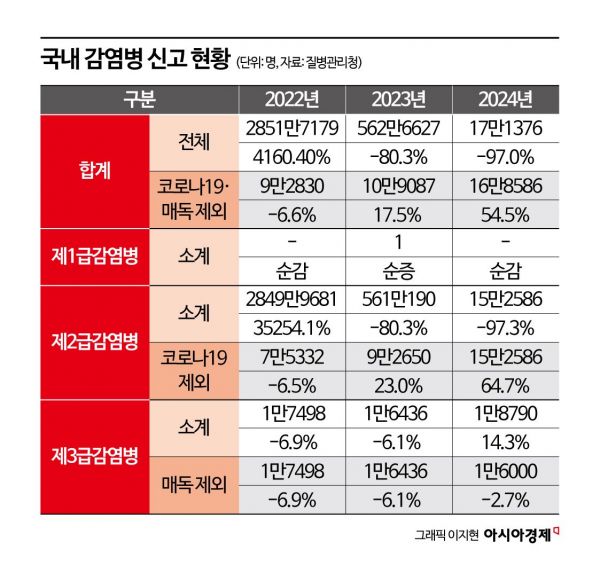
According to the "2024 Annual Report on Infectious Disease Notifications" published by the Korea Disease Control and Prevention Agency (KDCA) on June 26, the total number of reported cases of notifiable infectious diseases under complete surveillance (grades 1 to 3) in 2024 was 171,376 (334 cases per 100,000 population). This marks a significant decrease compared to 5,626,627 cases (10,951 per 100,000 population) in 2023. This decline is attributed to the reclassification of COVID-19 from grade 2 to grade 4 in August 2023, which affected the statistics.
Excluding COVID-19 and syphilis (2,790 cases), which was reclassified from grade 4 to grade 3 in 2024, the total number of reported infectious disease cases in 2024 was 168,586 (329 cases per 100,000 population), representing a 54.5% (59,499 cases) increase compared to the previous year (109,087 cases).
By classification, for grade 1 infectious diseases (17 types), there was one case of botulism reported in 2023, but no cases were reported in 2024.
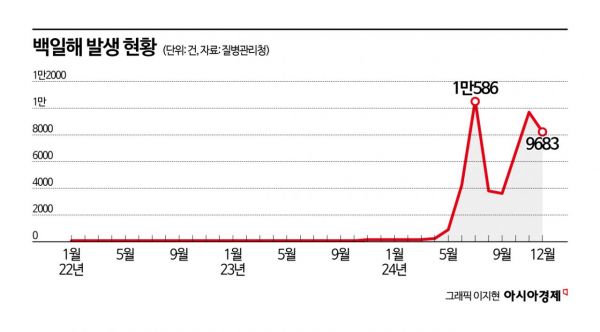
For grade 2 infectious diseases (21 types), a total of 152,586 cases were reported, an increase of 64.7% (59,936 cases) compared to the previous year. Pertussis, which had only 292 cases in 2023, surged to 48,048 cases last year. Additionally, there were significant numbers of scarlet fever (6,642 cases), chickenpox (31,892 cases), and carbapenem-resistant Enterobacteriaceae (CRE) infections (42,347 cases). These four diseases accounted for 84.5% of all grade 2 infectious disease reports. Respiratory infectious diseases such as pertussis and scarlet fever saw particularly large increases among preschool children and school-aged children and adolescents.
In contrast, some grade 2 infectious diseases, such as mumps, tuberculosis, and hepatitis A, saw decreases. Tuberculosis cases have declined by an average of 7.5% annually since peaking at 39,557 new cases in 2011, with a further 7.9% (1,228 cases) decrease last year compared to the previous year. However, the proportion of elderly patients among all new tuberculosis cases (14,412 cases) has steadily increased, reaching 58.9% (8,491 cases) in 2024.
For grade 3 infectious diseases (28 types), there were a total of 18,790 cases, an increase of 14.3% (2,354 cases) compared to the previous year. However, excluding syphilis (2,790 cases), which was reclassified from grade 4 to grade 3 in 2024, there was a 2.7% (436 cases) decrease. Among major infectious diseases, scrub typhus saw 6,268 reported cases, a 10.7% (605 cases) increase from the previous year, while hepatitis C has steadily declined since peaking at 11,850 cases in 2020, with 6,444 cases reported in 2024, an 11.1% decrease from the previous year.
Meanwhile, the number of infectious diseases imported from overseas had been reported at around 400 to 700 cases annually since 2010. However, during the COVID-19 pandemic, this number surged (56,037 cases in 2022), but has since declined to 7,122 cases in 2023 and 606 cases in 2024.
In addition, the number of deaths from notifiable infectious diseases, excluding tuberculosis, totaled 1,238 in 2024, an 18.2% (191 cases) increase compared to the previous year (1,047 cases). The infectious diseases with the highest number of deaths were CRE infections (838 cases), acquired immunodeficiency syndrome (158 cases), and pneumococcal infections (87 cases).
To respond quickly and efficiently to new infectious disease crises, the KDCA overhauled its existing integrated disease management system and launched the new "Integrated Infectious Disease Control Information System" in January last year. Now, whenever an infectious disease patient is identified, medical institutions, public health centers, and local governments use this system to report cases. The collected notification data is then made publicly available through the "Infectious Disease Portal" via dashboards, statistics, and weekly trend reports.
Ji Youngmi, Commissioner of the KDCA, emphasized, "The initial notifications of infectious diseases by medical institutions play the most critical role in the surveillance system, enabling early detection of outbreaks and minimizing the scale of damage by preventing community transmission."
© The Asia Business Daily(www.asiae.co.kr). All rights reserved.













