Personal Opinion: "The Meaning of Dollar as a Safe Asset Applies to Stablecoins, Too"
Bank of Korea Prepares for Second Digital Currency Test as Stablecoin Legislation Progresses
Bank of Korea to Request Expanded Authority to Supervise Non-Bank Institutions
Sharp Rise in Housing Prices..."Household Debt Now a 'Greater' Factor for the Monetary Policy Committee"
"I do not agree with the argument that institutionalizing a won-based stablecoin is urgently needed to replace dollar-based stablecoins."
Yoo Sangdae, Deputy Governor of the Bank of Korea, stated this as his personal opinion at the regular press conference of the Monetary Policy Committee held at the Bank of Korea Annex in Jung-gu, Seoul on the 24th. He explained that this is because the preference for the dollar as an asset and its status as a safe asset are applied to stablecoins in the same way. Deputy Governor Yoo said, "While I basically agree with the need for introduction for technological innovation and industrial development, the issuance of a won-based stablecoin could significantly change Korea's fundamental stance on capital liberalization and the internationalization of the won." He emphasized, "We need to establish safeguards from the outset to prevent system risks such as a coin run (large-scale coin withdrawals)." From the perspective of a central bank that must achieve price stability and financial stability based on the stability of payment and settlement systems, he said it is inevitable to be concerned about the impact on the overall macroeconomy.
The Bank of Korea's position is that even if a won-based stablecoin is introduced, issuance should first be allowed through banks, and then expanded to non-bank institutions based on that experience. Deputy Governor Yoo said, "Once the Ministry of Economy and Finance, the Financial Services Commission, and other government agencies have established their positions, we will communicate the Bank of Korea's concerns regarding economic stability, financial stability, payment and settlement stability, as well as the results of our research and positions to date, and engage in thorough discussions."
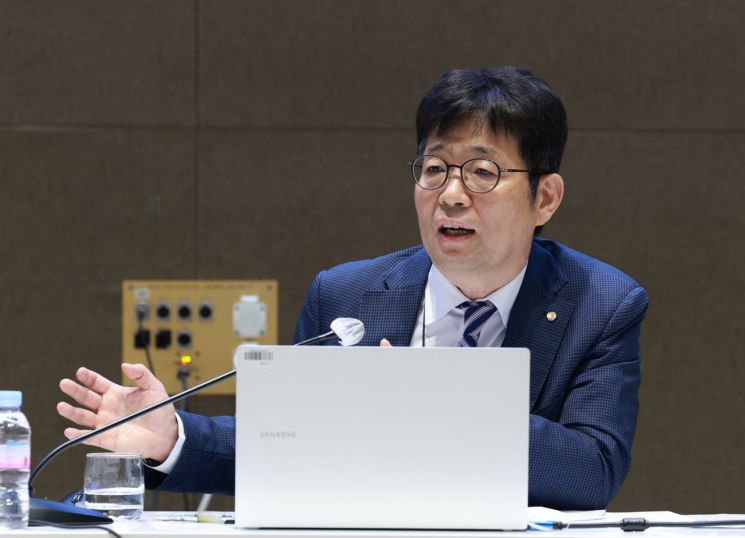 Yoo Sangdae, Deputy Governor of the Bank of Korea, is answering questions at the regular press conference of the Monetary Policy Committee held at the Bank of Korea Annex in Jung-gu, Seoul on the 24th. Bank of Korea
The Bank of Korea believes that "Project Hangang," which is conducting its first pilot test until the end of this month, could serve as a won-based stablecoin. This is a digital currency in which the Bank of Korea issues wholesale central bank digital currency (CBDC), and banks create and utilize deposit tokens. However, due to differences with the banking sector, the goal of accelerating commercialization after a second test at the end of this year has inevitably been adjusted. The banking sector has stated that the scope of follow-up tests for digital currency will expand to include person-to-person remittances and the discovery of additional merchants, which will require further IT development and budget execution. Therefore, they have indicated that a long-term roadmap, including commercialization plans, needs to be established before the second test. Deputy Governor Yoo commented, "The government has not yet established a clear position on the introduction of a won-based stablecoin, and there is significant uncertainty regarding related laws and regulations. Since considerable human and material investment will be required for the second test, we will consult with banks and proceed with the test when the necessary legal framework is in place."
"Bank of Korea to Request Expanded Authority to Supervise Non-Bank Institutions"
As the share of non-bank financial institutions in the financial industry has recently increased, there are growing calls to redefine the role of the Bank of Korea. Deputy Governor Yoo said, "We are conducting sufficient internal reviews on this matter," and added, "After the new government reorganizes its structure, if we are asked for our opinion, we will state that the Bank of Korea should play a role in macroprudential policy, including lending by non-bank financial institutions and inspections (submission of data) related to such lending."
The Bank of Korea is expected to communicate its position on stablecoins and its views on strengthening its organizational role, including the supervision and oversight of non-bank financial institutions, in its scheduled briefing to the National Planning Committee this week.
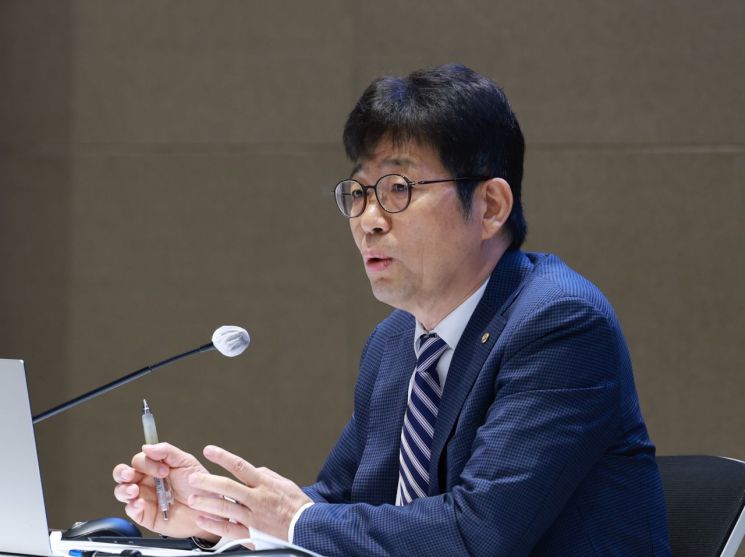 Yoo Sangdae, Deputy Governor of the Bank of Korea, is answering questions at the regular press conference of the Monetary Policy Committee held at the Bank of Korea Annex in Jung-gu, Seoul on the 24th. Bank of Korea
Sharp Rise in Housing Prices Weighs on July Rate Freeze..."Household Debt Now a 'Greater' Factor for the Monetary Policy Committee"
The base interest rate is expected to remain unchanged in July. This is because the recent sharp increase in housing prices in some areas of Seoul and the surrounding metropolitan area, and the spread of this upward trend, have heightened the concerns of the Monetary Policy Committee, which has been considering a rate cut. Deputy Governor Yoo said, "Although it is currently limited to certain areas of Seoul, housing prices are rising rapidly, and as a result, household debt is also becoming a concern," adding, "What can be said with certainty is that household debt has become a much greater factor in the Monetary Policy Committee's rate decisions than before." For these reasons, market expectations are also leaning toward a rate freeze in July. The next rate decision by the Monetary Policy Committee will be made on July 10.
He explained that the current base rate is at the midpoint of the neutral rate range. Deputy Governor Yoo said, "While long-term real interest rates are declining, the neutral rate is also falling but at a moderated pace," and added, "Globally, the increasing role of government fiscal policy, the rise in artificial intelligence (AI) investment, and the restructuring of supply chains are creating upward pressure on the neutral rate." He emphasized, "The Bank of Korea will continue to use monetary policy as a tool to stabilize the economy, such as mitigating economic volatility, while also diagnosing structural problems and presenting solutions."
© The Asia Business Daily(www.asiae.co.kr). All rights reserved.













