Six Chapters Covering Records from the Accident Site, Assessments, Reflections, and Recommendations
"Serving as a Catalyst for Advancing Future Disaster Response Systems"
 Junho Jung, member of the Democratic Party of Korea.
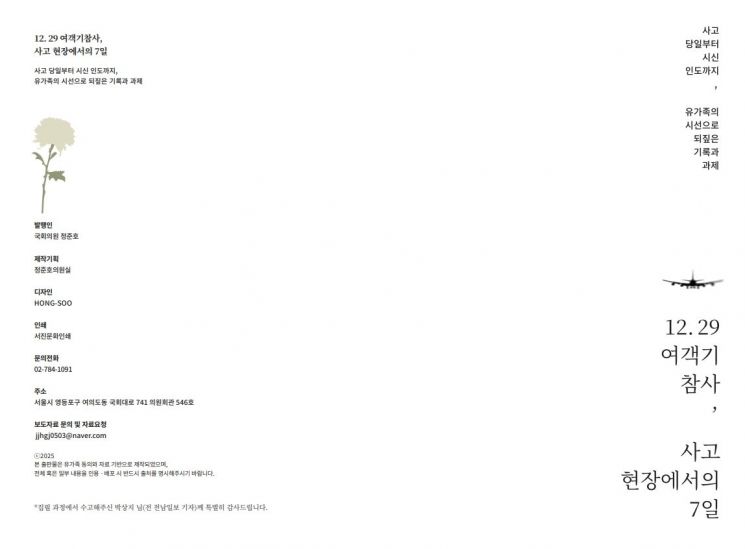
Junho Jung, a member of the Democratic Party of Korea representing Buk-gu Gap in Gwangju, announced on June 24 that he has published the white paper on the "December 29 Passenger Plane Disaster." The title of the white paper is "December 29 Passenger Plane Disaster, Seven Days at the Accident Site," with the subtitle "From the Day of the Accident to the Handover of the Remains: A Record and Challenges Revisited from the Perspective of the Bereaved Families."
Jung remained at the accident site from immediately after the December 29 Passenger Plane Disaster occurred, working to manage the situation and provide support from the perspective of the bereaved families. The white paper consists of positive assessments, such as the accident response process, support for the bereaved families, and volunteer activities; points for reflection, such as the lack of a control tower function among central government ministries; and recommendations for preventing recurrence.
The white paper documents the seven days from December 29 of last year, when the accident occurred, to January 4 of this year, and is organized into six chapters. Chapter 1, "Introduction," emphasizes the importance of transparent, victim-centered disaster response and provides a foundation for future improvements to the disaster response system. Chapter 2, "Memories of the Day," records the support for bereaved families and the accident recovery process at the accident site over the seven days starting from December 29 of last year.
Chapter 3, "Positive Assessments," describes elements that can be positively evaluated, including: prompt identification of victims, the first-ever implementation of body restoration in Korea, activities of the bereaved families' council, airline accountability, and the role of volunteers. Chapter 4, "Reflection and Self-Examination," points out limitations such as: the lack of a control tower function in central government ministries, insufficient procurement of supplies and information delivery, limitations in support and psychological care programs for bereaved families, the problem of malicious online comments, and inadequate support for volunteers.
Chapter 5, "Recommendations," proposes the following: establishment of an integrated and efficient communication system, operation and management of spaces centered on bereaved families, communication and consent procedures in sensitive processes, volunteer and sponsorship management centered on bereaved families, development of a pool of technical experts and professionals, and the need for and methods of simplifying documentation for the prompt handover of remains. Chapter 6 is an appendix.
Jung stated, "The December 29 Passenger Plane Disaster is a national tragedy that must never happen again. The truth must be thoroughly revealed, those responsible must be held accountable, and transparent disclosure of information must be ensured. I will continue to communicate closely with the bereaved families going forward."
Jung further emphasized, "The most important thing in managing the aftermath of the disaster is not an administration-centered approach, but thinking from the perspective of the bereaved families and providing support. I hope this white paper will serve as a catalyst for advancing future disaster response systems."
© The Asia Business Daily(www.asiae.co.kr). All rights reserved.
![Clutching a Stolen Dior Bag, Saying "I Hate Being Poor but Real"... The Grotesque Con of a "Human Knockoff" [Slate]](https://cwcontent.asiae.co.kr/asiaresize/183/2026021902243444107_1771435474.jpg)
















