Poster Presentation at the 2025 PAGE Conference
On June 24, Daewoong Pharmaceutical announced that it had released the results of a study that mathematically analyzed the pharmacokinetic action of its diabetes treatment, Enblo, based on international guidelines.
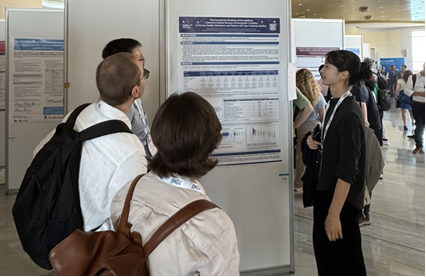 Researchers from the Department of Clinical Pharmacology at Seoul National University Hospital explained the results of their Enblo pharmacokinetic modeling study to attendees at the 2025 PAGE (Population Approach Group in Europe) conference held in Greece over four days starting from the 3rd. Daewoong Pharmaceutical
Daewoong Pharmaceutical presented the results of a population pharmacokinetic modeling study of Enblo, the first domestically developed SGLT-2 inhibitor class diabetes treatment, in a poster session at the 2025 PAGE (Population Approach Group in Europe) conference, which was held in Greece over four days starting from the 3rd.
This study, conducted jointly with the Department of Clinical Pharmacology at Seoul National University Hospital, used data from a total of 446 Korean individuals to mathematically predict how the drug is absorbed, distributed, and eliminated in the human body.
The significance of this study lies in its ability to go beyond simple clinical results, allowing for precise analysis and prediction through pharmacokinetic modeling of how the drug acts depending on individual patient factors such as age, food intake, and kidney or liver function.
According to the study results, age was identified as a major factor affecting the rate of drug elimination from the body, while food intake was found to significantly influence absorption time. By reflecting the characteristic that the drug distributes at different rates in various tissues, the research team applied a "three-compartment model" that divides the body into three virtual compartments, enabling precise prediction of actual blood drug concentrations in patients.
Analysis of this model showed high accuracy and reliability in several areas: goodness-of-fit (GOF) analysis, which evaluates the agreement between predicted and actual concentrations; residual analysis, which assesses reliability by analyzing the difference and pattern between predicted and observed drug concentrations; and visual predictive checks, which visually analyze whether observed values fall within the predicted intervals generated by simulation.
Daewoong Pharmaceutical's Enblo pharmacokinetic model is expected to contribute broadly in the future, including personalized dose adjustments for elderly patients or those with impaired liver or kidney function, expansion of indications, and the development of combination drugs.
Lee Seunghwan, Professor of Clinical Pharmacology at Seoul National University Hospital, who participated in this joint research, stated, "This study is significant in that it establishes a foundation for quantitatively understanding the pharmacokinetics of Enblo according to various patient characteristics. We expect it to greatly aid in establishing precision medicine-based treatment strategies for Enblo."
Park Sungsoo, CEO of Daewoong Pharmaceutical, said, "The modeling established through collaboration with Seoul National University Hospital is expected to greatly contribute not only to dose optimization in actual clinical settings but also to the development of global regulatory strategies. Based on these research results, we will do our utmost to accelerate the global expansion of Enblo and establish it as a blockbuster drug."
Meanwhile, Enblo is the 36th domestically developed new drug by Daewoong Pharmaceutical and the first SGLT-2 inhibitor class type 2 diabetes treatment developed in Korea. Despite its low dose (0.3mg), it has demonstrated strong blood glucose-lowering effects, and various studies are underway on its effects on weight loss, blood pressure and lipid improvement, and insulin resistance improvement.
© The Asia Business Daily(www.asiae.co.kr). All rights reserved.