College Graduates Hope for Starting Salary of 40.23 Million Won
A 3 Million Won Gap Between Job Seekers' Expectations and Companies' Offers
In the first half of this year, there was a clear trend in the job market of preferring experienced candidates over fresh graduates, and a significant gap was observed between the salary expectations of job seekers and companies. Additionally, it was found that among young job seekers, there is a growing perception that they are willing to work outside the Seoul metropolitan area if quality jobs are guaranteed.
On June 24, the Korea Chamber of Commerce and Industry announced the results of its survey on the characteristics and implications of the job market in the first half of this year, highlighting the following features: a preference for experienced candidates over fresh graduates, a salary mismatch (discrepancy in desired salary), and a shift in perception regarding non-metropolitan areas. These findings are based on a comprehensive analysis of a "Youth Employment Perception Survey" conducted with about 1,000 college-educated young job seekers and job postings from private recruitment platforms.
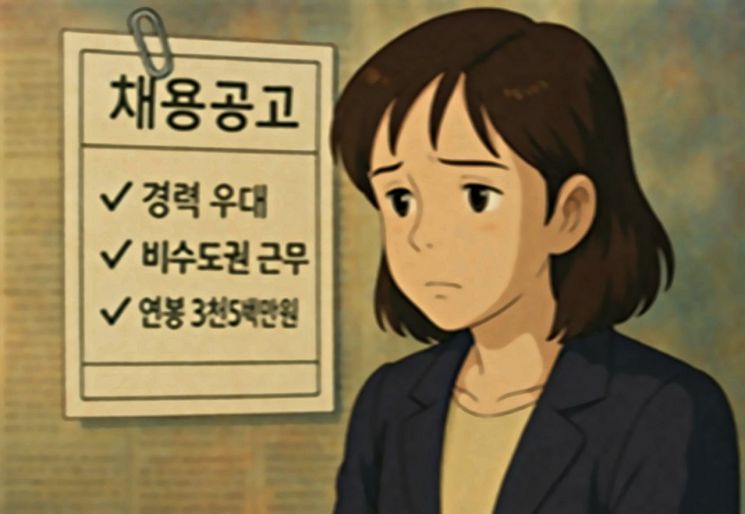 According to a survey by the Korea Chamber of Commerce and Industry, in the first half of this year’s job market, there is a clear preference for experienced candidates over fresh graduates, and a significant gap exists between the salary expectations of job seekers and companies. An image illustrating the analysis results implemented with ChatGPT. Korea Chamber of Commerce and Industry
The first characteristic is a distinct preference for experienced candidates. According to one major private recruitment platform popular among job seekers, there were 144,181 job postings in the first half of the year. Of these, 82.0% were looking exclusively for experienced candidates. Only 15.4% of companies were open to both fresh graduates and experienced applicants, and just 2.6% were hiring only fresh graduates. Among college-educated young job seekers, 53.9% identified "experience-focused hiring" as a barrier to employment.
While companies prefer candidates who can be immediately deployed in the field, young graduates commonly expressed that they have few opportunities to gain practical experience. In fact, 53.2% of young job seekers responded that they "did not gain work experience while attending university."
The Korea Chamber of Commerce and Industry stated, "As the direction and speed of change accelerate due to the new international order and the rapid advancement of artificial intelligence (AI), companies are increasingly favoring open recruitment on a rolling basis and 'experienced fresh graduates' over traditional entry-level hires." They further emphasized, "To help job seekers enter the labor market, it is necessary to establish systems that allow them to gain work experience, such as expanding internships, increasing credit-linked field training programs, and revising curricula to focus on job-based practical training."
The second characteristic is the "salary mismatch" between job seekers and hiring companies. The average annual salary desired by college-educated young people in the first half of the year was 40.23 million won, while the average salary offered in job postings for entry-level positions was 37.08 million won. Despite the challenging job market for new entrants, young people continued to show a strong preference for large companies. More than half preferred large enterprises (28.4%) or mid-sized companies (33.8%). Only 11.4% expressed a desire to work for small and medium-sized enterprises, and just 3.5% wanted to join venture startups, totaling only 14.9%.
The final characteristic is a sign of changing attitudes among young people toward working outside the metropolitan area. Among new job seekers living in Seoul, Gyeonggi, and Incheon, 63.4% said they would consider working outside the metropolitan area if good jobs were available.
However, they cited several conditions for accepting jobs outside the metropolitan area: a high salary level (78.9%), quality welfare programs (57.1%), work-life balance (55.8%), job security (42.5%), and opportunities for career and skill development (29.1%).
Yoon Jeonghye, head of the Employment Trend Analysis Team at the Korea Employment Information Service, analyzed, "As competition for jobs in the metropolitan area intensifies, the vague reluctance toward working in the provinces seems to be easing somewhat." She added that, as the new government has pledged to foster representative strategic industries in various regions, this trend is expected to expand further.
Lee Jongmyung, head of the Industrial Innovation Headquarters at the Korea Chamber of Commerce and Industry, emphasized the need to introduce a "mega sandbox." He stated, "The government must create bold regulatory reforms, aggressive incentives, and AI infrastructure to attract companies," adding, "It is time to create a foundation for young people to plan their futures in globally competitive, private sector-led cities."
© The Asia Business Daily(www.asiae.co.kr). All rights reserved.













