Reform Party Holds Presidential Election Review Seminar on June 23
"Focus on Men in Their 20s and 30s... Lacking Appeal to Women and Seniors"
Lee Junseok: "I Take Responsibility... Will Deliver Results in Next Year's Election"
On June 23, criticism was raised that Lee Junseok, a lawmaker and former presidential candidate of the Reform Party, failed to achieve his original goal in the last presidential election, securing only 8.34% of the vote. Many pointed to the failure of his strategy, which focused on men in their 20s and 30s. Observers also noted that he was unable to broaden his support base to include not only young men but also women and older voters, and that he failed to demonstrate a distinctive identity as a conservative reform party. There were also voices saying that the Reform Party missed an opportunity to capitalize on the internal strife within the People Power Party, which was triggered by the declaration of martial law and impeachment.
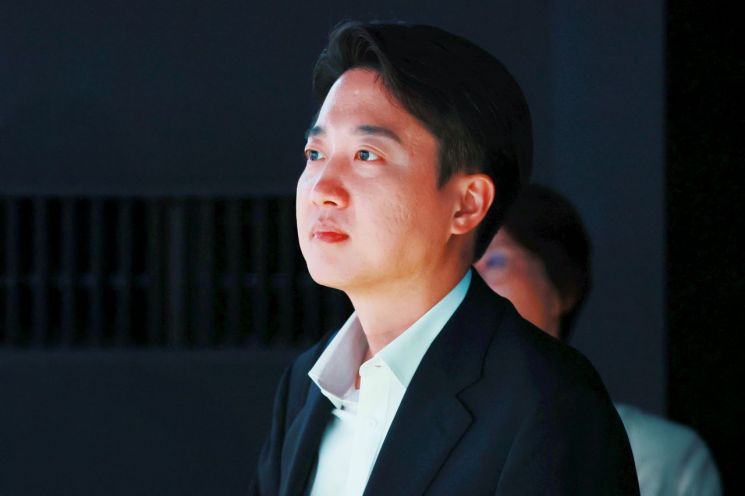 On the 18th, Lee Junseok, a member of the Reform Party, is touring booths at the 2025 Metaverse Expo held at COEX in Gangnam-gu, Seoul. Photo by Yonhap News
The Reform Party held a presidential election review seminar at the National Assembly Members' Office Building in Yeouido, Seoul, that afternoon to discuss the significance of Lee's presidential vote share and the party's future growth direction. The seminar was attended by Lee himself, Chun Haram, acting party leader and floor leader of the Reform Party, Lee Jooyoung, Policy Committee Chair, Kim Chongin, former senior advisor to the Reform Party, Cho Gapje, CEO of Cho Gapje Dotcom, Jin Joongkwon, distinguished professor at Kwangwoon University, and Kim Jaeseop, a lawmaker from the People Power Party.
Lee stated, "Since the presidential election is centered on the candidate, I am responsible," adding, "I will leverage the positive experiences from this election and do my best to minimize the negative ones so that the Reform Party can achieve good results in the local elections, which are just one year away." He continued, "If you have suggestions on how to improve upon the differences from when I was in the People Power Party, I will reflect on them and work to develop the party further."
Kim Jaeseop commented, "When considering whether Lee Junseok took votes away from the People Power Party or prevented votes from going to the Democratic Party, I think it is the latter." He explained, "He served as a minimum breakwater, preventing voters who wanted to vote for a conservative candidate but could not support those who did not distance themselves from former President Yoon Sukyeol or who were associated with election fraud, from defecting to the Democratic Party."
However, Kim also pointed out, "A major weakness is that Lee Junseok has a very high disapproval rating. Even when he says something correct, people dislike it simply because it is Lee Junseok saying it. This is an issue he must overcome." He added, "The most critical weakness is the question of who would actually run the government if Lee Junseok became president. No matter how capable he is, the lack of people to support his political views is a problem that must be addressed. This indicates the necessity of forming alliances."
Professor Jin Joongkwon remarked, "If you want to surpass the People Power Party as a small party, you must have a sense of responsibility as a universal party. Support among women in their 20s and 30s is in the single digits. How can you aim to be a universal party while turning all women into adversaries?" He continued, "For minor parties, a 'divide and conquer' strategy may be economically rational, but such division is rooted in hatred and animosity. While it may be rational for a small party, it naturally has its limits."
Cho Gapje stated, "I thought that even a 6% vote share would have been a good result, so surpassing 8% means he fought well." However, he added, "This election was about determining who the real conservative candidate was. Seeing that Lee Junseok, who opposed martial law, lost to Kim Moonsoo, the People Power Party candidate, I think there was a problem with the Reform Party's election strategy."
Cho also referenced Lee's so-called "chopsticks" remark during the third televised presidential debate. "During the TV debate, when Lee Jaemyung, the then-Democratic Party candidate, was criticized for buying fruit with a card, the comment 'Do you raise elephants at home?' was good. However, the chopsticks remark turned things negative," he said. "Asking Lee Jaemyung who he would support in the event of a Taiwan crisis was also an excessive question."
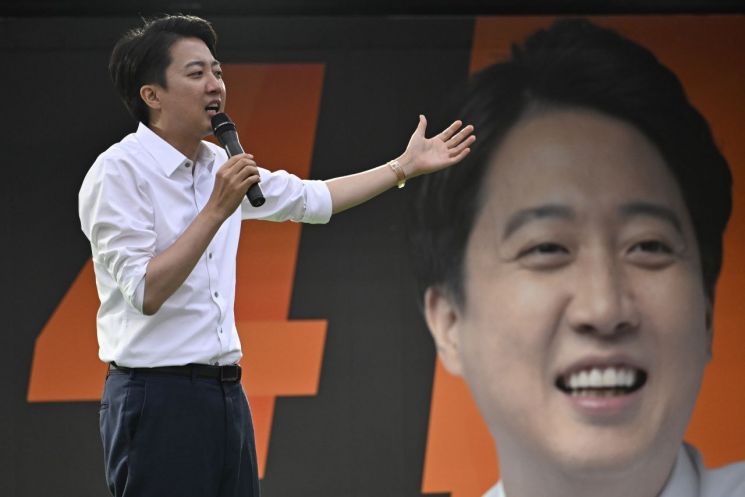 Lee Junseok, the presidential candidate of the Reform New Party at the time, is holding a final presidential campaign rally on the 2nd at Sanghwa Dongsan near Suseongmot in Suseong District, Daegu. Photo by Yonhap News
Political commentator Kim Junil said, "For a party that is only a year and a half old, this level of achievement cannot be ignored." However, he pointed out, "Outside of the 2030 generation, only about 3% support Lee Junseok. I have never seen a presidential candidate with such an extremely divided support base." Kim added, "Lee's vote share was evenly distributed nationwide, but by age and gender, the difference is stark: 37.2% of men in their 20s supported him, while only 10.3% of women did, nearly a fourfold difference." He also noted, "Among voters aged 60 and above, Lee did not attract any attention at all."
Ha Heongi, former youth spokesperson of the Democratic Party, also criticized, "If support among women is low, measures should be taken to address it, but nothing changed." He continued, "The Reform Party needed to reach out to women and seniors to expand its base, but there was no sign of this." He added, "Regardless of whether the 'chopsticks' remark in the third TV debate was factual or not, what kind of voter would it help? Whether for younger or older generations, the party needs to seek a politics that can mediate complex conflicts and bring people together."
In response, acting leader Chun Haram said, "If we had stable support before the election began, we could have run a campaign focused on expansion, so that is a regret. However, since the early presidential election was a short-term contest, it was a matter of prioritization, not that we excluded the interests of all groups except men in their 20s and 30s."
© The Asia Business Daily(www.asiae.co.kr). All rights reserved.


















