"We Can't Endure Any Longer," SMEs and Small Business Owners Appeal
"Even If We Want to Close, Debt Keeps Us Going"
After Rejection of Sector-Based Differentiation, "It Must Be Implemented the Year After Next"
Small and medium-sized enterprises (SMEs) and small business owners, facing both an economic downturn and rising costs, have strongly demanded a freeze on next year's minimum wage. They voiced their concerns over the risk of closure and employment instability, stating, "We cannot endure any longer," and urged policymakers not to ignore the desperate realities on the ground.
On June 23, the Korea Federation of SMEs held a "Press Conference Urging the Determination of the Minimum Wage for the Survival of SMEs and Small Business Owners" at its headquarters in Yeouido, Seoul. Attendees included Lee Jaegwang, Chairman of the Labor and Workforce Committee of the Korea Federation of SMEs; Lee Oseon, Chairman of the Busan Clean Surface Treatment Business Cooperative and a user representative on the Minimum Wage Commission; Song Yukyung, President of the Korea Supermarket Cooperative Federation; as well as representatives from various SME and small business sectors.
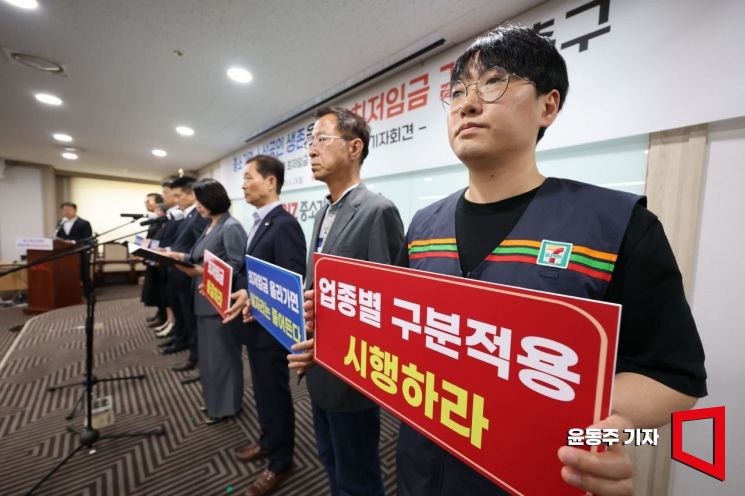 On the 23rd, small and medium-sized enterprises and small business owners attending the "Press Conference of the Small and Medium Business Community Urging the Determination of the Minimum Wage for the Survival of Small and Medium Enterprises and Small Business Owners, and the Minimum Wage for 2026" held at the Korea Federation of Small and Medium Business in Yeouido, Seoul, shouted slogans. Photo by Yoon Dongju
The SME community emphasized that next year's minimum wage should be frozen, taking into account the dire management crisis currently faced by SMEs and small business owners.
In their appeal, they stated, "The minimum wage in Korea has consistently risen without considering the limited payment capacity of SMEs and small business owners, and it is already high compared to competing countries. Above all, with continued sluggish domestic demand and ongoing internal and external uncertainties, loan delinquency rates and the number of business closures have reached record highs. Many SMEs and small business owners are at a breaking point, so we hope the minimum wage will be maintained at its current level next year."
They also expressed regret over the rejection, at the sixth plenary meeting of the Minimum Wage Commission on June 19, of differentiated application of the minimum wage by business type. The SME community stated, "If the different payment capacities of employers by sector are not considered, the sustainability of the minimum wage system itself will inevitably be threatened. Next year, discussions should be based on more robust data, and at the very least, differentiated application should be implemented for sectors with extremely limited payment capacity."
At the press conference, small business owners from essential sectors such as restaurants, convenience stores, and retail also participated and shared the difficulties they face on the ground.
Kim Haksoon, CEO of Sindongmyo Samgyetang, said, "Large businesses may have room to cut costs, but for small restaurants like ours, it's difficult. I consider my staff, who have been with me through thick and thin, like family, but if the minimum wage rises any further, we won't be able to survive." She continued, "Because of debt, I can't even afford the costs of closing down, so I can't just quit the business as I wish. Employees at least receive severance pay, but owners do not. Please carefully consider whether the minimum wage is truly helping small business owners and ordinary people like us."
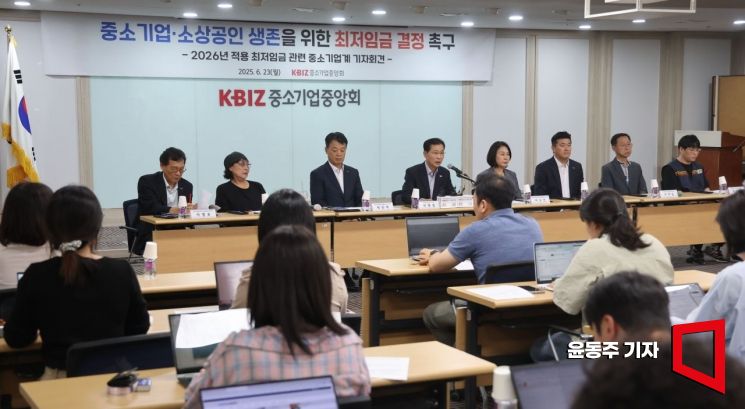 On the 23rd, Lee Jaegwan, Chairman of the Labor and Workforce Committee of the Korea Federation of SMEs, spoke at the "Press Conference of the SME Sector Urging the Determination of the Minimum Wage for the Survival of SMEs and Small Businesses, and the Minimum Wage for 2026" held at the Korea Federation of SMEs in Yeouido, Seoul. Photo by Yoon Dongju
Lee Taekjoo, co-CEO of Office Depot Gwanak-Dongjak branch, said, "All I can think about is how to get through each day. Over the past 10 years, sales have increased by 2.7%, while the minimum wage has risen by more than 6%. When you factor in rent, costs have increased far more than income."
He added, "In addition to hourly wages, business owners are required to pay various labor costs such as weekly holiday allowances, severance pay, and four major social insurances. When the minimum wage increases, these costs rise in tandem, but the burden on business owners is underestimated. Even if the minimum wage were simply frozen and the burden of weekly holiday allowances reduced, it would provide significant relief."
Park Taejun, owner of Seven Eleven Ramada Sinseoldong branch, said, "When the minimum wage was low, I fully supported its increase, but now it has risen as high as it can go. Some say that if you can't even pay the minimum wage, you should close your business, but I was deeply shocked by that comment. It's extremely unfair to have to close my business because of the minimum wage."
Kwak Inhak, Chairman of the Korea Metal Panel Industry Cooperative, said, "When the minimum wage increases, it becomes the standard, causing wage pressure not only for small business owners but for all SMEs. If labor costs continue to rise without improvements in business conditions or labor productivity, there will be no resources left for R&D or investments that drive corporate growth and secure the future."
Lee Jaegwang, Chairman of the Labor and Workforce Committee of the Korea Federation of SMEs, said, "The business climate as felt by SMEs is extremely poor, and many small business owners who maintained their businesses through loans in hopes of an economic recovery can no longer hold on and are collapsing. Taking into account the situation faced by our economy, SMEs, and small business owners, as well as the impact on employment, a reasonable decision to freeze the minimum wage is necessary."
© The Asia Business Daily(www.asiae.co.kr). All rights reserved.













