Anxiety Grows Among Construction Firms Amid US-Iran Conflict
Active in Iraq, United Arab Emirates, and Other Countries
Detour Routes Would Significantly Increase Time and Costs
As the crisis in the Middle East intensifies following the U.S. airstrike on Iran's nuclear facilities, South Korean construction companies are closely monitoring the situation. Due to years of ongoing geopolitical risks in Iran and international sanctions, there are not many local projects in the country. However, since there is a significant volume of orders in neighboring Middle Eastern countries, companies expect that if the situation is prolonged, negative impacts such as disruptions in the supply of raw materials will be inevitable.
According to statistics from the International Contractors Association of Korea as of the end of last month, South Korean construction companies had secured approximately $5.6 billion in orders from the Middle East. This accounts for 49% of all overseas orders. In the past, the share of Middle Eastern orders for Korean construction companies reached 70 to 80%, but this has decreased as companies diversified into more countries.
During 2018 and 2019, when falling oil prices led to fewer project tenders, the share dropped to the 20% range, but it has since rebounded and now accounts for nearly half of all overseas orders.
Korean construction companies anticipate that if Iran moves to blockade the Strait of Hormuz in response to the recent U.S. airstrike, a key shipping route connecting the Middle East will be cut off. Many Korean construction companies are currently engaged in projects in Iraq, Kuwait, the United Arab Emirates, and Qatar. In such a scenario, securing raw materials and other supplies could become increasingly difficult.
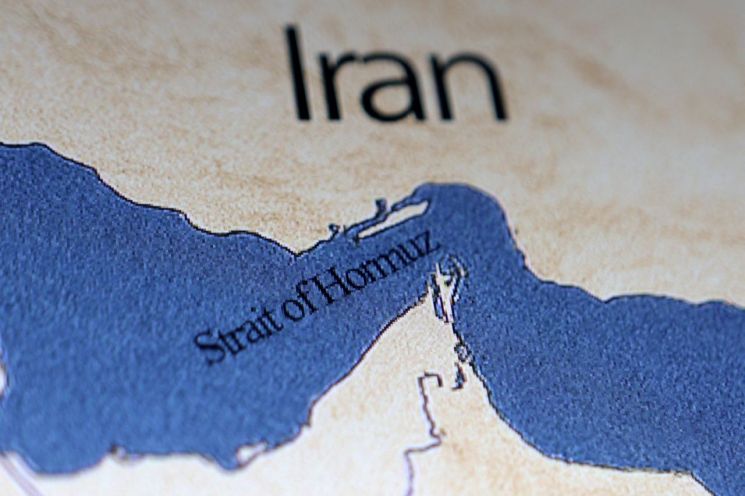
Saudi Arabia, the largest market in the Middle East, must also pass through the Persian Gulf to reach its western region. This means shipments must go through the Strait of Hormuz. An official from the International Contractors Association of Korea said, "In the past, when the Strait of Hormuz was blockaded, we had to devise detour routes via the Cape of Good Hope in Africa," adding, "This inevitably leads to significantly increased time and costs."
An industry official stated, "While ongoing projects are not being halted immediately, it is virtually impossible to find alternative transport routes over land. If the situation drags on, it could become difficult to secure raw materials, and negative impacts such as project suspensions will be unavoidable."
Iran is the third-largest construction market in the Middle East after Saudi Arabia and the United Arab Emirates (UAE). In addition to oil and gas, the country is rich in natural resources such as zinc and copper, making it an attractive destination for investment. However, due to longstanding conflicts and sanctions with the international community over issues such as nuclear development, it has not been easy for foreign construction companies to enter the market.
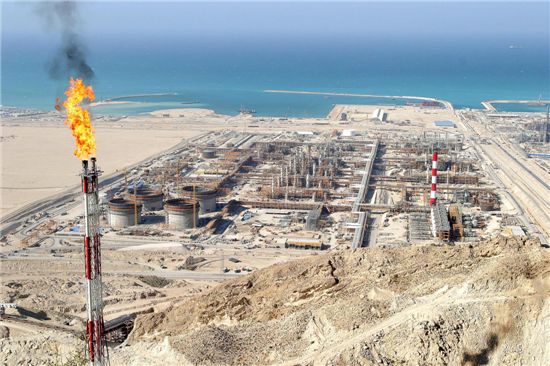 View of the South Pars gas field in Iran. Provided by Hyundai Engineering & Construction
During the presidency of Park Geun-hye, a state visit to Iran was touted as having achieved hundreds of billions of dollars in economic diplomacy, but very few of these deals led to formal contracts. Even when contracts were signed, many were later canceled, leading the industry to view Iran as a challenging market. In the past, Hyundai Engineering & Construction and GS Engineering & Construction have carried out local gas field projects.
An official from a Korean construction company currently working in Iraq said, "There has not yet been a direct impact on our site, but since this is a regional issue in the Middle East, we are closely monitoring the situation." DL E&C, the only Korean construction company currently operating an office in Iran, evacuated its dispatched personnel to other areas in the early stages of the Iran-Israel military conflict.
© The Asia Business Daily(www.asiae.co.kr). All rights reserved.
![Clutching a Stolen Dior Bag, Saying "I Hate Being Poor but Real"... The Grotesque Con of a "Human Knockoff" [Slate]](https://cwcontent.asiae.co.kr/asiaresize/183/2026021902243444107_1771435474.jpg)
















